
The Man Who Saw Tomorrow (1981)

Of all the outré mysteries of the unknowable, the prophecies of 16th-century mystic seer Michel de Nostredame — or, as we now call him, Nostradamus — fascinate me. Mostly, I was a weird kid about him. 

In sixth grade. I wrote a book report on the translated The Prophecies in Nostradamus’ lauded quatrain style. Getting an A- on it did me no favors in the “cool” department of my class, making it longer even until I got a kiss from a girl or a 1500s prognosticator.

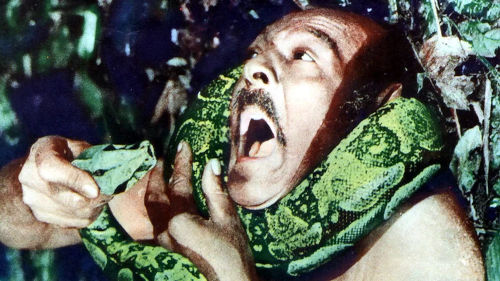
I got into Nostradamus after seeing the “documentary” The Man Who Saw Tomorrow at 3 a.m. on cable, only to rediscover it on VHS at my local library, like a sign from a prognosticator’s divine divining bowl. With tensions overflowing in Iran and the Middle East at this very moment, it’s been reintroduced into my life by YouTube. Bloatedly narrated by Orson Welles and four decades later, it’s pretty terrible. How did this movie scare me for so long?

Much like those unexplained docs from Rod Serling and the Schick Sunn Classics people, Tomorrow starts with three 1700s “skeptics” drinking from Nostradamus’s skull, which apparently was cursed. Fair enough, but it’s not brought up again. Drunk on wine and smoking a cigar, Welles says Nostradamus “mystified scholars” as he studied the intrinsic  kabbalah, braved the plague and, in his spare time, wrote the prophecies that are kind of vague, but in context, also totally accurate … right?

Most people know Nostradamus’s prophecies about Napoleon, Hitler (also called “Hister” in the movie) and the JFK assassination. But what about those of the future in 1981? Well, here’s the highlight reel:
• 1986: Worldwide Famine!
• 1988: Earthquake Will Decimate Los Angeles!
• 1994: World War III Begins!
• 1999: The King of the Mongols Is Revealed to Be the Third Antichrist!

When that final date passed over us, a small discharge of prophetic relief came over me, letting me know it was going to be okay. The Man Who Saw Tomorrow movie is a cultural oddity, when lots were cast and such things were left to the passing of time and phew, it’s all hokem.

Except it’s not anymore. It’s now playing out like Nostradamus and Welles said it would, with one exception: The Antichrist wears a blue suit and red tie. Or maybe this movie was a quick and easy way to make money by making people scared. I guess we’ll soon find out. Or maybe we won’t. —Louis Fowler

Get it at Amazon.

Watari, the Ninja Boy (1966)

Watari, the Ninja Boy is based on a classic Japanese manga, which I could tell just by looking at the kid’s haircut. Played by Kaneko Yoshinobu (who was a different child ninja in the similar, superior Ninja Scope), Watari lives with his sickly grandfather, plays the flute, jumps around, swings on ropes, flies through the air, walks up trees and, in a musical number, even grows to Jolly Green Giant height to touch a rainbow of Skittles.

But mostly, with the aid of his trusty metal ax, whose blade is bigger than his head, Watari spends his days and nights warring against adult ninja and monster ninja who want to kill him. He also decapitates a black cat, but TBH, that pussy had it coming.

Watari undergoes a litany of traumas in these colorful adventures, including surviving an earthquake, sinking in quicksand, finding dead dudes floating in the river, seeing a naked lady and meeting a grown man with lots of eye shadow.

Needless to say, this is one weird kiddie matinee — one that begins with a blue-skinned ninja losing his tongue for breaking the law. It’s also confusing, what with all the Japanese names thrown around of this clan and that clan, and not knowing who belong to which. Even with the benefit of crisp English subtitles, I was all like, whaaaaaaaaa … —Rod Lott

Get it at Amazon.

Man of Violence (1970)

With a title like Man of Violence, Pete Walker’s third feature gives no indication of its driving conflict: dueling British property developers. Smart move, Pete! Same goes for slapping your opening credits atop footage of a woman’s navel shot in such extreme close-up, it verges on the gynecological.

A real estate war may sound like a snore, but fear not, readers: These property bros aren’t above resorting to murder to get shit done. One side hires a freelance fixer named Moon (Michael Latimer, Hammer’s Prehistoric Women) to do their dirty work. The other side also hires Moon to do their dirty work. Moon being Moon, an opportunist crook, he plays both sides. After all, despite his tousled hair and a water pistol loaded with Heinz Tomato Ketchup, he’s got a taste for life’s finer things, and London’s clothiers don’t just give away collared tangerine shirts, luv.

The plot involves ax-clutching gangsters, a protection racket, a smuggling scheme — all a MacGuffin, as far as I’m concerned. Perhaps Walker felt the same, tasking the yowza Luan Peters (Hammer’s Twins of Evil) to deliver a chunk of exposition while undressing. (Like, are we supposed to pay attention? If so, that’s not playing fair.) Functionally, the story is more about biding time to get to the next set piece. My favorite among them might be Moon subduing a threatening passenger by braking so hard, the poor guy’s forehead smashes against the dash. Perhaps Schizo Walker felt the same, having Moon quickly drive forward and backward to brake again, over and over, making good on the film’s title. (Speaking of, its alternate one is, stupidly, Moon.)

A sign outside a club owned by one of Moon’s clients reads, “IF YOU DON’T SWING, DON’T RING.” The rhyme could double as a gatekeeper for viewers, too, as Man of Violence explores sexual kinks (hetero- and homo-) and spontaneously jet-sets to Marrakesh for the third act. This trip temporarily turns the movie into something of a freewheeling travelogue à la Harry Alan Towers’ 1960s espionage adventures (see Code 7, Victim 5!; Mozambique; Five Golden Dragons; et al.) — by no means a complaint. Walker’s conclusion bears so many twists, you’d think he’d installed a turnstile. It may be more complicated than necessary, yet also more clever. —Rod Lott

Get it at Amazon.

Tales of a Salesman (1965)

With Tales of a Salesman, we have a piece of unheralded cinema history: The lone movie shot in “Nudavision” and “Lusticolor.” To clear up any potential confusion, those labels just mean one thing: lotsa tits.

This nudie cutie follows Herman’s first day on the job as a door-to-door toilet brush salesman. Luckily, the milquetoast nerd gains unexpected help from a poltergeist who helps such paid-on-commission vendors. That’s both awfully specific and uncharacteristically kind for the spirit world. All this means is the poltergeist (read: the camera) sneaks peeks at the nekkid housewives on the block and makes horndog comments (via a wisely uncredited narrator).

So while Herman (David C. Reed, What’s Up Front) engages in tired pratfalls outside, the poltergeist scopes out a bare-breasted blonde struggling to move a couch, a skinny-dipping brunette, a sunbathing redhead and a brunette baking in her birthday suit. Then Herman, goaded by his supernatural guide, calls upon each woman and sells absolutely zip, due to mishaps like vacuuming a towel off a would-be client’s body or squirting cream on another’s face.

Finally, in a surreal dream sequence that shows no glimpse of the greatness in cinematographer Vilmos Zsigmond’s near future (aka winning an Oscar for Close Encounters of the Third Kind), Herman goes on trial for all these misdeeds. As punishment for one guilty verdict, the ladies (all topless, of course) inflate him like a bowtied, horn-rimmed Violet Beauregarde.

But did I mention there’s a poltergeist? Stupidity, inanity, nudity: They’rrrrre herrrrre … —Rod Lott

Get it at Amazon.

Vamp (1986)

Before Sinners was picking undead chords and From Dusk Till Dawn strummed along to a scantily clad Salma Hayek, 1986’s Vamp busted out massively bombed in empty theaters. With the statuesque domme Grace Jones bringing New Wave androgyny to the neck-biting role as a vampire demigod, Vamp set up the whole blueprint of the “vampiric whores” mythology. It’s a blood-caked piece of dark erotica with a pulsating electronic beat sequenced with shrill screams, grimy alleys and an artistic flair for the supernatural. 

On the other side of the churched-up coin, Vamp is a long-forgotten piece of semi-demonic trash that implies a much better movie, a conceit of both vampire lore and semi-nude ladies, one I still enjoy in all its low-budget, badly edited, completely rushed grandeur.

Released when horror-comedies were trying to get their foot (and other extremities) through the door, the movie starts with a trio of ’80s movie teens, Keith (Chris Makepeace, Meatballs), A.J. (Robert Rusler, Thrashin’) and Duncan (Gedde Watanabe, countless Asian stereotypes), trying to find strippers for their frat party. Craigslist hadn’t been invented yet, so they drive to the big bad city with a soundalike copy of Robert Palmer’s “Bad Case of Loving You (Doctor, Doctor)” blaring.

They enter the After Dark Club, a rough but serene establishment where white women with jiggly asses in spandex dance onstage. Then Katrina (Jones) performs a very arty, very kabuki, very unerotic striptease; think David Bowie meets Keith Haring at a downtown art show with fusion tapas and no lube, and you’ll get the vibe. Being a hungry vampire, she eats A.J.’s heart, drains him and, sadly, is put on ice for most of the movie.

That’s okay, though, because Keith meets a ditsy waitress (Dedee Pfeiffer, Michelle’s sister), eats some cockroaches and wars with an albino punk (Billy Drago). Eventually, the undead A.J. helps him save the day (night?). In the climax, Katrina flips the bird from beyond the grave.

The best part of Vamp is the casting. Even though she’s barely part of the movie and has no discernible dialogue, fresh off Conan the Destroyer and A View to a Kill, Jones casts an intimating shadow over the comedic proceedings, made all the stranger by the club managers who look like they came out of a Goodfellas casting call. What’s her story, I wonder …

The guys are also well cast. As the hero , once-a-nerd Makepeace holds his own, with ’80s mainstay Rusler doing his preppy-punk thing that, kudos, he does well. The biggest surprise is Watanabe, doing an Asian take on a W.A.S.P. that’s kind of groundbreaking when you think about the time.

What hurts Vamp is that it’s half-baked. It has a real storyline and some great characters, but does nothing with them. I could see someone wanting to remake this in the Sinners/From Dusk Till Dawn vein, but I guess that ship has been burned, most likely with a raised finger. Oh, well, at least Jones’s end-credits song, “Vamp”, is actually pretty darn good. —Louis Fowler

Get it at Amazon.

Random Genre & Cult Movie Reviews