
All posts by Daniel Bokemper

Event Horizon (1997)

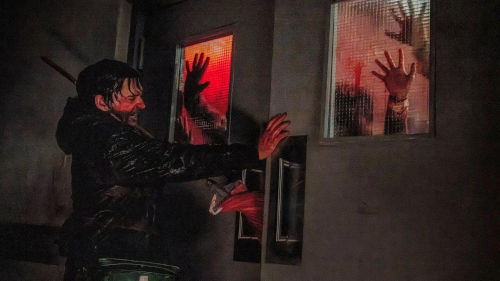
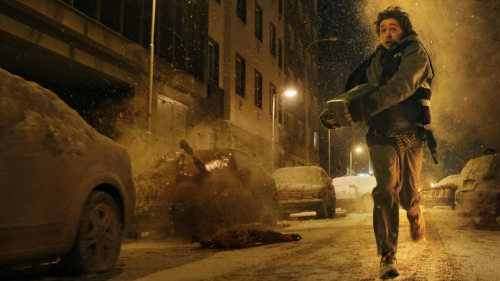
If Lars von Trier’s Dancer in the Dark didn’t make it clear enough, take it from Paul W.S. Anderson: You really don’t need eyes to see. At least, you don’t need them after you take the scenic route through an interdimensional version of hell, courtesy of the titular spacecraft in the grimdark, sci-fi schlock-fest, Event Horizon

In 2040, the Event Horizon, a massive ship designed for high-volume space travel and colonization, vanished during its first cruise. Seven years later, it re-emerges. Capt. Miller (Laurence Fishburne, The Matrix), Dr. Weir (Sam Neill, Possession) and a handful of other unfortunate crew members fly out to investigate it aboard the Lewis and Clark, a vessel about one-hundredth of the Event Horizon’s size.

The Lewis and Clark crew discover the Event Horizon abandoned, save for a few eviscerated corpses. A few audio logs and one horrific recording later, Capt. Miller resolves to abandon ship. That’s easier said than done, however, as the seemingly possessed craft reactivates its warp drive, trapping the crew of the Lewis and Clark aboard. The survivors race to execute a desperate backup plan as the demonic presence that seized the ship slowly digs its way into their psyches.

Hellraiser: Bloodline wishes it were Event Horizon. Not that the bar for sacrilegious sci-fi horror is super-high, but for his film, Anderson (the Resident Evil franchise) brings tight cohesion, a genuinely intriguing setting and a quality of acting that leaves the rest of the genre in shambles. Fishburne and Neill transition from contentious comrades to cosmic nemeses believably enough, and the sparse comic relief from Richard T. Jones (2014’s Godzilla) doesn’t feel terribly forced despite being cheesy as — appropriately — hell.

While some may call Alien’s Nostromo the quintessential haunted house in space, Event Horizon’s lead spacecraft may actually exceed it. No, it doesn’t feature cramped quarters and an acid-bleeding Xenomorph, but it is actually haunted by the impression of an ineffable, chaotic dimension. Unlike the versions of space hell seen in Warhammer 40,000 or Doom, however, Event Horizon is less concerned with socketing in demons to make itself a half-baked creature feature. Instead, its terror is predicated largely on just the idea of hell.

Leaning on the concept as a source of horror instead of an overly manifested version of it (like the aforementioned Hellraiser sequel) likewise helps push the film’s theme. Event Horizon centers on a civilization that has pushed too far. It wasn’t good enough for us to get to another planet in a few days; we had to go faster than light itself, and in doing so, we didn’t just travel beyond humanity’s physical limitations, but the psychological ones as well.

Dr. Weir’s transformation into essentially a cenobite at the climax undermines this idea a bit, but otherwise, the crew of the Lewis and Clark aren’t fighting ghosts or demons. They’re fighting their own minds as punishment for not just fucking around and finding out once, but twice. This isn’t necessarily anything new in sci-fi, but using hell as an allegory for what little we know about space is still clever. (And maybe just a little heavy-handed.)

If anything, Event Horizon is worth the price of admission to catch the 30-or-so seconds of the sadomasochistic slaughter orgy captured on the recording the Lewis and Clark crew recover. This includes a follow-up line from Fishburne that is timed so well, it’s sort of baffling Anderson didn’t use it as the film’s tagline: “We’re leaving.” You should stay for the movie’s entirety, of course, even if it means disobeying a directly order from Laurence Fishburne. He’ll probably understand. —Daniel Bokemper

Get it at Amazon.

Possession (1981)

While it might be one of the most recent examples, Coralie Fargeat’s The Substance was hardly the first film to use bizarre and outlandish horror to earn critical acclaim. Possession isn’t necessarily the first, either, but you’d be hard-pressed to call 100-plus-year-old flicks like The Cabinet of Dr. Caligari and Nosferatu even remotely as jarring Andrzej Zulawski’s plunge into one of the worst breakups imaginable.

That’s not hyperbole, either: Like, have you lost a spouse to a free-loving German karate expert, only to find out later your ex also left him for — spoiler — a primordial, tentacled man-beast that feeds on human flesh? (If you have, please contact us.)

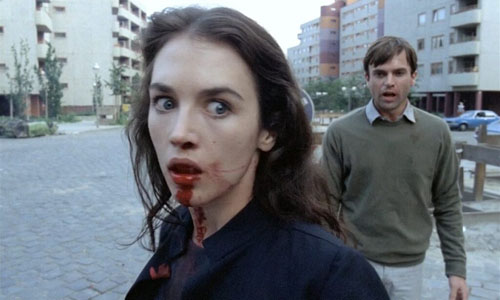
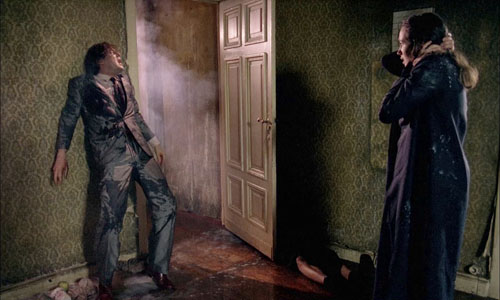
After wrapping his latest mission and coming home to West Berlin, Mark (Sam Neill, Event Horizon), likely the most mundane international man of mystery, is greeted by his wife, Anna (Isabelle Adjani, 1979’s Nosferatu the Vampyre), with the news she wants a divorce. Mark naturally goes on a skin-crawling bender, but snaps back to reality after realizing Anna has left Bob, their young son, by himself and on the verge of neglect.

They loosely attempt to mend things for Bob’s sake, but they mostly just harm themselves with an electric meat carver instead. Mark tries to move on with the help of Helen, Bob’s schoolteacher who suspiciously looks like Anna (and is also played by Adjani), except for her lighter hair and greener eyes. Meanwhile, Anna rents a dilapidated apartment that practically pushes against the Berlin Wall to look after her latest, more monstrous lover.

Dichotomies define Possession. Anna and Mark both vie for better versions of themselves. The former struggles with trying to reconcile her “Faith” and her “Chance” before “Faith” violently ejects itself from her uterus in an empty subway. The latter, however, forces himself to step up as a more present father, only to inevitably devolve into a self-destructive lunatic. All of which, appropriately, takes place in a physically and politically divided city. If Wim Wenders’ Wings of Desire is an examination of how to potentially heal Berlin’s scar tissue, Possession is a nosedive into its festering wound.

What grounds the film is a pair of performances that shift on a dime. Adjani absolutely outshines Neill, but both show a physical and emotional toll from filming that rivals — and even matches — the very real distress seen from Shelley Duvall and Jack Nicholson just a year earlier in Stanley Kubrick’s The Shining.

Most will point to Adjani’s subway sequence, where Zulawski simply told her to “fuck the air,” as one of the main justifications for her Best Actress win at the 1981 Cannes Film Festival. And they wouldn’t be entirely wrong, but the scene just before that, where she whimpers and whines at a statue of Christ, might be even more telling of her character’s condition. Anna essentially begs for some answer to chaos, for some cosmic force to “fix” the calamity that’s tearing her and every relationship she has apart. But all she’ll ever get is a stone-cold stare from yet another man (or even a symbol of a man) who has no chance of understanding her. And no chance of helping, either.

Scholars have managed to dissect almost everything about Possession, and yet it still persists as a bizarre, mysterious and even schlocky horror drama. Maybe that’s what makes it so challenging. Even as touching and shocking as movies can be, this feels like something different and perhaps more intrusive. It’s like putting the saddest song you can think of from The Cure or Nine Inch Nails on loop, with every iteration getting a few seconds slower until it’s incomprehensible two hours later.

Possession is a free fall into an emotional chasm. You’ll catch your head on a protruding rock every few hundred feet. Eventually, you’ll forget that you ever stood on solid ground. —Daniel Bokemper

Get it at Amazon.

Frankenstein (2025)

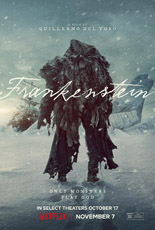
Between 2024’s Lisa Frankenstein and Maggie Gyllenhaal’s upcoming The Bride!, new iterations of the stitched-together and woefully misunderstood monster drop on a damn-near annual cycle. Lately, these takes have been far-removed from Mary Shelley’s classic novel. So much so, Guillermo del Toro’s Frankenstein — while still highly anticipated by the filmmaker’s faithful — almost seems passé and uninspired on its surface. At the same time, the director’s work is rarely skin-deep. And similar to his last adaptation, 2022’s Pinocchio (the good one, without Tom Hanks), del Toro wraps his iconic aesthetic around an emotional and accessible narrative heart.

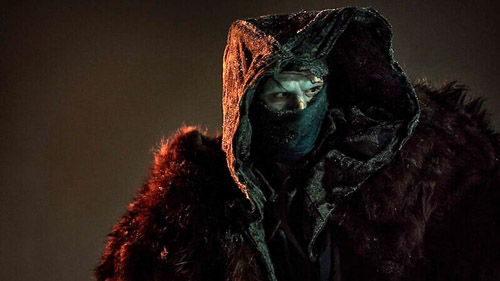
After Capt. Anderson (Lars Mikkelsen, Netflix’s House of Cards), his crew and his ship get stuck in the North Pole, they rescue a dying Victor Frankenstein (Oscar Isaac, Ex Machina). Unfortunately, saving Victor incurs the wrath of his creature (Jacob Elordi, Saltburn), who quickly turns a third of the crew into ragdolls and human accordions. After temporarily subduing his monster, Victor recounts his history, including his tumultuous relationship with his brother’s fiancée, Elizabeth (Mia Goth, MaXXXine). Before he can wrap up his memoir, however, the creature returns with a forceful request: to tell his own story.

Frankenstein is a straighter adaptation than Pinocchio, though both necromancy-laden films feel tonally and thematically inseparable. The former notably lands on a less bleak note than its source material without significantly changing Shelley’s plot. Still, it takes some liberties to modernize with mixed results. On the plus side, Elizabeth has exponentially more agency and purpose, who’s made even more vibrant by Goth’s performance.

And despite its two-and-a-half-hour runtime, the film’s pacing is far brisker than a mostly faithful Frankenstein adaptation has any right to be. That said, the film omits a particularly famous act that — while it ultimately makes sense — is nonetheless missed given everything else del Toro includes. Finally, the forced creature fight scenes feel at odds with the film’s celebration of life, almost like they were jammed in because someone felt the film was too boring without some Marvel-esque violence.

Overtly, this may be the most del Toro of the director’s filmography. It’s not for everyone, but for those who vibe with his craft, Frankenstein feels like the film he was born to make. It has some superficial flourishes, like the flaming angel of death that sort of looks like an unused asset from a Hellboy flick, but most of his visual storytelling lands poetically. As far as the cinematography is concerned, it’s a little more muddled. For the most part, the ample closeups lend themselves to the film’s overall intimacy. Conversely, only a few shots of Victor’s castle and Anderson’s ship convey the sprawling epic that the film — at least at times — tries to be.

Frankenstein, like the monstrosity it revolves around, isn’t perfect. But deep down, it delivers a message that we desperate need: We try so hard to beat death, we unintentionally forget to champion life. In a time where catastrophic violence can seem imminent, living might be the greatest act of defiance. —Daniel Bokemper

Weapons (2025)

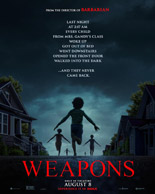
Zach Cregger’s Weapons taps into the same suburban fear that gave his 2022 surprise hit, Barbarian, staying power. What’s more, while Weapons includes a similarly rewarding and refreshing twist, the film doesn’t depend on it. Instead, it uses it to create a tonal anomaly of a flick that — at least for now — solidifies the former Whitest Kids U’ Know member as a must-watch horror director on the level of Jordan Peele and Ari Aster.

At 2:17 a.m. in the middle of a week, 17 third-grade classmates mysteriously vanish, save Alex (Cary Christopher). Their teacher, Justine (Julia Garner, The Fantastic Four: First Steps), shoulders the blame as the town demands a culprit. Archer (Josh Brolin, No Country for Old Men), the father of one of the missing kids, begins his own investigation of the disappearances while school principal Marcus (Benedict Wong, Doctor Strange) struggles to quell the town’s spiraling rage.

Like Barbarian, Cregger opts for a split narrative across six characters. While this helps Weapons comfortably outpace its two-hour runtime, it does feel somewhat needlessly inflated and could’ve benefited from a narrower focus. That said, it doesn’t significantly detract from the film; it just causes it to tread water for a decent chunk of the third act.

Minor criticisms aside, Weapons shines with exceptional cinematography, snappy dialogue and an expectation-subverting meld of heartwarming storytelling and unflinching brutality. Multiple tracking shots cleverly capture the self-destructive drinking and “eating” habits of three prominent characters. (This aspect of the film culminates with an especially wild scene that feels like it borrows from 2000’s Snow Day as much as it does 1980’s Cannibal Holocaust.)

While the film’s central figures feel a bit one-note, they’re leveraged by excellent performances from Garner, Brolin and a returning Amy Madigan (Uncle Buck). And while Austin Abrams’ (Scary Stories to Tell in the Dark) character is ultimately overexposed, his future collaboration leading Cregger’s Resident Evil movie carries a lot of promise.

Ultimately, Weapons earns most of its resonance through its unexpected accessibility. No, this isn’t a kids’ movie. Yet it borrows enough elements from early 1990s films like The Witches and Ernest Scared Stupid that it feels comfortably nostalgic despite its originality. Declaring it an instant classic feels like an overstep, but its undeniable charm paired with its grotesque violence could give it the legs to be timeless. And maybe it will be.

In a year already stacked with heavy-hitting horror movies, Weapons rises to the top of the pack. While it might not be technically “better” than Ryan Coogler’s Sinners, it operates on a different, largely incomparable level. In the end, Weapons is a crowd-pleasing flick that reminds us we should spend less time placing films on hierarchies and more time celebrating them.

See Weapons in a theater, and be sure to order seven hotdogs and a couple cookies. It’ll be more immersive than any RealD Cinema ever could be. —Daniel Bokemper

Get it at Amazon.

Clown in a Cornfield (2025)

Aliens in a cornfield? Obviously. Murderous children in a cornfield? But of course. Mia Goth violating a scarecrow in a cornfield? Uh, sure. But a Clown in a Cornfield? Maybe we’re jumping the shark. Wait, that’s been in a cornfield, too?!

While Eli Craig isn’t the first to put horror on the cob, 2010’s Tucker & Dale vs. Evil showed a playful understanding of the genre — not originality — is the director’s strong suit. An adaptation of Adam Cesare’s 2020 novelClown in a Cornfield sees Craig drop an original story credit, too. This change in his routine doesn’t quite hit the highs of his first standout film. But in a world where Terrifier’s Art reigns supreme, the Midwestern clown holds its ground.

Looking for a fresh start, Quinn (Katie Douglas, Lazareth) and her doctor dad, Glenn (Aaron Abrams, Code 8), move to a seemingly quiet, rural town. As Glenn discovers the residents’ firm commitment to tradition, Quinn meets a classmate named Cole (Carson MacCormac, Shazam!) and quickly falls in with his group of friends looking to buck the old-fashioned values of Kettle Springs. However, the teens quickly discover the town’s mascot, Frendo, isn’t playing around when it comes to community’s way of life. As Frendo starts to prey on Quinn and her friends, they start to unravel the mystery behind the town’s killer clown.

Unfortunate spoiler alert: Frendo isn’t from outer space. In fact, Clown in a Cornfield is significantly more grounded than you’d probably expect from Craig. While it doesn’t avoid humor outright, it doesn’t really try to channel it either. If it weren’t for casting Will Sasso (2012’s The Three Stooges) as the town sheriff, one could almost argue that Craig decided to take this flick a bit too seriously. Those who expect a return to Tucker & Dale’s uproarious gags — or, hell, even Little Evil’s — might find this clown running out of steam fast.

Granted, what makes Clown in a Cornfield at least somewhat interesting isn’t dependent on humor. It’s his straightest horror film yet, with a bit of classic slasher allusions thrown into the mix. It also dips its big, red shoes into an examination of generational tension. Unfortunately, it doesn’t dig particularly deep into this idea. It just kind of dances around it with about as much strength as a rubber chicken with a broken squeaker.

Which isn’t an entire miss, either. In the era of A24’s elevated horror, Clown in a Cornfield is admittedly very accessible. Similar to Cesare’s book, the movie is extremely easy to grasp. It’s not entirely inconsequential, either, as its romantic subplot is surprisingly deep and fresh. Still, it’s as if we’re trained at this point to expect something more from every horror film that isn’t franchised. And that’s probably unfair, given we need introductory films like this to get younger horror fans to dive deep.

Clown in a Cornfield has its moments, including a fair share of creative kills. Still, if you’re expecting some kind of in-depth dissection or even a few decent gags to wash down the mayhem, this cornfield probably isn’t for you. —Daniel Bokemper

Get it at Amazon.