
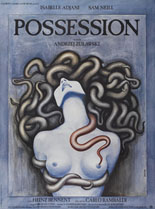

While it might be one of the most recent examples, Coralie Fargeat’s The Substance was hardly the first film to use bizarre and outlandish horror to earn critical acclaim. Possession isn’t necessarily the first, either, but you’d be hard-pressed to call 100-plus-year-old flicks like The Cabinet of Dr. Caligari and Nosferatu even remotely as jarring Andrzej Zulawski’s plunge into one of the worst breakups imaginable.
That’s not hyperbole, either: Like, have you lost a spouse to a free-loving German karate expert, only to find out later your ex also left him for — spoiler — a primordial, tentacled man-beast that feeds on human flesh? (If you have, please contact us.)
After wrapping his latest mission and coming home to West Berlin, Mark (Sam Neill, Event Horizon), likely the most mundane international man of mystery, is greeted by his wife, Anna (Isabelle Adjani, 1979’s Nosferatu the Vampyre), with the news she wants a divorce. Mark naturally goes on a skin-crawling bender, but snaps back to reality after realizing Anna has left Bob, their young son, by himself and on the verge of neglect.
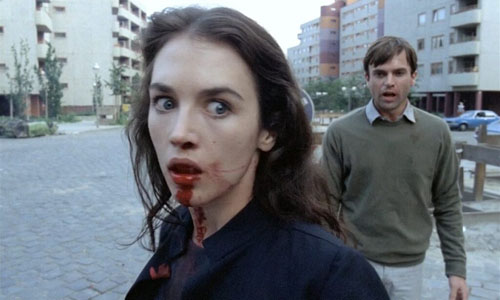
They loosely attempt to mend things for Bob’s sake, but they mostly just harm themselves with an electric meat carver instead. Mark tries to move on with the help of Helen, Bob’s schoolteacher who suspiciously looks like Anna (and is also played by Adjani), except for her lighter hair and greener eyes. Meanwhile, Anna rents a dilapidated apartment that practically pushes against the Berlin Wall to look after her latest, more monstrous lover.
Dichotomies define Possession. Anna and Mark both vie for better versions of themselves. The former struggles with trying to reconcile her “Faith” and her “Chance” before “Faith” violently ejects itself from her uterus in an empty subway. The latter, however, forces himself to step up as a more present father, only to inevitably devolve into a self-destructive lunatic. All of which, appropriately, takes place in a physically and politically divided city. If Wim Wenders’ Wings of Desire is an examination of how to potentially heal Berlin’s scar tissue, Possession is a nosedive into its festering wound.
What grounds the film is a pair of performances that shift on a dime. Adjani absolutely outshines Neill, but both show a physical and emotional toll from filming that rivals — and even matches — the very real distress seen from Shelley Duvall and Jack Nicholson just a year earlier in Stanley Kubrick’s The Shining.
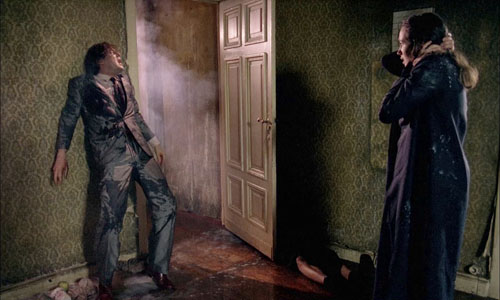
Most will point to Adjani’s subway sequence, where Zulawski simply told her to “fuck the air,” as one of the main justifications for her Best Actress win at the 1981 Cannes Film Festival. And they wouldn’t be entirely wrong, but the scene just before that, where she whimpers and whines at a statue of Christ, might be even more telling of her character’s condition. Anna essentially begs for some answer to chaos, for some cosmic force to “fix” the calamity that’s tearing her and every relationship she has apart. But all she’ll ever get is a stone-cold stare from yet another man (or even a symbol of a man) who has no chance of understanding her. And no chance of helping, either.
Scholars have managed to dissect almost everything about Possession, and yet it still persists as a bizarre, mysterious and even schlocky horror drama. Maybe that’s what makes it so challenging. Even as touching and shocking as movies can be, this feels like something different and perhaps more intrusive. It’s like putting the saddest song you can think of from The Cure or Nine Inch Nails on loop, with every iteration getting a few seconds slower until it’s incomprehensible two hours later.
Possession is a free fall into an emotional chasm. You’ll catch your head on a protruding rock every few hundred feet. Eventually, you’ll forget that you ever stood on solid ground. —Daniel Bokemper