
Category Archives: Documentary

That’s Sexploitation! (2013)

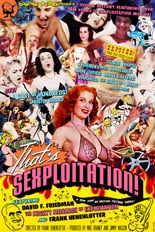
thatssexploitationIn conjunction with the mighty Something Weird Video, cult director Frank Henenlotter (Frankenhooker) takes moviegoers on an epic, yet whirlwind tour of a film genre as old as cinema itself. Ladies and gentlemen, That’s Sexploitation!

For assistance, Henenlotter calls upon someone who not only knows his sexploitation history inside and out (and in and out), but had a hand in directly steering it: the legendary producer and distributor David F. Friedman, who died in 2011; the finished film is rightfully, lovingly dedicated to him. While I would have preferred to see more than one talking head contributing to the documentary — especially one of such significant length, as it runs two hours and 15 minutes — Friedman was renowned for a colorful personality. It’s on full display and matched only by his wit as he takes viewers through sexploitation’s life cycle, from its demure birth to its death, when hardcore pornography took over and, as a result, says Friedman, “the fun stopped.”
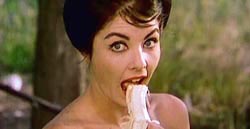
thatssexploitation1But wasn’t it fun while it lasted? Henenlotter is out to prove that with an emphatic “hell, yes!” With a cup-runneth-over wealth of clips, the doc beckons you through the entire tits-a-twirlin’ timeline of subgenres: morality scares (Damaged Goods), “goona-goona”/jungle natives (Ingagi), peep-show loops, instructional/hygiene (USS VD: Ship of Shame), strip/burlesque (Teaserama), nudie cuties (The Immoral Mr. Teas), roughies (The Defilers), dopers (The Acid Eaters) and white-coaters (Man and Wife).

Among those whose work is featured are behind-the-camera trailblazers like Russ Meyer, Herschell Gordon Lewis, Doris Wishman and Michael Findlay, and such in-front talents as Bettie Page, Blaze Starr, Lili St. Cyr and Tempest Storm. Henenlotter is nothing if not thorough, and while he obviously loves these films, he doesn’t pretend they are something they’re not; of one group in particular, he remarks, “They were called ‘nudie cuties.’ And they were the stupidest films on the face of the earth!” That much, we knew. But even to those well-versed in sexploitation, this documentary still has lessons to teach. It’s jarring, for example, to see an example of a silent hardcore, complete with an “I’m going to fuck you!” title card. —Rod Lott
Get it at Fandor.

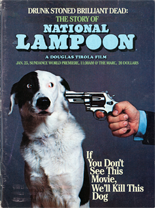
Drunk Stoned Brilliant Dead: The Story of the National Lampoon (2015)

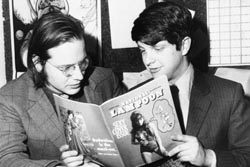
drunkstonedWhen I spied a copy of National Lampoon at my Uncle Bill’s house one evening in 1979, the bored, Mad magazine-loving, 8-year-old me snatched it up and started flipping through it. I’ll never forget the shock of seeing real women’s breasts staring back at me from the “Foto Funnies” page. I’ll never forget the comic strip of two boys making shadow puppets using not their hands, but their prepubescent genitals. I’ll certainly never forget, when I laughed aloud and bravely shared that strip’s crasser-than-crass “Abraham Leakin’” punch line, how fast my mom traversed the kitchen to confiscate the issue from my hands and far-too-young eyes.

And that, ladies and gentlemen, was my introduction to the Lampoon. The story has a happy ending, because a mere four years later, in 1983, Mom took me to see my first R-rated movie in theaters: National Lampoon’s Vacation. For fellow children of the ’70s and ’80s, I suspect exposure to the Lampoon brand arrived far more through its films than the actual publication. I’ve never read a complete issue, yet am fully aware of its enormous and ever-continuing influence on modern comedy — dangerous, politically incorrect and sacred cow-punching — perhaps most notably with the birth of Saturday Night Live. Regardless, Douglas Tirola’s feature-length documentary, Drunk Stoned Brilliant Dead: The Story of the National Lampoon, is not to be missed.

drunkstoned1In its opening minutes alone, the documentary does what Ellin Stein’s 2013 book on the topic could not achieve in 464 pages: Capture the anarchic energy and unrestrained creativity of the mag at its mid-’70s’ peak. Its success was not immediate, and that it was successful at all is something of a right-place/right-time fluke. Outside of the magazine eventually sucking from the mid-’80s to its 1998 death, Tirola and his talking heads (Chevy Chase, Matty Simmons, Kevin Bacon, P.J. O’Rourke, John Landis and Tim Matheson among them) skip over the Lampoon’s many misfires beyond the stapled pages; Class Reunion and Movie Madness are completely MIA, while Disco Beaver from Outer Space gets a cursory mention without even explaining what it was (an HBO special). I would call this the only fault to be found in Drunk Stoned Brilliant Dead, but instead I choose to flip it into a positive and say I wish the doc had kept going to share even more.

Not all of the humor has aged well — far from it (especially the live Woodstock parody Lemmings, the appeal of which escapes me based upon the footage shown here) — yet that doesn’t make this retrospective any less fascinating, particularly with so many caustic, drug-fueled egos at play, more than one of whom met tragic ends. Even with those secondary routes into weightier matters, the movie zips by us with immeasurable verve, often so fast that my thumb happily leapt between the rewind and pause buttons so much to get a closer look at the art. In doing so, I inadvertently added nearly 45 minutes to the running time. (The last time I did that, I seem to recall Christie Brinkley stripping for a motel-pool skinny dip, just to bring this review full-circle.) —Rod Lott

Get it at Amazon.

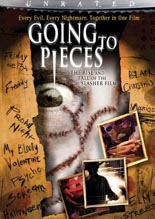
Going to Pieces: The Rise and Fall of the Slasher Film (2006)

goingtopiecesSlasher films are targets of scorn from critics and other high-minded pillars of the community, yet a nonstop source of fun for movie buffs. Adam Rockoff’s 2002 critical study, Going to Pieces: The Rise and Fall of the Slasher Film, 1978-1986, stands as the definitive guide to this subgenre — extremely well-written and well-researched, with neither a dry spot nor scholarly leaning within its pages.

The same can be said for the resulting documentary, Going to Pieces: The Rise and Fall of the Slasher Film, whose title drops the text’s range of years addressed.

In the book, Rockoff (more recently, author of The Horror of It All) is quick to defend his beloved slashers, making a good point about how tame they are violence-wise when compared to the body count of the 1980s’ testosterone-overdosed actioners like Commando and Rambo III.

goingtopieces1Better yet, he’s honest; as willing as he is to call John Carpenter’s Halloween a classic (and it is), he’s just as willing to call a stinker a stinker (and there are more than a few). By interviewing some of the principals behind the screen’s seminal slashers — and even some comparatively fringe ones — Rockoff gives us a detailed and eye-opening all-access pass into some juicy, behind-the-scenes stories. And who knew there were any such tales to be told regarding Terror Train, Happy Birthday to Me or My Bloody Valentine?

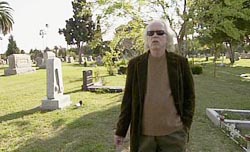
The documentary seems practically lifted from the pages, with the added benefit of bloody footage from the films being discussed. (It’s one thing to read about Sleepaway Camp’s disturbing twist ending, but another thing altogether to see the damned thing.) In addition to the heavy-hitters, the B- and C-titles like those above are given equal time, making them appear even more watchable than they actually are in full. Although the filmmakers — that includes Rockoff, who scripted — deserve credit for seeking out so many on-camera participants, I only wish they wouldn’t have employed the annoyingly pretentious device of having them walk while talking to us viewers.

From the slashers’ early days of Psycho to its post-modern parody days of Scream and Scary Movie (and, in the doc, the then-current revival with the likes of Saw and Hostel), Rockoff has all the gory bases covered. If Michael Myers, Jason Voorhees and Freddy Krueger are your idea of a good time, his book was written just for you. Oh, and ditto the doc. —Rod Lott

Get it at Amazon.

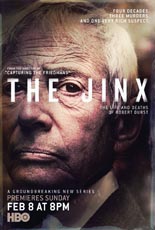
The Jinx: The Life and Deaths of Robert Durst (2015)

jinxTechnically, the year’s finest documentary isn’t even a movie, but a six-episode HBO miniseries: The Jinx: The Life and Deaths of Robert Durst. I prefer to think of Andrew Jarecki’s project as a four-and-a-half-hour film; so binge-worthy is the true-crime narrative that you may wish to consume it in a single sitting, if not actually hunker down and do just that. Like the metaphorical cliché holds for many a hardcover whodunit, I just couldn’t put it down.

While Jarecki is best-known for his Oscar-nominated doc, 2003’s Capturing the Friedmans, he made a foray into more conventional filmmaking with the 2010 Ryan Gosling/Kirsten Dunst mystery, All Good Things, a fictionalized retelling of the Robert Durst saga. For those of us living outside the Big Apple’s haute ZIP codes, Durst long has been the scorned scion of his family’s eponymous real-estate empire. Following the limited release of Things — in which, it should be noted, Gosling plays a character named not Bob Durst, but David Marks — the press-avoiding Durst contacted Jarecki with a proposition: that the director interview him on camera, so that he could share his side of the story.

jinx1Given that Durst avoids the press, this move was highly unusual … and one he’s likely to regret deeply, if he doesn’t already.

See, despite his silver-spoon upbringing and all the millions that grew alongside him, Durst allegedly is a murderer three times over, yet somehow escaped arrest and/or prison sentencing each time, starting with his first wife, who disappeared in 1982, and most recently where The Jinx begins: with the 2001 discovery of a dismembered torso in Galveston Bay. Says one of many interviewees, “He’s not crazy. He’s diabolical.”

And endlessly fascinating. With black pools for eyes, the 70-something Durst is not entirely unsympathetic, even with the sky-high likelihood of committing such heinous, disturbing acts. Viewers may find themselves struggling with the realization that they feel a tinge of sorrow for him, even while recognizing that every sentence emerging from his mouth reeks of calculated bullshit.

The less you know about Durst going in, the more compelling The Jinx will be; even if you are familiar with its celebrated and controversial outcome, the series is riveting all the same. Remaining admirably epic while achieving cohesion, Jarecki’s Jinx owes a sizable debt to Errol Morris’ The Thin Blue Line; like that 1988 groundbreaker and Joe Berlinger and Bruce Sinofsky’s Paradise Lost trilogy, it stands as a work of extraordinary journalism, in which the doggedness of the filmmaker “writes” a new ending stranger than any fiction. —Rod Lott

Get it at Amazon.

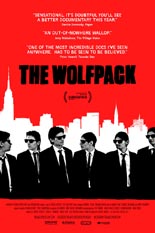
The Wolfpack (2015)

wolfpackFor as long as they’ve been around, filmmakers have been making movies about the movies. From Stanley Donen’s Singin’ in the Rain to Federico Fellini’s nearly every corner of the moviemaking map has been covered through the years, and through a variety of stylistic lenses to boot. But The Wolfpack — director Crystal Moselle’s striking debut feature and winner of this year’s Grand Jury Prize for a documentary at Sundance — casts the power of cinema under a murky new light, focusing instead on how the movies themselves can mold us as emotional creatures, and telling an incredible story of her own in the process.

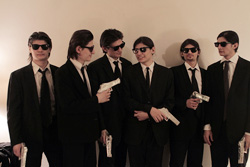
Moselle met the Angulo brothers — ranging from 11 to 18 years old at the time, with hair down to their backs and dressed as if they’d just left the Reservoir Dogs set — by chance encounter in Manhattan in 2010. A friendship then blossomed over a shared affinity for certain movies, and after sharing their unlikely, almost unbelievable backstory, the Angulos invited Moselle into their cramped Lower East Side apartment, where she would film her documentary.

wolfpack1At the time, Moselle was the family’s first guest in their nearly 20 years of residence in the neighborhood. And if that sounds strange, prepare to be stupefied: The brothers (and their younger sister) had only left the apartment a handful of times for the entirety of their lives, sometimes going an entire year without walking through the front door. Their literally sheltered childhoods were the wishes of their father, a Peruvian immigrant with a radical distrust of the American government and society as a whole, and their mother, a soft-spoken Midwesterner who was tragically convinced that shielding her children from the society’s hazards was for the best.

Because they had so little experience in the outside world, the Angulo brothers’ (named Bhagavan, Govinda, Mukunda, Narayana, Jagadisa and Krsna) only knowledge of it came through their massive DVD and VHS collections, which featured classics like Casablanca and contemporary standards like Pulp Fiction. To pass the time (of which they had a lot), the boys recreated entire scripts of their favorite films, then memorized the lines, built props and costumes from household materials, and reenacted scene by scene with remarkable detail — all from within the confines of their apartment. This was more than just an expression of a love for movies, though; it was how these kids lived, their way of experiencing the real world — or at least their perception of it — and assuaging their mounting curiosity.

But there’s a point at which a massive home video collection will no longer suffice. Through a series of candid, expertly shot interviews, Moselle documents their determination to flee, to experience the lives of which they had been robbed. Much of the documentary examines these grand-scale desires, but it also depicts more subtly meaningful life events, like walking barefoot on a sandy beach or going to a movie theater for the first time. It’s in these moments of understated significance are when The Wolfpack is at its most potent and captivating.

Questions will be raised about whether the Angulos’ story had been exaggerated for artistic license — a definite no-no in the documentary world — and how exactly Moselle was permitted such a degree of access to such a hermitic home. Others will critique the film’s focus on the group rather than examining the brothers as individuals (they all look strikingly similar to one another, and Moselle never really puts names to faces). But The Wolfpack, like many of cinema’s most revered achievements (many of which it references), serves as a reminder of the immense mental and emotional spectrum that the medium often explores, reaffirming the idea that it isn’t as much about the story, but who’s telling it and how it’s being told. —Zach Hale, Oxford Karma

Get it at Amazon.