
Category Archives: Documentary

Killer Legends (2014)

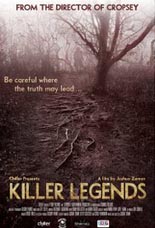
killerlegendsAfter the acclaimed 2009 documentary Cropsey, what does filmmaker Joshua Zeman do for a follow-up? More of the same, with emphasis on “more.” See, rather than spend an hour and a half investigating the truth behind another urban legend, Killer Legends sees Zeman investigating four of them. The film’s style continues in that Cropsey vein, meaning I was glad I wasn’t watching this at night or alone.

Again acting as narrator and on-camera interviewer, writer/director Zeman gains a co-conspirator in researcher Rachel Mills. Together, they form a true-life Mulder and Scully, as they travel across the United States to dig into each case, in hopes of separating the myth from the mystery. Only the occasional and obviously staged bit of setup or transition strikes a false note; it’s no coincidence that both times they venture into pitch-black wooded areas, Mills manages to frighten herself.
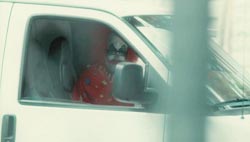
killerlegends1As for their subjects, the Killer quartet entails the Texarkana Phantom, as depicted in 1976’s The Town That Dreaded Sundown; tampered Halloween candy; killer clowns; and the terrorized babysitter, popularized by 1979’s When a Stranger Calls. Clips of these films, their remakes and related movies — from Campfire Tales to The House of the Devil — give the doc added production value, but Legends manages to elicit enough chills on its own. —Rod Lott
Get it at Amazon.

Electric Boogaloo: The Wild, Untold Story of Cannon Films (2014)

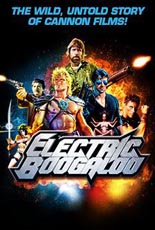
electricboogalooIsraeli cousins Menahem Golan and Yoran Globus absolutely loved movies. It’s just too bad that, during their 1980s reign as owners of The Cannon Group, they had “cash registers where their hearts should be,” as disgruntled actress Laurene Landon puts it, just before she burns a VHS tape of America 3000, the forgotten flick she regrets making for them. Her anecdote represents the kind of filter-free candor that alights Electric Boogaloo: The Wild, Untold Story of Cannon Films, Mark Hartley’s third (and reportedly final) documentary devoted to a specific branch of exploitation film.

Told with the same fervor flavor of his Not Quite Hollywood of 2008 and Machete Maidens Unleashed! two years later, Hartley’s Electric Boogaloo is a wondrous whirlwind tour of the chaos that erupted behind the B-movie label, birthing such releases as Breakin’, Bloodsport, Masters of the Universe, Superman IV: The Quest for Peace, Ninja III: The Domination and practically everything that decade in which Chuck Norris or Charles Bronson starred.

electricboogaloo1In general, those larger-than-life Cannon boys kept costs low, opened wide and, if they were lucky, clicked big with a ticket-buying public — a surefire formula until it suddenly wasn’t. Not coincidentally at the end of the ’80s, Golan and Globus bitterly parted ways; ever the dick-swinging showmen, the two then competed to beat the other to theaters with a movie about (of all things) the lambada dance craze. (Spoiler: Both opened the same day, to empty theaters.)

That “duel” is one of dozens of crazy, can’t-make-this-up stories shared by those Cannon alum who survived their time on various projects (and almost all of whom can do a killer Golan impression). We hear about the guys’ delusion that they were Oscar-bound with the Brooke Shields vehicle Sahara. That they stole private photos from Bo Derek’s bag, which they then issued as publicity stills for Bolero. That they accidentally cast Sharon Stone opposite Richard Chamberlain on King Solomon’s Mines because they thought they were getting Romancing the Stone’s Kathleen Turner. That their mid-movie replacement of a real orangutan with a fake one (a man in a suit) would go unnoticed — which it kinda did, since so few ever saw Going Bananas. That they made Michael Dudikoff a star with American Ninja because a super-vain Norris — not wanting his precious face obscured by ninja fabric — turned it down. There are tons more where those came from.

Supplemented with glorious clips, these tales arrive rapid-fire, ensuring Electric Boogaloo remains a live wire for its whole. Fast, loose and easy, the doc is over in less than two hours, yet so invigorating and engaging that I gladly would have sat for two more. —Rod Lott

Get it at Amazon.

So Wrong They’re Right (1995)

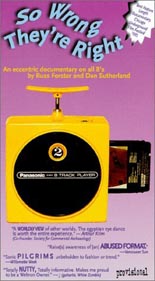
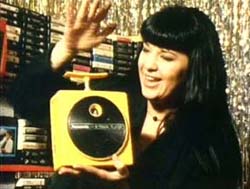
sowrongBefore covering the subculture of cover bands in 2002’s little-seen Tributary, director Russ Forster pursued another “notable” subject in oddball music. So Wrong They’re Right examines the small, but fervent — okay, freakishly obsessed — cult surrounding the music industry’s most Jurassic of formats: the 8-track tape.

Filmed cross-country, the lo-fi movie interviews nearly two dozen 8-track enthusiasts — a few of them falling into what society would deem “normal,” but a majority of them otherwise — about their unusual hobby. Among the notable subjects are members of the ’90s grunge-rock outfit Gumball, who once bought a garage full of 30,000 tapes because they could, and a woman whose fondness for the format is surpassed only by an unhealthy fixation for toothy CHiPs star Erik Estrada.

sowrong1Too long by a tad, yet always amusing, So Wrong proves not having a budget is insignificant if your camera is aimed at real people with compelling stories to tell. The highest praise I can give it is it made me want to buy one those cool, highly coveted “space helmet” 8-track players — not to play anything; just for purposes of aesthetic display. —Rod Lott

The Death of “Superman Lives”: What Happened? (2015)

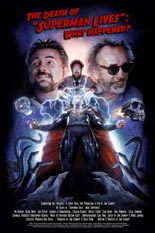
deathsupermanAlthough the book world has chronicled the making of unmade movies for decades, only recently has cinema itself caught on. Now, documentaries of Films That Might Have Been include Lost in La Mancha, Jodorowsky’s Dune, Lost Soul: The Doomed Journey of Richard Stanley’s Island of Dr. Moreau and, for the purposes of this review, The Death of “Superman Lives”: What Happened?

After the Cannon Films-funded failure of 1987’s Superman IV: The Quest for Peace, nearly 20 years passed before Warner Bros. and DC Comics were able to get another Man of Steel movie off the ground. But it wasn’t for a lack of trying! Since Tim Burton had ignited the cultural craze of the multiplex modern superhero craze at the multiplex with 1989’s Batman, producer Jon Peters enlisted him to shepherd DC’s other caped MVP back to the silver screen.

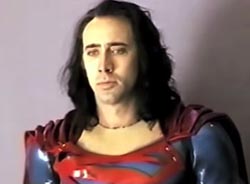
deathsuperman1With a long-haired Nicolas Cage signed on to portray Krypton’s last son, Superman Lives began production in 1998 and was primed to be … well, who can say for certain? With a way-out concept heavy on the sci-fi and a mounting price tag heavy on the ninth number to the left of the decimal point, the project was killed by nervous studio heads in the wake of such Warner high-priced bombs as Tarzan and the Lost City, Sphere and Steel (the latter, ironically, a Superman spin-off). We have only the events of this tell-all documentary as a guide to gauge what Burton may have wrought.

And since writer/director Jon Schnepp (TV’s Metalocalypse) indeed has rounded up all but Cage to tell, their stories vary. Initial screenwriter Kevin Smith (Clerks) appears in his Kevin Smith costume to confirm that his script was essentially “fan fiction.” Long cast as a villain in tales of Lives’ unmaking, a project-passionate Peters actually emerges as sympathetic. Burton still seems a tad peeved about having his baby smothered in the crib, yet admits, “But I also wanted Sammy Davis Jr. for Beetlejuice.”

In the end, it’s hard to say where and how his vision for a reboot would have landed, if completed and released. Schnepp gives viewers absolute riches of concept art and test footage that exude positive vibes, yet also anecdotes of baffling corporate decisions that do the opposite, such as ideas that Superman should wear basketball shorts and fight ninjas. That we get a glimpse of both sides, however, is why The Death of “Superman Lives” succeeds as an informative and entertaining peek into the gears that grind Hollywood’s blockbuster machine. I only wish Schnepp and his untucked shirts didn’t appear onscreen for the interviews; it’s not like he’s a known quantity à la Michael Moore. With Schnepp nodding distractingly like a bobblehead throughout as his subjects speak, his creative choice to be part of the action is as questionable as Peters’ insistence upon a third-act giant spider. —Rod Lott

Get it at Amazon.

Hitchcock/Truffaut (2015)

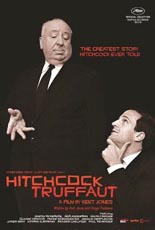
hitchtruffautHowever one pulls off a successful documentary about the making of a book, Kent Jones has done it with Hitchcock/Truffaut. Borrowing its title from the now-seminal film text published in 1966, the feature chronicles the unprecedented week of interviews between the two filmmaking giants (and their unheralded interpreter) and examines the volume’s unprecedented decades of influence ever since.

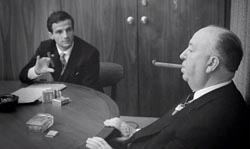
On one side of the table, we have Alfred Hitchcock, the undisputed “master of suspense” and arguably regarded today as cinema’s greatest director — thanks in part to the man at the other side of the table: Francois Truffaut. The French New Wave pioneer questions Hitch at great length about each of his pictures, which, of course, comes to extend to the broadest scope of cinema as a whole. At the time, Hitch had only a few films left in him, whereas Truffaut was just getting started; while at different points in their respective careers, they found equilibrium in their love of the movies, which Jones renders infectious.

hitchtruffaut1Although film cameras ironically were not present for the men’s talks, an audio recorder was; Jones lucks into having their actual voices at his show-don’t-tell disposal, along with a smattering of behind-the-scenes photographs. Without these, the doc would lose what makes it special. He doesn’t rely solely on his subjects, either, opening the floor to such celebrity admirers as Martin Scorsese, David Fincher and Wes Anderson, all avowed fans of the classic book, which has inspired and informed work of their own.

The middle stretch of Hitchcock/Truffaut ceases to be about the book per se and becomes about Hitchcock’s films and his style. That’s not a knock against the doc, as such exploration is on-topic. Naturally, a wealth of clips is employed — with a heavy emphasis on 1958’s Vertigo — so the audience can see exactly the points being discussed; the result is like a crash course in Introduction to Film Theory. (Hitch’s stated position on an “erect” James Stewart as Kim Novak emerges from the closet is priceless.)

All of these tools grant Hitchcock/Truffaut a significant coat of polish; the film exhibits more flair than the Hollywood documentary for which Jones (an ace critic for Film Comment and elsewhere) heretofore was best known: 2007’s Scorsese-produced and -narrated Val Lewton: The Man in the Shadows. That said, there is something Hitchcock/Truffaut’s construction that gives it the feel of being made for cable or a Blu-ray box set vs. the big screen; however, that does not make the hour and a half any less absorbing or delicious. —Rod Lott