
Category Archives: Documentary

Kung Fu Elliot (2014)

kungfuelliotAt the start of Kung Fu Elliot, the outstanding and crazy-entertaining documentary that bears his name, Elliot “White Lightning” Scott expresses his life’s purpose: to “make Canadians go, ‘Wow, we can have an action hero.’” He wants to be Halifax’s answer to Jackie Chan.

Not so fast, Elliot. You’re not even Halifax’s answer to Jackée Harry.

As co-directors Matthew Bauckman and Jaret Belliveau inform us, their subject’s first and second steps toward that lofty goal are the homemade feature films They Killed My Cat and Stalker and the Hero. Both exist to showcase the martial-arts skills of their — how you say? — unconventional (and unemployed) leading man. Both were directed by his longtime, live-in girlfriend, Linda Lum, who appears to be operating the digital point-and-shoot camera under emotional duress and with a saint’s patience. Both are hocked to unimpressed shoppers on the sidewalk outside CD Heaven. (You know CD Heaven, right? Dude, it’s right next door to The Curling Store!)

kungfuelliot1In theory, Bauckman and Belliveau were tagging along to document the making of Elliot’s latest no-budget bid toward superstardom, Blood Fight. However, shooting of the schlump’s would-be epic is erratic at best. He spends more time trying to convince strangers of his MOD DVD greatness and bragging to them about his championship trophies in kickboxing, sport of the future. If he can trick the more gullible into an autograph and/or a photograph they didn’t ask for, all the better for his unjustifiably enormous ego!

With Kung Fu Elliot, the obvious point of comparison is Chris Smith’s perfect American Movie, also following a regular guy with big-screen aspirations and little talent to back them up. Whereas the delusional underdog Mark Borchardt was someone you wanted to root for — and did — Elliot Scott is merely delusional, and that takes the documentary into dark territory viewers will not expect. Don’t let anyone tell you what that is; be highly unsettled for yourself. —Rod Lott

Get it at Amazon.

Lost Soul: The Doomed Journey of Richard Stanley’s Island of Dr. Moreau (2014)

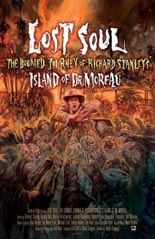
lostsoulIf Hardware auteur Richard Stanley had his way, his adaptation of the H.G. Wells sci-fi novel he loved as a child would have featured such shocking scenes as a human man engaged and engorged in foreplay, sucking the many nipples of a panther woman.

But, as we know, he didn’t; New Line Cinema replaced the in-over-his-head Stanley with veteran John Frankenheimer (1962’s The Manchurian Candidate), and the tortured result, 1996’s The Island of Dr. Moreau, tanked. Today, the colossal boondoggle is regarded as one of the worst movies ever made. Personally, I think that’s a bit harsh, but whatever it is, at least it finally yielded some good, nearly two decades after the fact, with Lost Soul: The Doomed Journey of Richard Stanley’s Island of Dr. Moreau, a documentary of What Went Wrong.

lostsoul1A whole helluva lot! That’s why, even with so many of its players dead or absent, Lost Soul can clock in at feature-length. Admittedly an outsider, Stanley is forthright about the mistakes he made before his dismissal; chief among them, he recalls, “I then made another strategic error: I met Val Kilmer.”

While Stanley is pegged as passionate and paranoid from both his supporters and detractors, no one has nice things to say about Kilmer. Then at the height of his Hollywood powers, the Batman Forever star was, by all accounts, an asshole forever. Further poisoning the well was the legendary Marlon Brando, bringing with him an ego larger than his don’t-give-a-shit girth.

Those stories of bad behavior are well-documented. What justifies Lost Soul’s existence is director David Gregory, co-founder of the Severin cult-video label and contributor to The Theatre Bizarre, allowing more time for anecdotes that didn’t make Variety’s front page. For example, before a single frame was shot, New Line toyed with taking the reins from Stanley and giving them to Roman Polanski; understandably frustrated, Stanley did what he had to do: Enlist a genuine warlock on the other side of the world to cast a spell exactly as the filmmakers met in Tinseltown.

Giving lip service to both sides of the fray, Lost Soul may be executed as a glorified DVD extra, but it’s no puff piece. Between this and 2013’s Jodorowsky’s Dune, the case could be made that any high-profile picture that ends up unmade — or not as intended by its original shepherd — deserves a documentary in lieu of a severance package. —Rod Lott

Get it at Amazon.

Atari: Game Over (2014)

atarigameoverIn 1982, nearly every kid with an Atari 2600 had one white-hot, new cartridge atop his or her Christmas or Hanukkah list: E.T.: The Extra-Terrestrial. By Dec. 26, I’m guessing they collectively experienced beggars’ remorse, because less than a year later, in September 1983, some 4 million units were dumped in the landfill of the small New Mexico town of Alamogordo.

Or were they?

In the three decades since, the unceremonious mass burial of pop culture’s “worst video game of all time” has been shrouded in enough mystery to morph into urban legend. In the hour-and-some-change documentary Atari: Game Over, director Zak Penn — screenwriter of such Marvel movies as The Incredible Hulk, Elektra and X-Men: The Last Stand — literally goes digging for the truth.

atarigameover1In doing so, we get scoops of gossipy bits (and bytes) from Atari’s heyday in the early 1980s — a workplace of pot, booze, Jacuzzis and, every now and then, games that changed the world one rumpus room at a time. Their blocks-and-bricks graphics are laughable by today’s standards (although I still prefer them to modern games), but they were — and this is no overstatement — revolutionary.

One of those Atari 2600 programmers, Howard Warshaw, pushed the boundaries of game design further with such titles as Yars’ Revenge, Raiders of the Lost Ark and then the aforementioned E.T. Although ambitious in scope and intent, the cartridge proved a crushing disappointment with the public, thanks to a mix of corporate greed, Warshaw’s hubris and an impossibly compressed development schedule that made for maddening game play. What it did not do, contrary to public belief, is kill Atari.

With no shortage of self-deprecating humor, Penn’s Xbox-funded doc aims to rewrite passages of incorrect history and reverse the scorn that has hounded Warshaw ever since. In giving Warshaw a platform, Penn grants his film an emotional center as warm and winning as E.T.’s heartlight. Who would expect that watching grown men sift through trash could make for gripping viewing? That it does is but one reason Game Over simply cannot lose. —Rod Lott

Get it at Amazon.

Kink (2013)

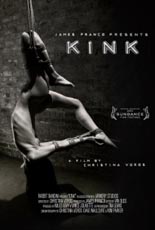
kinkCo-produced by James Franco, the documentary Kink goes behind the scenes of Kink.com, purportedly the Internet’s hottest spot for BDSM content. Don’t know what that alphabet-soup of a phrase stands for? Then the movie and the site are not for you.

Director Christina Voros plops us deep in the bowels of a former armory that now serves as the HQ for the XXX provider founded by Peter Acworth, a jolly Brit who initially doubles as our tour guide. He’s unfazed when the tour is halted temporarily because of an in-progress gang bang. Other than tortured moans, we don’t witness the group activity; instead, Voros leapfrogs into darker territory of bound-and-gagged men and women having various orifices violated by terrifying dildos attached to far more terrifying pneumatic machinery of intimidating speeds.

“You ever come that many times in a row?” one dominant asks his hanging-from-her-feet submissive, who manages to form an answer even with all the blood pooling in her head: “Uh … not upside down.”

kink1For 80 cold and clinical minutes, Voros lets the scenes play out without commenting on them or taking a side; her camera simply acts as an all-access observer, à la a fly on the wall — different kind of fly, mind you. The proper color of straitjacket is discussed; a glory hole is constructed; house director Maitresse Madeline teaches the fine art of slapping and stepping on an erect penis without harm. (Nope! Not buying it!)

Another shot-caller preps a fresh piece of talent for the willing punishment about to be unleashed: “You’re not gonna get nailed for four hours straight,” she says. “There are breaks.” (Whew! Praise be, Samuel Gompers!)

Despite Voros’ detachment, one young woman’s screams in Kink’s final scenes register disturbingly higher than volume allows, ringing with sadness, echoing down dungeon-like halls as hollow as, we presume, her soul. —Rod Lott

Buy it at Amazon.

Jingle Bell Rocks! (2013)

jinglebellSo wide is the appeal for Jingle Bell Rocks! that the documentary can be embraced by Christmas-music fanatics and foes alike. From Thanksgiving to New Year’s, its subject is virtually inescapable to the ears of America’s shoppers, drivers and diners, yet what tickles the tympanic membrane of one tortures another. While lending credence to both groups, the film unmistakably stands on the side of letting such sounds snow.

Its audience surrogate is also its director and producer, Mitchell Kezin. To say he’s (chest)nuts over holiday harmonies is an understatement; the man collects seasonal slabs of vinyl and polycarbonate plastic like a skid-row prostitute does STDs. In this, his first feature, he travels cross-country to talk with fellow collectors, as well as creators of timeless classics and outright obscurities.

jinglebell1Among them are cult filmmaker John Waters, who shared his love for oddball, tinsel-strewn tunes with the masses via the 2004 compilation album A John Waters Christmas; Run-D.M.C.’s Joseph Simmons, who recounts how he wrote the 1987 charity track “Christmas in Hollis” over a spliff and eggs; and The Flaming Lips ringleader Wayne Coyne, whose mother’s unreliable TV memories led the alt-rock iconoclast to birth the 2008 sci-fi film Christmas on Mars (certainly the only soundtrack album to contain such Yuletide gems as “The Gleaming Armament of Marching Genitalia” and “In Excelsior Vaginalistic”).

Bringing a side dish of gravitas to the party is Kezin’s own narrative about how his Christmas-music obsession is fueled by hole-in-his-heart memories of hearing Nat King Cole’s “The Little Boy That Santa Claus Forgot” as a child pining for his absentee father. His bittersweet recollections culminate in a moment that gives Rocks! a climax that can be forgiven for feeling a little forced, because Kezin has accumulated so much goodwill in the interim. With impressive animated sequences and, ironically, no soundtrack disc of its own, it’s a doc as accomplished as it is infectious. —Rod Lott

Buy it at Amazon.