
All posts by Rod Lott

Portals (2019)

An anthology of speculative fiction, Portals posits that man has created a black hole. Global blackouts follow, as do odd behavior from citizens, citywide evacuations and mysterious monoliths — portals, if you will — that pop up everywhere with no apparent rhyme or reason. This setup, courtesy V/H/S: Viral producer Christopher White, is full of possibilities.

The four selected to explore, however, greatly underwhelm. A family flees its California home, encountering a portal on a desert road. Amid the chaos, a 911 call center’s operations are paused by a portal suddenly appearing between cubicle rows. Sisters in Indonesia stumble upon a portal in a parking garage. Finally, after the credits, scientists in Liverpool play guinea pigs with the portals, taking one giant leap for mankind.

Portals is nothing if not consistent, but that consistency arrives as aggravating ambiguity. Nothing is explained; rules appear to be as bendable as wire hangers; characters are barely introduced; they spout mumbo jumbo that hardly moves things forward. If you intend your sci-fi film to be that vague, may I suggest your name be Stanley Kubrick or Andrei Tarkovsky? Being deceased, neither numbers among the helmers involved: The Blair Witch Project’s Eduardo Sanchez, Beyond Skyline’s Liam O’Donnell and V/H/S/2 contributors Timo Tjahjanto and Gregg Hale.

Portals’ problem is its script, not the effects. Undaunted, White tried again two years later, reviving his vertical-rectangular-object concept with a fresh coat of paint (and lesser-known directors) as the omnibus Doors. I won’t knock it ’til I try it. —Rod Lott

Get it at Amazon.

Midnight Movie Massacre (1988)

Often cited as a forerunner to the meta likes of Mystery Science Theater 3000, Midnight Movie Massacre exists as a playful ribbing of old B movies. Nonetheless, the film squanders that premise — one so simple, it should be can’t-miss.

One night in 1956, Kansas City’s Granada Theater packs moviegoers in to watch the sci-fi serial Space Patrol (which was actually a TV show) starring Robert Clarke and Ann Robinson. Meanwhile, off the big screen, a gelatinous, tentacled alien invades the bijou to kill the patrons.

As story goes, that’s all this Massacre offers, leaving a wide berth for jokes, more jokes and also jokes involving the various patrons and their various body parts and functions thereof. They include a poodle-skirted woman with balloon-sized breasts (Lori Davis, The Bikini Open 5), an obese family lugging enormous trays of concessions and, up in the balcony, a sneezing girl constantly pulling gunk from her nostrils like a magician to a chain of colored hankies. 

Amid this vacuum of comedy, two characters stand out for their overly insipid nature. One is a fat nerd (Vince Cabrera) obsessing over a foxy sweater girl (Tamara Sue Hill) only he can see: “Holy Toledo, look at those milk bottles! She’s a one-woman dairy farm! I can’t go in there, I’ve got a boner! … I bet she’s got nipples like flapjacks! … My dick’s harder than Chinese arithmetic!”

The other, cowboy Tex (Brad Bittiker), longs to lay his date (Susan Murphy): “Oh, darlin’, my one-eyed muff torpedo wants to go to Tuna Land tonight. .. Howazbout a little stink on the dink, baby duck?”   

If co-directors Mark Stock and Larry Jacobs hold nostalgia for the single-screen moviegoing experience — and casting has-beens Clarke (The Hideous Sun Demon) and Robinson (1953’s The War of the Worlds) suggests as much — it’s lost within the tacky, lowest-level humor. Although credited to four writers, the lines play like someone’s sixth grader gave his dad’s script a “polish” as a prank … and no one noticed or bothered. Not even the movie within the movie is immune to such prepubescent chicanery: “Probing devices were penetrating Uranus to crack its dark and hidden interior.”

Preceded by trailers for Cat-Women from the Moon and Devil Girl from Mars, the Space Patrol portion aims for a lighthearted lampoon, but isn’t funny enough (if funny at all) to function properly, like the titular segment of Amazon Women on the Moon does with aplomb. Between Midnight Movie Massacre’s halves, what’s projected is slightly less dreadful than the in-theater gags, which are the dregs of failed camp. —Rod Lott

Get it at Amazon.

The House of Usher (1989)

Alan Birkinshaw enjoys the distinction of directing two Edgar Allan Poe adaptations in South Africa in 1989: Masque of the Red Death and The House of Usher. But only one dared put Frank Stallone’s name atop its poster!

It wasn’t this one.

Set in the present day, Birkinshaw’s House opens with Ryan Usher (Rufus Swart, River of Death) and his fiancée, Molly (Romy Windsor, Howling IV: The Original Nightmare), being invited to the titular, palatial estate by his enigmatic uncle, Roderick Usher (Oliver Reed, Burnt Offerings). Despite never having met the guy, Ryan and Molly go anyway.

Ulterior motive alert: Being the last of his lineage, Ol’ Roderick feels an urgent need to seed, and views Molly as his perfect bride/birthing vessel. Like Olive Garden, Roderick operates from the mindset of “When you’re here, you’re family,” assuming Olive Garden still performs mandatory pelvic floor exams at the table.  

That’s just the start of the craziness under this House’s roof. A visiting physician loses his penis to a gnawing rat. Living in a hidden room, a sooty Donald Pleasence (Nothing Underneath) has an electric drill bolted to his forearm. Going so hammy that Jewish and Muslim populations may be forbidden from viewing, Reed’s Roderick humps Molly in the shower with pained thrusts that suggest he’s struggling to move a divan up a flight of stairs.

The travails of a Harry Alan Towers budget are apparent, with the Usher estate’s interior rather cramped, dressed and blocked like a sitcom set. (Somehow, the place looked more spacious in Masque.) Elsewhere, in the family crypt, stone tombs are clearly Styrofoam. More gaudy than Gothic, this House of Usher falls in on itself in credibility, especially with one of those “JK!” cheat endings. —Sir Roderick Lott 

Get it at Amazon.

The Ghost Station (2022)

Young web journalist Kim (Kim Bo-ra, Ghost Mansion) is in dire need of a scoop that’ll rake in the clicks and likes. She finds it in a subway train accident, when her friend Woo-won (Kim Jae-Hyun), who works security at Korea Metro, tells her about the ghost of a little girl spotted hiding in the rails of Oksu station.

Strangely, the ghost girl isn’t the only spirit hanging around Oksu. Stranger still, they all spout four-digit numbers when asked for their names. The more Kim digs, the more she uncovers, like how everyone who’s died at that platform in the last three decades bears deep scratches on their arms. Then there’s the matter of one of Kim’s sources committing suicide … before the two spoke!

The Ghost Station marks director Jeong Yong-Ki’s return to horror since his 2004 debut, The Doll Master. Unfortunately, it’s your standard Korean fright fare — substandard, even, if you’ve seen more of these things than the average bear. As if “ghost children” didn’t already drive the point home, it doesn’t tread new territory as much as repeat the familiar tropes by rote. Co-screenwriter Takahashi Hiroshi, best-known for the J-horror classic Ringu (aka The Ring) even has the gall to include a well. A well! With trapped kids! Thus creating, to use the movie’s own words, a grudge! And a curse to pass on, which Kim totally girlbosses.  

Shouldn’t some blame land on the unimonikered Horang, on whose webcomic the film is based? No, since his source material is adapted in whole for the prologue. Other than establishing the subway setting, the standalone scene shares nothing with the mélange of jump scares that follows. —Rod Lott

Get it at Amazon.

Mercy Road (2023)

As Steven Knight proved a decade ago with the Tom Hardy vehicle Locke, viewers can be riveted by a feature film set entirely within a moving car at night. Now, Mercy Road gives that concept an Aussie spin. It’s a real change of pace for John Curran, heretofore known for directing tony, buttoned-up awards bait like The Painted Veil and Stone. Here, he loosens the collar and tells the world to eat his dust.

Hardy’s luxury car is downgraded to a dirty work truck driven by Tom (Luke Bracey, 2015’s Point Break remake), who’s fleeing the site of where something bad just happened. I’ll let you learn the “what”s and “why”s as Curran intends, with hints dropped a quarter-mile at a time; suffice to say, Tom’s searching frantically for his 12-year-old daughter, who isn’t answering her phone. According to an ominous caller identifying himself as “an associate” (Toby Jones, Berberian Sound Studio), Tom has exactly 60 minutes to find her.

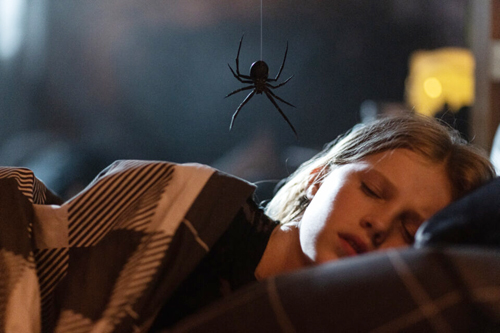
As the clock ticks, so does your pulse. With a recurring cameo from one of those notorious Australian spiders and Curran’s own intense score banging on the left-hand side of the piano, Mercy Road makes for a stressful ride. Bracey makes you feel it, too, selling his accelerating frustration and panic with a worn-raw throat and bursts of unplanned spittle.

I only wish the resolution were concrete. No fewer than three endings run right after the other, I assume rendering the previous one null and void. It’s unclear — and this sure ain’t Clue — as we’re left with more questions when Tom kills the ignition. —Rod Lott

Get it at Amazon.