
All posts by Rod Lott

The Gamblers (1970)

Aboard a cruise ship, cheapskate crook Rooney (Don Gordon, Bullitt) poses as a doctor in order to con an aristocrat (Massimo Serato, Killer Nun) out of his considerable wealth. Making Rooney’s job easier is that his mark loves to gamble. 

Meanwhile, Rooney hopes to get into the bikini bottoms of an incomparably beautiful passenger (Torso’s Suzy Kendall, suntanned within an inch of, well, every inch).

Okay, so The Gamblers isn’t exactly Dostoevsky. 

Except — surprise! — it is! Writer/director Ron Winston (Banning) based his film on the Russian novelist’s 1866 follow-up to Crime and Punishment. Liberties have been taken. (Or so I assume. I don’t read Dostoevsky unless eight pages of full-color photos of Kendall come inserted at the book’s midpoint.)

With the story fresh from celebrating its first century at the time, the third-act twist is obvious as soon the first act puts its players in place. Obviousness notwithstanding, The Gamblers reveals itself as a more-than-capable caper as bubbly as the champagne its characters imbibe, with a jaunty score to match, courtesy of Mel Brooks’ regular composer, John Morris. 

With dated but delightful support from Richard Ng (Winners & Sinners) in his first feature, the comedy is featherweight-light until the last couple of minutes. At that point, Winston seems to realize he’s wasted Kendall on every level but eye candy, and ends The Gamblers with a grand, unearned romantic gesture. From what I gather, that’s the kind of scenario that happens among people more attractive than you, gallivanting about more attractive places you’ll never be able to visit. —Rod Lott

Get it at Amazon.

Nightmare on 34th Street (2023)

As Christmas horror anthologies go, Nightmare on 34th Street bears a title so clever, it’s something of a Miracle it hadn’t been co-opted before filmmaker James Crow got to it. Now, the movie itself is less inspired, but it’s watchable. Because it’s British, prep to hear “Santa” pronounced as “Santer.”

As this movie’s jolly old St. Nick, Pierse Stevens (Crow’s House of Salem) tells a boy five bedtime stories, plus gets in a few choice words about the true reason for the season: “The poor fucker was on a cross, died, and all they want is fucking presents!”

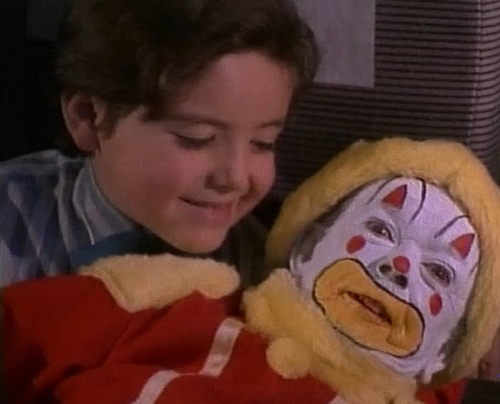
The stories involve a home invasion by “three Christmas nutters” who drive a van marked “THE SLAY”; a down-on-his-luck ventriloquist and his homicidal Frosty the Snowman puppet; and your garden-variety store Santa who, after being fired, poisons cookies and causes other general mischief. In arguably the most successful segment, a single mom/MILF (former lad-mag vixen Lucy Pinder) gets a visit from Krampus; in easily the worst, an infirm priest (Spidarlings‘ Jeff Kristian) and his past are key to “The 12 Kills of Christmas.”

Individually and overall, 34th Street houses too many characters, too few fresh ideas, no real jolts and, most regrettably, more padding than the average pillow supporting the heads of nestled children as they dream of sugar plums. However, Crow is able to pack a streak of nastiness under his low-budget tree, as kids are not only put in danger, but participate in it. He also stuffs its stocking with dark laughs; in addition to Santa’s possibly sacrilegious spouting above, an earlier cut features a now-excised babysitter tale in which a girl dismisses a Virgin Mary figurine with “Whatta slag!” —Rod Lott

Get it at Amazon.

Cottonpickin’ Chickenpickers (1967)

Country singers Del Reeves and Hugh X. Lewis don’t play themselves in Cottonpickin’ Chickenpickers, but considering their obscurity, who would know the difference? As the respective Darby (the one in a red cap) and Jerry (the one not in a red cap), Reeves and Lewis are the most well-dressed hobos ever to grace the picture show as they make their way to My-am-uh — “Miami” to you and me — but get stuck in the swampy Toover County, Florida.

It’s the kind of backwater boondocks populated with all sorts of crazy characters and trouble awaiting at every turn, as are a git-tar or banjo, each as near-omnipresent as a jug of moonshine. So starved that Quincy Jones and Bob Geldof could build competing all-star charity singles around them, Darby and Jerry raid a chicken farm — hence the title — which lands them in the clinker. But not for long!

Full of gators and groaners, this film produced by Dick Randall (Pieces) and David Putnam (not that one) earns itself the moniker of “prize dingaling of all time,” to borrow a line from Jerry. (Or was that Darby? It doesn’t matter.) The action (as it were) pauses often for a diegetic country song. Perhaps most notable is Johnny Cash’s Folsom Prison novelty, “Dirty Old Egg-Sucking Dog,” performed here by future Burt Reynolds punchline Mel Tillis.

There’s something to the hicksploitation brand of cornpone comedy-musical that tickles me, even though its world is as alien to me as, say, Uganda. (Despite my red-state residency, I don’t own a truck, belt buckle or pair of boots, and can’t stomach one fucking second of Hee Haw.) Chickenpickers scratches the same itch as the Ferlin Husky Hillbillys duology, half of which incidentally features Reeves and a script by this pic’s director, Larry E. Jackson.

As Cousin Elmore, Robert V. Barron (Abe Lincoln of Bill & Ted’s Excellent Adventure) supplies most of the slapstick, while the spoken-aloud jokes resemble Abbott and Costello’s “Who’s on First?” routine, if it were kicked in the head by a horse:

“Sylvia’s my real name, but nobody knows that.”
“You can trust us. We won’t tell anyone.”
“Tell anyone what?”
“That your real name is Sylvia.”
“How did you know about that?”

Like its own dentistry gag about gum removal, Cottonpickin’ Chickenpickers possesses no teeth for humor, but has all it needs to smile. So shall you, in between rolling your eyes. —Rod Lott

Get it at Amazon.

The Black Demon (2023)

If you ask me, the wrong sharksploitation movie hit theaters this summer, while the better one went straight to VOD: respectively, Meg 2: The Trench and The Black Demon. From Rambo: Last Blood director Adrian Grünberg, The Black Demon is, incidentally, also about the now-nonexistent Megalodon.

Poseidon’s Josh Lucas returns to ocean waters as Paul, a safety inspector for Nixon Oil (subtle!). With his wife (Fernanda Urrejola, Bring Me the Head of the Machine Gun Woman) and two kids in tow, he comes to Mexico to see about decommissioning an offshore rig (which should be the new “see a man about a horse”). To their surprise, the coastal town is nearly uninhabited. Might that have to do with the 70-ton giant shark? ¡Sí!

Bearing a “Based on the Mexican legend” credit, Grünberg’s likable Demon might play better to Those Who Believe, but it’s hardly a prerequisite. Compared to the Meg movies, it may be vastly smaller in scale, yet yields bigger entertainment returns for your time invested. Given its rig setting, its hot-wired execution and its Home Depot pitchman star’s resemblance to Thomas Jane, the film exudes more Deep Blue Sea vibes than the actual Deep Blue Sea sequels, not to mention snazzier shark CGI.

The worst element is an ending so cheesy, it practically suggests a chardonnay to pair. —Rod Lott

Get it at Amazon.

Scream Queen (2002)

In Brad Sykes’ Scream Queen, real-life VHS scream queen Linnea Quigley plays the fictitious scream queen Malicia Tombs. On the set of her latest opus, she argues with her co-stars, director and crew members before leaving in a huff. Tragically, Malicia’s car crashes and explodes, killing her.  

The director, Eric Orloff (Jarrod Robbins, Sykes’ Zombie Chronicles), remains haunted by the events of his unfinished picture. One day, via an invite to a mansion, he’s offered $10,000 to complete it. Despite the place being located at 101 Killington Street, he shows up at the designated time, only to find a reunion of sorts of his ill-fated production’s cast and crew. They’ve been gathered for an evening of revenge in Malicia’s name — call it Six Little Indians with zero second takes. “Cut” means “cut.” 

Let’s acknowledge the obvious: Shooting on VHS presents several inherent and inescapable challenges, such as wind overpowering the camera’s microphone or night scenes looking especially ugly. The more SOVs you expose yourself to, the easier it is to forgive those limitations. Here, doing so leaves you with terrific fun. Your one true complaint may be the absence of nudity from the chesty Nicole West (Ted V. Mikels’ Dimension in Fear) in her animal-print underwear sex scene. I’m with you.

Building his slasher with a meta setup, Camp Blood creator Sykes gives the shot-on-video world its Scream. At the risk of oversell, it’s clear from the outset Sykes poured his all into the project, where others would half-ass it. His opening shot is Altman-style audacious for any format, running a couple of minutes as the camera moves from person to person, introducing viewers to each character and requiring every performer to be on their toes. 

Similarly, the prolific Quigley (Murder Weapon) is asked not simply to show up, but act. Don’t worry, kiddos, because your beloved kill scenes remain in full supply. Serving as host for the proceedings is a dwarf (Kurt Levee) — a nice Gothic touch, even if the guy is wearing a quasi-Christmas sweater. That’s just one element making Scream Queen the most wonderful kind of SOV horror. —Rod Lott

Get it at Amazon.