
Category Archives: Kitchen Sink

The Trip (1967)

WTF

Growing up, I never drank alcohol or took drugs, mostly because of an unwavering superiority complex that tended to rub people the wrong way, alienating them and leading me to a lifetime of hardship, strife and loneliness.

But if I had to do an addictive substance, I probably would do acid.

I mean, from what I’ve heard from classroom film strips, after-school specials and related docudramas, it’s a total carnival freakshow where the sights, smells and other sensory factors create a real horror vibe, drudging up the demons of your mind so you can, typically, cast yourself out a fifth-story window. That sounds kind of fun …

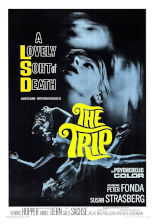
Even though I’m far too old now for drug-fueled shenanigans, 1967’s The Trip is supposedly a based-on-real-life excursion to the hallucinogenic world, but with the MPAA on hand to regulate everything we’re about to see … or not see. Written by pre-Chinatown Jack Nicholson, directed by pre-New World Pictures Roger Corman and starring a pre-Easy Rider Peter Fonda, it’s automatically a cinematic exploitation beatdown of low-budget proportions.
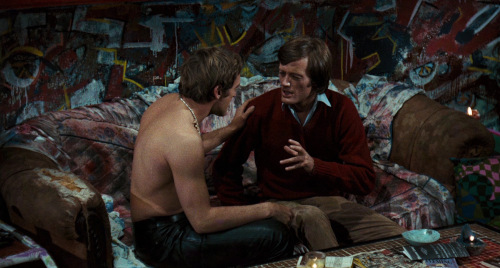
The Trip finds the somewhat tanned Fonda as successful commercial director Paul. He’s in the doldrums of ’60s depression from a somewhat-bitter Hollywood divorce, so friend-with-weed-is-a-friend-indeed John (Bruce Dern) takes him to a swingin’ bachelor pad — or, if you’re so inclined, a psychedelic drug den to take some primo stuff, man.

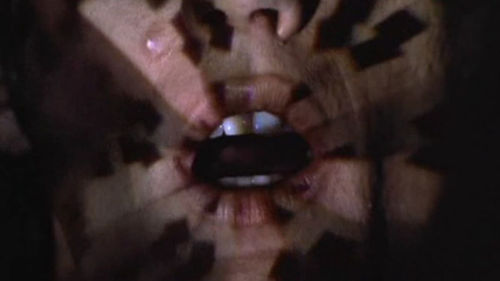
As some trippy sitars begin to play, Paul takes some blotter-paper LSD and slowly starts to float downstream. Here, the movie takes on the approximation of what a trip “actually” feels like, starting from the blending of colors, shapes and strobing dots, man, to on-location shots of rock-climbing, cliff-diving and love-making to buxom women on said rocks.

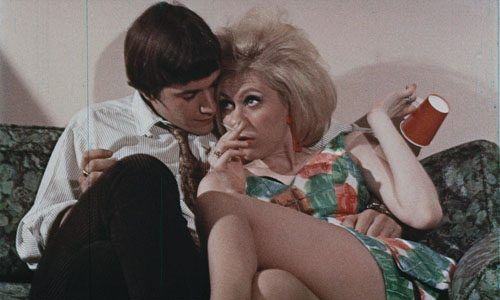
On his journey, Paul encounters hooded figures, spooky witches, go-go dancers and, of course, the occasional midget. There’s a haunted house, peeling faces, burial shroud, a big-haired woman and campy Mexican music on the soundtrack. And don’t forget the old-time carousel, paranoid delusions about chairs and Dennis Hopper doing his comedic (?) Church of Satan routine with bloodstained pictures on LBJ on the wall.
As his trip comes down — and as the audience loses patience — Paul goes on a rampage though the Sunset Strip, meeting various dancers at a “happening,” laundromat patrons just trying to do their laundry and a real menacing tiger on black velvet that somehow terrorizes him into sobriety.

Hmmm … maybe I don’t want to try acid?

Sure, Fonda, Dern and Hopper are/were great actors after — and in spite of — The Trip, but it’s on par with a Reefer Madness scare film: great to take a toke, a hit or a dose to, but after 30 minutes, you’ll be reaching for the remote and down a box of Ding-Dongs. Or, if you’re really tripping balls, a tentacle will come out your slimy sternum to change the mellow groove-box, man, and take you to the other side.

In the end, the movie is a bum Trip. —Louis Fowler
Get it at Amazon.

Blast-Off Girls (1967)

WTF

In Chicago’s garage-rock scene — or at least the one depicted in Herschell Gordon Lewis’ Blast-Off Girls — Boojie Baker (Dan Conway) wants to rule the roost as the local music promoter du jour. Imagine Scooter Braun, but carrying a cane for show — one that looks two brim taps shy from producing a rabbit.

Boojie’s latest target for his 50/50 contract scheme is a mop-topped quintet he restyles and rebrands as The Big Blast. He succeeds at getting them noticed, written about, photographed, booked, played, recorded and hitting! That’s because Boojie is a master manipulator as a manager, wheelin’ and dealin’ via cooze-slingin’. Every decent-looking woman in the Windy City is willing to move up and down on whomever can help The Big Blast move up the charts.

It works so well, Boojie lights his cigars with cash … but only a dollar bill — and just the corner, if you please, so the thrifty Lewis could still use it as legal tender, of course. The Big Blast soon threatens to implode when they don’t see any of that money. Such one-sided success forms the template of many a rock ’n’ roll movie so in vogue at the time, but only Lewis, free of studio interference, could get away with a bongo pot party.

Certainly no filmmaker other than Lewis would stop his music pic cold for what amounts to a Kentucky Fried Chicken commercial with Col. Harland Sanders himself supplying buckets to the band in exchange for an impromptu gig outside the restaurant. Original-recipe or extra-crispy, it’s my favorite instance of product placement in movie history. It would be even if it didn’t end with Sanders winking at the camera. Fourth wall, you’ve just been eye-fucked-through by the Colonel.

The biggest shock of Blast-Off Girls isn’t that Lewis titled the film after minor characters (if characters at all), but that the music is legitmately good. Having amped-up tunes supplying energy takes the onus off Lewis to be concerned with camera placement. For what it’s worth, he saves the group members’ Richard Lester-esque montage of mischief for the closing credits.

Worrying over an absence of gore in a Lewis picture turned out to be moot. This movie frugs! As Boojie says about 12 or 13 times, “Have a blast!” —Rod Lott

Get it at Amazon.

Triple Fisher: The Lethal Lolitas of Long Island (2012)

WTF

Name a current narcissistic, headline-hangry piece of shit posing as a human being — I’m going with Ruby Franke — and odds are, you’ll find multiple documentaries about them scattered across various streaming platforms. In the pre-digital world, however, their lives and crimes were quickly churned, burned and turned into made-for-TV movies.

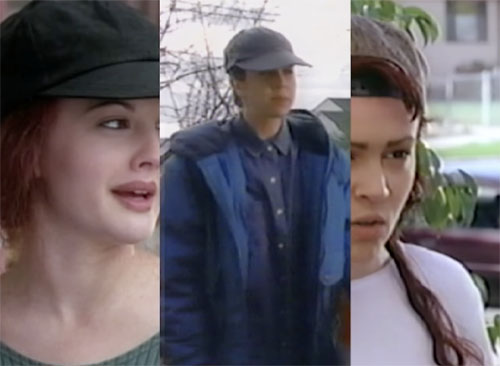
Take Amy Fisher — please! Barely six months after the New York teenager put a bullet in the noggin of her married lover’s spouse in 1992, her story became fodder for such three prime-time premieres: NBC’s Lethal Lolita, ABC’s Amy Fisher: My Story and CBS’ Casualties of Love, respectively starring Noelle Parker, Drew Barrymore and Alyssa Milano. Not only did all three air within a week’s time, but two aired opposite each other. I’ve never seen any.

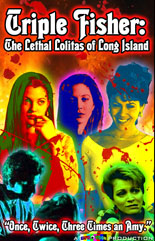
But I have seen all — in a way, via Dan Kapelovitz’s mashup, Triple Fisher: The Lethal Lolitas of Long Island. Riotously entertaining, it tells the same story using select bits from the competing pics. Other than Barrymore’s Amy longing for eggplant parm, it’s difficult to keep track of who’s in which, and it doesn’t matter. In fact, that’s exactly Kapelovitz’s point. 

Down to the beepers and goombah ’fros, the triplets’ shared resemblance is so uncanny, a 23andMe test would be superfluous. It’s almost as if they worked from the same outline; essentially, by pulling info from the shared Porta-Potti of ’90s tabloid journalism, they were. One can imagine the individual producers collaborating:

“Do we really want to spend time on the promotional shirts for Joey Buttafuoco auto repair shop?”
“Well, we will if you will.”
“Okay, settled.”

Triple Fisher is hilarious, although none of the material was intended as anything but Serious Drama. One has Joey, looking not unlike Saturday Night Live’s Horatio Sanz, snorting coke while driving. One’s Mary Jo Buttafuoco is a spitting image of Amy Sedaris’ Strangers with Candy character. Best of all, one has Mr. Fisher asking his daughter who gave her “the herpes.”

Way to go, Joey! —Rod Lott

Under the Cherry Moon (1986)

WTF

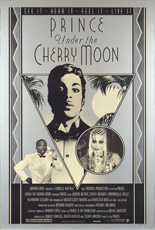
In between 1984’s utterly transcendent Purple Rain and 1990’s much-maligned Graffiti Bridge, Under the Cherry Moon is the 1986 outlier that Prince fans forgot. That being said, I’ve always thought it’s the better Prince movie. Its soundtrack is a brilliant companion piece I often play as well. Does anyone agree with me? Anyone?

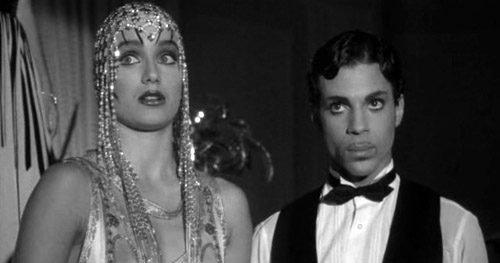
In the glam retaliation of the French Riviera at an unspecified time, Christopher Tracy (Prince) is a stylish piano player at a swanky nightclub. He and his ambiguous partner/roommate, Tricky (mirror master Jerome Benton), are high-priced gigolos, methodically preying on the wealthy women of the lavish coast while homoerotically playing in their shared bathtub.

Either way, while crashing a party, they meet spoiled socialite and spicy ingenue Mary (Kristin Scott Thomas) in her birthday suit. Spasmodically, they play the drums at her coming-out party. True to form, Christopher gives her the searing eye while she does the cha-cha and kicks him out of the party but

As their relationship forms, it becomes a constant battle of wills and wiles, barbs and beauty, will they or why they shouldn’t, with him calling her a “cabbage head” in a paralyzing sneak attack of words.

They fall in tragic love that’s more chaste than expected, filled with more dirty talk than actual realized sex, giving more pomp (pump?) than penetrative circumstance. In a weird way, Cherry Moon is a truly romantic film that only become more endearing with its taut strangeness.

The soundtrack is one of my favorite albums, one where the grooves are about to be blown out from constant play. The same thing can be said for the actual movie, where Prince’s style and grace are fully encapsulated in a funky 100 minutes.

After the movie bombed, Prince made one more film (the aforementioned Graffiti Bridge), but it was too late; he was culturally dead until he was actually dead. But, in my opinion, Under the Cherry Moon is his pinnacle in a career of high points, dramatic and otherwise, and should be re-evaluated.  —Louis Fowler

Get it at Amazon.

Xanadu (1980)

WTF

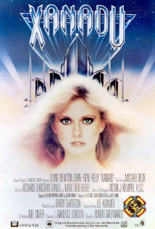
In the mid-’80s, I had (have?) a huge crush on Olivia Newton-John, thanks to obsessive repeat HBO airings of 1983’s Two of a Kind. Even though I’d never seen her other films like Grease or, well, Grease, I got a Sears-supplied, clearance single of “Twist of Fate” from the movie I routinely staged intricate dances to when no one was looking.

“Sex Shooter” singer Vanity took ONJ’s sex-symbol throne in HBO’s The Last Dragon era, but I never forgot Olivia. (Or Vanity.) Once I had my own Blockbuster card in the early ’90s, I rented a sun-bleached VHS copy of Xanadu and all these hormone-driven feelings came back to the forefront, this time with an ELO soundtrack!

Xanadu came recommended by one of those somewhat prolific “bad movie” books that took up so space on my shelf. It was described as a “turkey” to comedically scorn and anthemically balk at. As the VHS played, I thought, “Sure, it’s a little corny … but what ’80s musical isn’t?

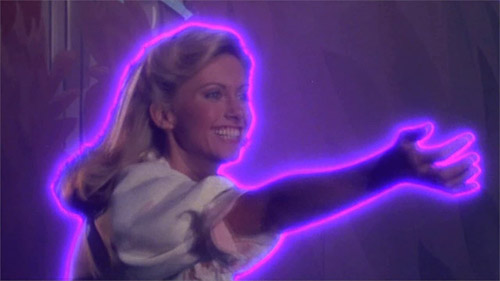
I mean, this film has everything, including a post-The Warriors/pre-Megaforce Michael Beck, a duet with New Wave band The Tubes, an animated sequence from Don Bluth, glitzed-out dancing machine Gene Kelly and, in a most virginal wardrobe choice, ONJ and her sisters — mythological muses, of course — dancing off a mural in the street and into my dreams.

Really, that’s the best entertainment for the likes of me. I can see now why everyone thought I was gay. I wasn’t.

Even if the Xanadu movie isn’t your cup of bleach, the Xanadu soundtrack is a truly stellar find. Half ONJ, half Electric Light Orchestra, these worlds collide on the singles “Magic” and “All Over the World,” as well as the title cut — a total banger. It’s pure pop perfection that can be found in the discount bin!

Rewatching Xanadu all these years later on Kino Lorber’s Blu-ray keeps the late ONJ on my schoolboy crushes list, but now it’s more for the stylish grace, playful demeanor and wistful wiles that takes me back to a time where a musical can still be magical for the right person.

And that person is me. —Louis Fowler

Get it at Amazon.