
All posts by Rod Lott

Sting (2024)

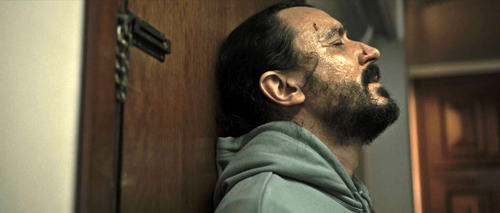
Nothing’s tantric with this Sting, a spider movie from Down Under that delivers a load. Of fun.

During a city-crippling ice storm, a Brooklyn apartment building gains an unexpected visitor: a rock from space that houses a dandy li’l spider. It’s found by Charlotte (Alyla Browne, Furiosa), a young girl who lives there with her family. From room to room and floor to floor, Charlotte traverses the complex via its ventilation ducts, foreshadowing the eventual activity of her new eight-legged pet, whom she names Sting and keeps in a jar.

This being an arac-attack film, Sting grows to horrific size — enough to give even the most hard-nosed he-man a case of The Shivers. Like Charlotte’s stepdad (Ryan Corr, Wolf Creek 2), who serves as the building’s super. We meet him running the basement’s trash compactor, which practically screams, “See you back here for the showdown!”

So originality isn’t Sting’s strong suit. Nor did I want it to be. From a spider movie, I seek only three things:
• spider action
• and lots of it
• without shoddy CGI

Is that so much to ask? Not for writer/director Kiah Roache-Turner. One of Ozploitation’s rising stars as the creative force behind the Wyrmwood zombie franchise, he delivers on all three. In initial, tiny form, Sting is computer-generated — required for the incredible title sequence, depicting the spider crawling through a dollhouse — but done without cutting corners. When the arachnid grows (and grows!) to sizes not even Australian spiders get, Sting is presented as a practical, in-camera effect, meaning it’s all the more terrifying — doubly so being built by Wētā Workshop, known mostly for its stellar work on everything Peter Jackson.

Although no Arachnophobia, Roache-Turner’s Sting does take a cue from John Goodman’s exterminator by casting Jermaine Fowler (The Blackening) to function as similar crowd-pleasin’ comic relief: “Let’s kill this bitch!” He nearly steals the show out from under all eight legs, a pair of balls and a couple of good jumps. —Rod Lott

Get it at Amazon.

James Bond and the Sixties Spy Craze

As George Lazenby’s 007 opined in 0n Her Majesty’s Secret Service, the world is not enough. Neither is the new book James Bond and the Sixties Spy Craze, although it gets close.

Written by Thom Shubilla (Primetime 1966-1967), the handsome hardback from Applause tracks the wannabes, never-weres, knockoffs, one-offs and other Bondy-come-latelys proliferating after the worldwide moviegoing public gave a hearty “yes” to 1962’s Dr. No.

Rather admirably, the book gives overdue attention to those cinematic spies of comparatively short shrift — many colorful and comical — from Matt Helm and Derek Flint to Harry Palmer and Bulldog Drummond. Even better, Shubilla doesn’t stop there, devoting later chapters to the Mexican and European also-rans (including Sean Connery’s own sibling, Neil, in Operation Kid Brother), as well as television. It’s thorough enough, you may cry U.N.C.L.E.

But all this comes after the author spends nearly 50 pages introducing us to Bond, James Bond. While I get the need to set the table, 007 could be handled in the introduction, since we’re not told anything new — unless you count Lazenby’s aforementioned quote erroneously attributed to Connery.

Sixties Spy Craze reads like a Wikipedia page, for both good and ill, meaning it’s packed with facts, but lacks a narrative. For delivering pure production info, one could make the case nobody does it better. However, what’s sacrificed are Shubilla’s own viewpoint and assumed passion for this subgenre. —Rod Lott

Get it at Amazon.

Ninja Scope (1969)

Cobbled from episodes of the children’s TV series Masked Ninja Red Shadow, this Japanese feature has popped up under numerous titles in its lifetime. Thanks to importing, white people like me are apt to encounter it as Ninja Scope. Whichever name it bears, the flick packs a lot of action in a mere 52 minutes.

It pits the red-masked, swoopy-haired superhero Akakage (Yuzaburo Sakaguchi, Lone Wolf and Cub: Baby Cart at the River Styx) and kid-ninja sidekick Akokage (Kaneko Yoshinobu, Watari) against a cult. Do you think the cult leader is cool with this? No, he is not, so he sends in his clowns to battle. By “clowns,” I mean creatures of all shapes and sizes and sativa-inspired designs, including a:
• rock monster
• giant, flame-breathing toad
• rectangle-faced goon with sawblade sandals

For these and other colorful storybook shenanigans in which our heroes find themselves, the matinee movie occasional pauses to allow Akakage to bust that fourth wall and inform audience members to don their 3-D viewers. With each fight sequence, Ninja Scope diverts to black and white to allow for anaglyph antics; while it’s kind of a bummer to lose color, when it comes to pushing objects toward the lens, the filmmakers didn’t dick around. 

With a pantyhose-headed puppeteer, exploding plums and a dude on a kite, Ninja Scope never rests to allow itself to get dull.  It’s as if your eyes ate 12 bowls of cereal in a sitting. —Rod Lott

Get it at Amazon.

Herencia Diabólica (1993)

As his great aunt’s sole living heir, Tony (Roberto Guinar) inherits her Mexican mansion — lush landscape, spacious back patio and creepy clown doll included. 

The doll, named Payasito (“Little Clown”), is played alternately by a limp bag of rags and dwarf Margarito Esparza Nevares, whose white-greasepaint face suggests the unholy union of Bob Hope and Ringling Bros. and Barnum & Bailey circus performer Michu. Because it can, Payasito frightens Tony’s pregnant wife down a short flight of stairs to her death, but the baby is saved. 

Years later, that lucky embryo swells into Tony’s tot son, Roy (Alan Fernando), whose attachment to the doll rivals Velcro, glue traps and static cling. This skeeves out Tony’s new trophy wife, Doris (Mexico Playboy model Lorena Herrera). Every time she and her hoochie-mama pants try to hide and/or ditch Payasito, the damn thing escapes and/or returns and kills somebody. Repeat until you hit the bare minimum for feature-length qualification, which you can do if you direct the dwarf to move … verrrrry … slowwwwwly. 

Also known by its English title of Diabolical Inheritance, Herencia Diabólica is referenced in shorthand as “the Mexican Chucky.” Not to desiccate the corpse of director Alfredo Salazar, but he wishes this thing were mas like Child’s Play. In a still photograph, Payasito may strike you as creepy, but in motion, he inspires laughter; with Chucky, the opposite is true.

Salazar clearly exhibited better luck at the typewriter, where his formidable résumé includes screenplays for such Mexploitation mainstays as The Batwoman, the Wrestling Women, the Aztec Mummy and many a Santo adventure — yep, even the one with big-breasted vampire ladies.  —Rod Lott

Get it at Amazon.

Late Night with the Devil (2023)

Late Night with the Devil tells the story of an American cultural institution — the post-prime-time talk show — turned into a circus of satanic trickery by a malevolent force. Other than Jimmy Fallon, that is.

The movie is cleverly presented as a long-suppressed live episode of the syndicated, ratings-starved Night Owls from Halloween night 1977.  Although still smarting from the death of his beloved wife (Georgina Haig, TV’s Snowpiercer), host Jack Delroy (David Dastmalchian, The Last Voyage of the Demeter) has lined up a really big show in hopes of staving off cancellation.  

The lineup includes a medium (Fayssal Bazzi, We’re Not Here to Fuck Spiders) and, for built-in friction, paranormal investigator/skeptic á la James Randi (Ian Bliss, Man-Thing). Last but the furthest from least, a parapsychologist (Laura Gordon, Saw V) brings a young patient (feature-debuting Ingrid Torelli) rescued from a fringe church rumored to sacrifice children. The girl also claims to be possessed by a demonic entity she calls — and this isn’t eerie at all — “Mr. Wriggles.” 

With millions of eyeballs watching, what better time to attempt to draw this Mr. Wriggles out, right? 

From the monologue to each guest segment — with black-and-white backstage footage during commercial breaks — Late Night with the Devil admirably replicates the ’70s-era vibe of the chat format, particularly for those who grew up ending each weekday evening with Johnny Carson. All the details are here: the corny jokes, silly skits, forced patter with the bumbling sidekick (first-timer Rhys Auteri), cheesy title cards, smoking guests — plus subliminal images, gushing fluids, fateful on-air “demo” and so on. It’s nearly as faithful to its ruse as the infamous Ghostwatch, but with its time-capsule approach, likely owes more debt to WNUF Halloween Special.

A never-better Dastmalchian, who also produced, anchors the Australian pic with a committed performance that skillfully takes his character from empathetic to pathetic at a moment’s notice. If only he were able to convince sibling directors Colin and Cameron Cairnes (100 Bloody Acres) to end their script 10 minutes earlier, the movie would resonate with the intended staying power. After the prologue, it never needed to leave the studio. But do tune in, ladies and gentleman, and don’t touch that dial. —Rod Lott

Get it at Amazon.