
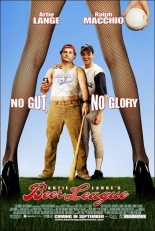
 What’s Tina Fey doing in a vehicle for a Howard Stern staffer? I know what Seymour Cassel’s doing — enjoying his face being planted in the giant breasts of a hooker — but Fey? The reigning queen of intelligent comedy? She has no business — not even at this one-line cameo level — being anywhere near a script that delights in throwing around “fucknuts” and “shitnuts.” Such is Beer League.
Also the co-screenwriter, Lange stretches to play a lazy schlub named Artie, who still lives with his mom (Laurie Metcalf), constantly smokes and drinks, and plays softball with his blue-collar Joisey friends — Ralph Macchio among them — in a two-bit league where he espouses such theories as “Practice is for fags.”
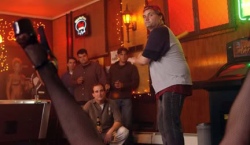 On and off the field, Artie’s rival is mayoral candidate Mangenelli (Anthony DeSando, New Jack City‘s Frankie Needles), mostly because the guy once slept with the loose girl (Cara Buono, TV’s Mad Men) for whom Artie has a soft spot.
Beer League reeks of sitcom scripting, where every line is a pitch at which Artie is to swing. Whether he hits depends upon whether you find his shtick — potentially racist, sexist and homophobic, but certainly simple — to be funny; I don’t. The Lange litmus test may be the movie’s use of porn star Keisha as a slab of bachelor-party entertainment known as Pitching Machine, so named for shooting ping-pong balls from her vagina. Batter up? —Rod Lott
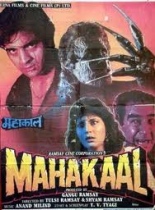
 If you thought Wes Craven’s
 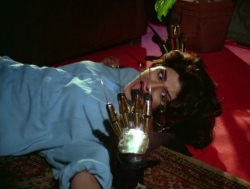 Anyhoo, Anita (Archana Puran Singh), the girl whose dreams he torments, resembles a Miami Sound Machine-era Gloria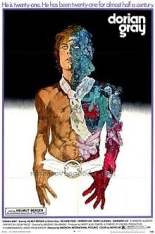
 Rather than being a straight (no pun intended) adaptation of Oscar Wilde’s
 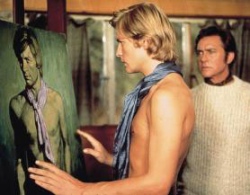 When an arrogant art buyer (Herbert Lom, the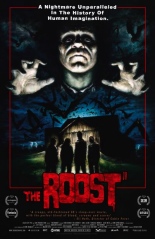
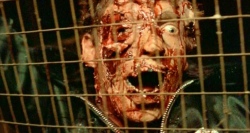 Yep, bats. Have such things ever been frightening on film? That was meant as rhetorical, but no, they haven’t, not in 1979’s
 As if Mark Hartley’s 2008 documentary,
  Chock full of interviews with the movement’s filmmakers and performers who remain alive (plus John Landis), the excellent Unleashed also considers the careers of Cirio H. Santiago (Savage!,