
Category Archives: Thriller

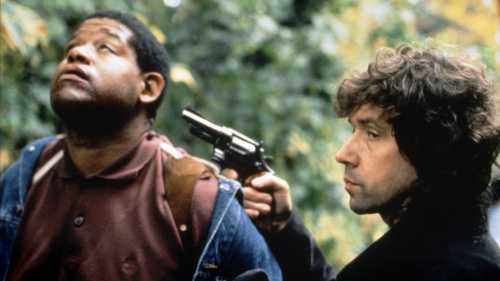
Judgment Night (1993)

The Judgment Night soundtrack was (and still is) one of my favorite soundtracks of all time, with rock/rap collaborations between Teenage Fanclub and De La Soul, Sonic Youth and Cypress Hill, and Helmet and House of Pain. Pick up a copy!

That being said, I’d never seen the actual movie Judgment Night until one recent afternoon. And you know, it’s not bad. If I had watched it in 1993, like I should have, I would have liked it quite a bit.

The plot is extremely simple: Emilo Estevez, Cuba Gooding Jr., Stephen Dorff, and, ugh, Jeremy Piven rent a luxury camper for a title fight in the big, bad, unidentified city. Looking for a shortcut to the bout, they come across Denis Leary and his goons trying to kill them, turning the dangerous streets in a small-time bloodbath, with the climax in a rundown department store or a Chinese warehouse — I can’t be sure.

With the exception of Piven, who is mercifully taken out in the middle of the film, it’s a good little urban survivalist film, with Estevez, Dorff and even Gooding on the top of their game — whatever that game is — with Leary playing against his acerbic comedian persona as a real menacing figure.

Sure, Judgment Night’s at the bottom of my list of great good action films list, but it is pretty darn entertaining with some real playful setups, like the whole scene at the apartment slums, and enough white-knuckle suspense to keep you on your toes. And even though it won’t be remembered for anything but the insane soundtrack, it’s a pretty good watch overall. Give it a try.

Earlier that year, Estevez and Leary were also in National Lampoon’s Loaded Weapon 1, a pretty perfect rip-off of the ZAZ formula that I happen to love. So Judgment Night should have been at least a rental — why did I miss this? And were Estevez and Leary the Hope and Crosby of their day? We’ll never know. Either way, get that soundtrack. —Louis Fowler

Get it at Amazon.

Tuner (2025)

Nothing against crime films in which the bad guys share names with subs and pizzas — your Fat Tonys, your Big Frankies — but it’s nice to see one that uses a simple Benny. That makes the movie feel more realistic. Not that I know anyone with an allergy to loud sounds as Leo Woodall’s protagonist suffers throughout Tuner, but hey, take your cinematic victories where you find them.

Woodall’s Niki is a piano tuner whose sensitivity issue requires him to wear noise-killing headphones. What the world sees as his disability actually provides him with a superpower: perfect pitch. It may also be his Kryptonite, once he accidentally finds his gift extends from Steinways to safecracking. Soon, a security company owner (Lior Raz, Glaidator II) for the toniest of clients hires Niki for freelance gigs that aren’t exactly — how to put this? — legal.

That’s great for Niki’s cash flow, but potential dynamite to his burgeoning relationship with a composition major (Havana Rose Liu, Lurker) he meets at one of his appointments — the on-the-up-and-up kind. In his fictional feature debut, Academy Award-winning documentarian Daniel Roher (Navalny) had me so invested in their fireworks, I was legitmately thrown for a second when the criminal element kicked back in.

If Tuner weren’t fantastic, the headline would be Dustin Hoffman’s return to the big screen in a high-quality project, here as Niki’s mentor and father figure. Instead, the news is three performers turning in breakout work that knocks Hoffman off said screen. Woodall (HBO’s The White Lotus) brings a sad, quiet intensity, while Liu brings feistiness and distrust to what could been a thankless window-dressing part, giving her character dimension and spark. And Raz is believably chummy one moment, terrifying the next, and back again.

If forced to pick a fourth standout, it’d be one unseen: sound. It — and often the lack thereof — is not merely integral to the story, but immersively so. The auditory experience is reminiscent of 2019’s Sound of Metal, but with a rap sheet. Sharp, tense and unexpectedly moving, Tuner is a thriller in the key of excellence. —Rod Lott

In theaters May 29.

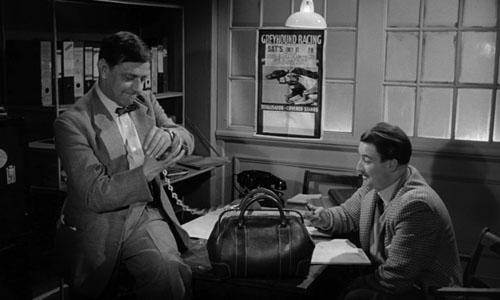
Strongroom (1962)

After a bank closes on Easter Saturday, three men burst in to clean out the safe. To help ensure a scot-free getaway, the trio locks the bank manager (Colin Gordon, The Pink Panther) and his cashier (Ann Lynn, A Shot in the Dark) in the vault.

Because the vault is airtight, the looters risk their simple robbery being upgraded to a double murder. One of the thieves (Derren Nesbitt, The Playbirds) has enough of a heart and soul to return to the scene of the crime to free the employees before they run out of oxygen. Through a series of extraordinary circumstances best left to your discovery, that proves easier said than done.

All of 80 minutes, Strongroom qualifies as a ticking-clock thriller, even though director Vernon Sewell (The Blood Beast Terror) approaches the material with a low-key manner typical of the British film industry’s buttoned-up B pictures of the era. In the second half, it even takes something of a sojourn into pavement-pounding detective work to allow a police sergeant (John Dearth, ITV’s The Adventures of Robin Hood) to assemble the puzzle. It’s confidently taut without breaking a sweat.

None of that is to be taken as a weakness. But if you’re looking for one, allow me to point you to the bank manager unwilling to dial or answer a telephone on his own, because that’s what women were for. Anyway, Stronghold: economic storytelling without surrendering anything in return, as one hell of an ending coldly corroborates. —Rod Lott

Deep Crimson (1996)

The salacious true crime story of the Lonely Hearts Killers in the 1940s was dramatized in the down-and-dirty flick The Honeymoon Killers, with Shirley Stoler and Tony Lo Bianco. (Surely, you’ve seen the far-out promotional images for that 1970 movie, right?)

Even though Killers was a slight precursor to John Waters’ comic misanthropy, it took director Arturo Ripstein — one of Mexico’s premier filmmakers — to really give it a sensational retelling in 1996’s dark and dour Deep Crimson, not to be mistaken for Deep Red, Crimson Peak or the pornographic Deep Peaks.

In 1940s Mexico, slightly overweight nurse Coral (the brilliant Regina Orozco) leads an extremely unhappy life. She not only is a single mother of two young kids, but has monstrously bad breath. Her only sexual outlet is to feel up her comatose and disabled patients, and she’s obsessed with actor Charles Boyer, an obsession that plays to her disembodied fantasies of leading a full life.

On the other side of town, Coral meets a man named Nicolás (a swarthy Daniel Giménez Cacho). He’s dangerously slick, well-toupéed and, of course, also seriously lovelorn. After a brief meeting and a slice of cake, they make passionate love and fall head over heels in love. So, what do they do next?

They send her kids to the orphanage, then immediately find a drunken woman to kill with rat poison. After dumping the stranger at a train station, they continue their murderous streak, conning elderly women and taking out their liver-spotted bodies Their worst act is an old-time home abortion that cumulates in the bathtub drowning death of a 4-year-old.

This being 1940s Mexico, justice is appropriately dealt. Cut to credits.

Having seen only a few of Ripstein’s genre films — the severely spooky La Tía Alejandra being the creepiest — I found the impact of the couple’s crimes, combined with the damaged psychology of the mother, makes Deep Crimson a truly engaging movie, especially for Orozco, whose performance always rides the tenuous line between depressive love to maniacal woe. Turning subversive love and perverse longing into a real necessity, Deep Crimson is a dry, dusty tale told through the perceptive lens of the sterile Mexican desert. Ripstein tears apart the Lonely Hearts Killers’ story and rebuilds it the way should have been done right from the beginning. —Louis Fowler

Get it at Amazon.

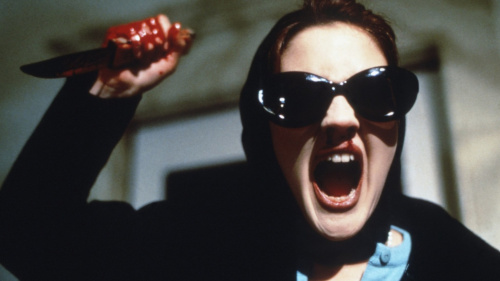
Confessions in Static (2025)

Told through interrogations, surveillance tapes and general camcorder clowning, Bob Freville’s Confessions in Static isn’t your usual found-footage project. Despite teaser trailers selling otherwise, it isn’t even horror, but a crime story in which the wattage matches the fidelity of the format.

Four friends — including an annoying conspiracy bro and a loathsome crypto investment bro — are questioned separately about the events of Easter weekend, particularly their whereabouts in relation to the Dekker house, the site of a famous Long Island murder spree. As we’re shown via the pals’ videos, which are intercut with the third-degree questioning in a nonlinear fashion, they’re sickened the home is now exploited as an Airbnb to true-crime fanatics, so they decide to do something about it.

While certainly interesting from a square-one premise, Confessions in Static covers acres and acres of conversational ground — from philosophy and dark tourism to Kitty Genovese and Pootie Tang — before viewers are able to form a baseline of understanding, Once you’ve got your bearings, though, you have the twist figured out, halfway before arrival.

That might not be such a problem if the dialogue throughout weren’t so stilted and ostentatious in the key of Kevin Smith, where everyone’s a comedian. It might work for one character, but not all characters, especially as the cast members struggle to deliver lines in the manner intended. Then again, Freville hails from the not-for-everyone’s-taste world of bizarro fiction, where not everything has to jell … and doesn’t. That explains why Static often feels a couple steps removed from the experimental — perhaps the best way to approach it. —Rod Lott

Get it at Janice.Click or Relay.