
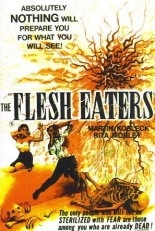
 Decades before the flesh-eating virus jumped from science fiction to science fact, there was The Flesh Eaters, the only film from director Jack Curtis (better known as the voice of Speed Racer‘s Pops) and screenwriter Arnold Drake (better known as the DC Comics creator of Deadman and Doom Patrol).
In the prologue, a guy toys with woman by tearing off her bikini top, for which he’s punished by succumbing to flesh eaters of the title. But it’s really about a for-hire pilot (Byron Sanders) whose plane and passengers become stranded on an unprotected island. Their first night marooned, he tells his fare — an alcoholic actress (Rita Morley) and her comely assistant (Barbara Wilkin, who looks fantastic in a bra) — “I can assure you, we are in for a good pounding.”
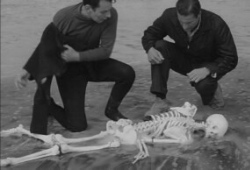 And how! Their horrors begins by finding a whole human skeleton on the beach, grasping that aforementioned bikini top. Then there’s the glowing fish bones. It’s all due to the “silver stuff” in the water that results in some nifty, surprisingly gory effects on the skin it touches. A beatnik (Ray Tudor) wearing rope sandals doesn’t heed their warnings at first: “Where’s the love, Max? Don’t tell me about that ugly jazz!”
If you think the Nazis may have something to do with it, apply now for your Flick Attack gold star! The person behind it all explains as much when he contracts diarrhea of the mouth. The movie’s 87 minutes spew just as quickly, and the sicko in me wishes the thing were in bloody color. —Rod Lott
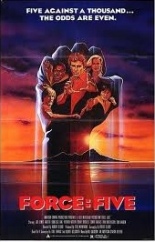
 After you’ve made the best and worst Bruce Lee movies —
 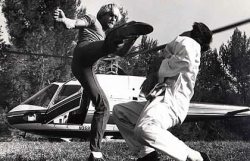 They include poncho-clad Billy Ortega (kickboxer Benny Urquidez); big, black cyclist Lockjaw (Sonny Barnes,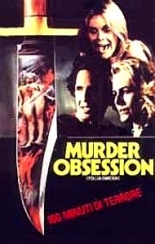
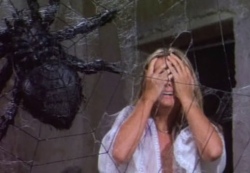
 For some R&R after wrapping a movie, mustachioed prick actor Michael (Stefano Patrizi) takes his girlfriend, Deborah (Silvia Dionisio), and select fellow cast and crew members to the spooky, middle-of-nowhere mansion where he grew up. His ailing mother (Anita Strindberg) still lives there, despite the home being the spot where Michael, as a child, fatally stabbed his maestro father for beating up Mom.
 The final film for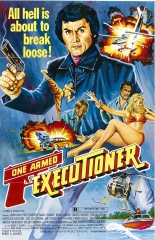
 It’s hard to hate a movie whose first scene depicts a tough guy trapping a Filipino midget in a phone booth and throwing it into the bay. As the box goes splash, the film freeze-frames to announce its awesome title:
 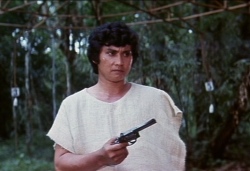 As spoiled by that title, Ortega isn’t about to take his handicap lightly. Trained by the Philippines’ equivalent of Tommy Lee Jones, he becomes a ruthless warrior, albeit one with a sleeve flopping around. Ortega then goes hunting for Edwards (“What balls!”), whose boat bears a swastika and who keeps a henchman on staff whose sole purpose is to act as a human thesaurus. (His lone African-American henchman is dubbed by a redneck.)
 But you also get a surprising amount of flair. Director Jason Eisener is a real talent, using a grittily gorgeous color palette that recalls giallo at its most vivid, and if his script is intentionally silly, it also has a sly wit (at one point, a newspaper headline reads, “Hobo Stops Begging, Demands Change”). While the movie is constantly cranked to 11, Eisener takes everything to another level altogether with The Plague, a pair of armor-clad hit men who may or may not have killed Jesus Christ (if a freeze-frame of their lair is any indication).