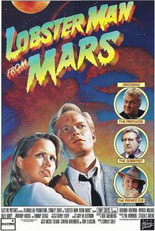

Lobster Man from Mars (1989)

Co-opting more than a cue from Mel Brooks’ The Producers, a studio mogul played by Tony Curtis faces debt so deep, his only hope is to make a movie guaranteed to fail in order to claim it as a tax write-off. In walks a nebbish kid filmmaker (Dean Jacobson, Child’s Play 3) with his latest opus, a 1950s-style sci-fi cheapie called Lobster Man from Mars.

As you can guess, Lobster Man tonally plays like the titular spoof of Amazon Women on the Moon. But that all-star comedy has the good sense to include about 20 other sketches. This sticks to its one, only occasionally cutting to the studio screening room where Curtis watches the mess unspool. The look on Curtis’ face is so pained, one can infer he’s thinking of the great works of art he used to be in, like Stanley Kubrick’s Spartacus, Billy Wilder’s Some Like It Hot and Janet Leigh’s cleavage.

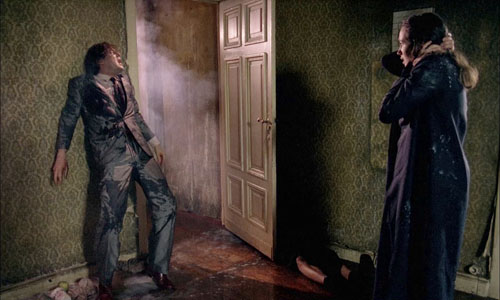
In the movie within the movie, the red planet’s king (Bobby “Boris” Pickett of “Monster Mash” fame) sends the giant crustacean creature (S.D. Nemeth, RoboCop) to Earth to steal our air supply. Witnessing the alien’s crash-landing are an all-American sweater girl (Valley Girl’s Deborah Foreman, adorable as ever) and her British beau (Anthony Hickox, Foreman’s Waxwork director). Few believe their story, other than Tommy Sledge, P.I., played by comedian Tommy Sledge, which is to say he performs his stand-up routine parodying noir detectives. He’s also the best part.

I put off seeing Lobster Man from Mars for decades because I had my fill of its trailer while working at Blockbuster Video in college. For months on the store’s overhead TVs, management played a preview tape with a spot pairing the movie with Girlfriend from Hell, presumably due to their schlocky titles. With the opening notes of “Rock Lobster” announcing its arrival, I heard it multiple times a shift. To this day, any second of The B-52s’ hit elicits a Pavlovian shudder, although the flick uses a soundalike band in place of the real cosmic thing.

There’s a reason the radio version of “Rock Lobster” trims two minutes or more. I bring that up because here, Stanley Sheff (Vincent Price: The Sinister Image) and co-writer Bob Greenberg grossly misjudge audiences’ tolerance for their lampoon. It suffers from the same problem as Attack of the Killer Tomatoes!: The joke just isn’t good enough to drag into lollygagging territory, wearing my goodwill down so much, I turned on it. That leaves me without the patience to discuss Billy Barty in swami get-up, narration by Dr. Demento, a clown named Nose-O, former Playboy Playmate Ava Fabian, future Price Is Right model Mindy Kennedy, Robot Monster’s space gorilla or opening credits that feature scissors-cut faces of the actors next to their names. —Rod Lott


Get it at Amazon.

Possession (1981)

While it might be one of the most recent examples, Coralie Fargeat’s The Substance was hardly the first film to use bizarre and outlandish horror to earn critical acclaim. Possession isn’t necessarily the first, either, but you’d be hard-pressed to call 100-plus-year-old flicks like The Cabinet of Dr. Caligari and Nosferatu even remotely as jarring Andrzej Zulawski’s plunge into one of the worst breakups imaginable.

That’s not hyperbole, either: Like, have you lost a spouse to a free-loving German karate expert, only to find out later your ex also left him for — spoiler — a primordial, tentacled man-beast that feeds on human flesh? (If you have, please contact us.)

After wrapping his latest mission and coming home to West Berlin, Mark (Sam Neill, Event Horizon), likely the most mundane international man of mystery, is greeted by his wife, Anna (Isabelle Adjani, 1979’s Nosferatu the Vampyre), with the news she wants a divorce. Mark naturally goes on a skin-crawling bender, but snaps back to reality after realizing Anna has left Bob, their young son, by himself and on the verge of neglect.

They loosely attempt to mend things for Bob’s sake, but they mostly just harm themselves with an electric meat carver instead. Mark tries to move on with the help of Helen, Bob’s schoolteacher who suspiciously looks like Anna (and is also played by Adjani), except for her lighter hair and greener eyes. Meanwhile, Anna rents a dilapidated apartment that practically pushes against the Berlin Wall to look after her latest, more monstrous lover.

Dichotomies define Possession. Anna and Mark both vie for better versions of themselves. The former struggles with trying to reconcile her “Faith” and her “Chance” before “Faith” violently ejects itself from her uterus in an empty subway. The latter, however, forces himself to step up as a more present father, only to inevitably devolve into a self-destructive lunatic. All of which, appropriately, takes place in a physically and politically divided city. If Wim Wenders’ Wings of Desire is an examination of how to potentially heal Berlin’s scar tissue, Possession is a nosedive into its festering wound.

What grounds the film is a pair of performances that shift on a dime. Adjani absolutely outshines Neill, but both show a physical and emotional toll from filming that rivals — and even matches — the very real distress seen from Shelley Duvall and Jack Nicholson just a year earlier in Stanley Kubrick’s The Shining.

Most will point to Adjani’s subway sequence, where Zulawski simply told her to “fuck the air,” as one of the main justifications for her Best Actress win at the 1981 Cannes Film Festival. And they wouldn’t be entirely wrong, but the scene just before that, where she whimpers and whines at a statue of Christ, might be even more telling of her character’s condition. Anna essentially begs for some answer to chaos, for some cosmic force to “fix” the calamity that’s tearing her and every relationship she has apart. But all she’ll ever get is a stone-cold stare from yet another man (or even a symbol of a man) who has no chance of understanding her. And no chance of helping, either.

Scholars have managed to dissect almost everything about Possession, and yet it still persists as a bizarre, mysterious and even schlocky horror drama. Maybe that’s what makes it so challenging. Even as touching and shocking as movies can be, this feels like something different and perhaps more intrusive. It’s like putting the saddest song you can think of from The Cure or Nine Inch Nails on loop, with every iteration getting a few seconds slower until it’s incomprehensible two hours later.

Possession is a free fall into an emotional chasm. You’ll catch your head on a protruding rock every few hundred feet. Eventually, you’ll forget that you ever stood on solid ground. —Daniel Bokemper

Get it at Amazon.

Redneck Miller (1976)

A radio DJ conveniently named DJ Miller is at risk for being squelched after his flame-emblazoned motorcycle is, unbeknownst to him, “borrowed” to steal a shipment of dope belonging to local drug kingpin Supermack (Lou Walker, 1979’s The Visitor). Presumably named after Super Fly, this gangster looks like that blaxploitation icon on a Whataburger Patty Melt diet.

In between ducking Supermack’s jive-talking henchmen and deposits of dynamite, Miller stops to aid a stranded female motorist. She offers to pay, but Miller refuses cash; instead, he says he’ll take it out in trade, and forces her into some backseat bangin’. Mind you, this is played for laughs. Also mind you, the woman is Supermack’s best gal, thus further enraging the smack slinger.

Al Adamson regular Geoffrey Land (Blazing Stewardesses) has no charisma as Miller, who hops around the clubs and beds of Charlotte, North Carolina, like he’s King Shit. Dude, he’s a DJ. And it’s not like we’re talking Wolfman Jack territory here. IRL, Mr. Miller would be appearing at an appliance store’s “everything must go” inventory sale, then doing spokesman duty on an UHF TV commercial for a roofing company, and maybe introducing the sneak preview of Silver Streak at the twin-screen bijou.

From Summerdog director John Clayton, the hicksploitation obscurity Redneck Miller is most likely to find favor with those who delight seeing a honky outsmart a bunch of Black guys for 90 minutes. It’s pretty dull. You really have to be into banjos, slide whistles, ahooga horns, canary-yellow bedsheets, floral-print couches, stars-and-stripes trucks, astrological necklaces, shag carpets as wall art, pool halls with Elton John posters, canned Schlitz, fake tits and those rock-hard stuffed animals people “win” at carnivals. In other words, not I. —Rod Lott

Get it at Amazon.

The Man Who Saw Tomorrow (1981)

Of all the outré mysteries of the unknowable, the prophecies of 16th-century mystic seer Michel de Nostredame — or, as we now call him, Nostradamus — fascinate me. Mostly, I was a weird kid about him. 

In sixth grade. I wrote a book report on the translated The Prophecies in Nostradamus’ lauded quatrain style. Getting an A- on it did me no favors in the “cool” department of my class, making it longer even until I got a kiss from a girl or a 1500s prognosticator.

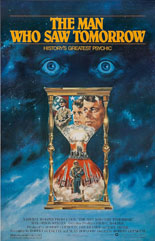
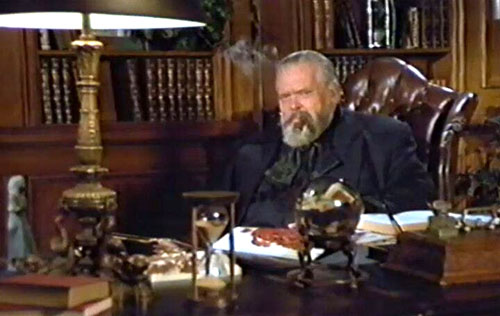
I got into Nostradamus after seeing the “documentary” The Man Who Saw Tomorrow at 3 a.m. on cable, only to rediscover it on VHS at my local library, like a sign from a prognosticator’s divine divining bowl. With tensions overflowing in Iran and the Middle East at this very moment, it’s been reintroduced into my life by YouTube. Bloatedly narrated by Orson Welles and four decades later, it’s pretty terrible. How did this movie scare me for so long?

Much like those unexplained docs from Rod Serling and the Schick Sunn Classics people, Tomorrow starts with three 1700s “skeptics” drinking from Nostradamus’s skull, which apparently was cursed. Fair enough, but it’s not brought up again. Drunk on wine and smoking a cigar, Welles says Nostradamus “mystified scholars” as he studied the intrinsic  kabbalah, braved the plague and, in his spare time, wrote the prophecies that are kind of vague, but in context, also totally accurate … right?

Most people know Nostradamus’s prophecies about Napoleon, Hitler (also called “Hister” in the movie) and the JFK assassination. But what about those of the future in 1981? Well, here’s the highlight reel:
• 1986: Worldwide Famine!
• 1988: Earthquake Will Decimate Los Angeles!
• 1994: World War III Begins!
• 1999: The King of the Mongols Is Revealed to Be the Third Antichrist!

When that final date passed over us, a small discharge of prophetic relief came over me, letting me know it was going to be okay. The Man Who Saw Tomorrow movie is a cultural oddity, when lots were cast and such things were left to the passing of time and phew, it’s all hokem.

Except it’s not anymore. It’s now playing out like Nostradamus and Welles said it would, with one exception: The Antichrist wears a blue suit and red tie. Or maybe this movie was a quick and easy way to make money by making people scared. I guess we’ll soon find out. Or maybe we won’t. —Louis Fowler

Get it at Amazon.

Watari, the Ninja Boy (1966)

Watari, the Ninja Boy is based on a classic Japanese manga, which I could tell just by looking at the kid’s haircut. Played by Kaneko Yoshinobu (who was a different child ninja in the similar, superior Ninja Scope), Watari lives with his sickly grandfather, plays the flute, jumps around, swings on ropes, flies through the air, walks up trees and, in a musical number, even grows to Jolly Green Giant height to touch a rainbow of Skittles.

But mostly, with the aid of his trusty metal ax, whose blade is bigger than his head, Watari spends his days and nights warring against adult ninja and monster ninja who want to kill him. He also decapitates a black cat, but TBH, that pussy had it coming.

Watari undergoes a litany of traumas in these colorful adventures, including surviving an earthquake, sinking in quicksand, finding dead dudes floating in the river, seeing a naked lady and meeting a grown man with lots of eye shadow.

Needless to say, this is one weird kiddie matinee — one that begins with a blue-skinned ninja losing his tongue for breaking the law. It’s also confusing, what with all the Japanese names thrown around of this clan and that clan, and not knowing who belong to which. Even with the benefit of crisp English subtitles, I was all like, whaaaaaaaaa … —Rod Lott

Get it at Amazon.

Random Genre & Cult Movie Reviews