
Cotton Comes to Harlem (1970)

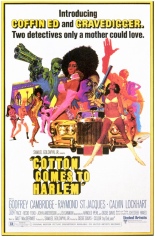
Although often lumped in with the blaxploitation films of the period, Ossie Davis’ Cotton Comes to Harlem feels a lot less Superfly and a lot more like a classic ’70s buddy cop movie, albeit one set in a Harlem where the possibility of a race riot is always just a few minutes away. The result is one of the most entertaining films the period produced.

Based on a Chester Himes novel, Cotton stars Raymond St. Jacques and Godfrey Cambridge as Coffin Ed Johnson and Gravedigger Jones, two police detectives whose detached cynicism is only matched by their sense of justice. Viewed by the black citizens they serve as Uncle Toms in cahoots with a racist police force, and by their white co-workers as black troublemakers who don’t know their place, they’re classic outsiders who aren’t above breaking the rules (and law) to do what they know is right.
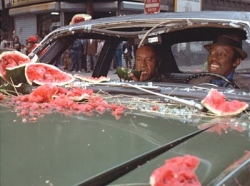
In this case, it’s finding the $87,000 “stolen” from crooked Rev. Deke O’Malley (Calvin Lockhart), who has promised credulous investors that their funds are going to the construction of a boat to take them back to Africa and away from the racism they have to deal with everyday. Once it’s determined that the money has been hidden in a bale of cotton retrieved by kindly street person, Uncle Bud (Redd Foxx), the race is on between Johnson and Jones to find it before the bad guys.

Despite touching on some rather heavy social themes, director/co-writer Davis keeps the tone light and often comic, thanks to the efforts of his talented cast. The soundtrack also features standout work by Galt MacDermott and is worth buying on its own. Two years later, St. Jacques and Cambridge reprised the roles in Come Back, Charleston Blue, a sequel Davis on which chose not to work. —Allan Mott


Buy it at Amazon.

Audition (1999)

Few movies will make you happier to be married than Audition. I mean, wives may eat your souls, but they don’t cut off your feet with razor wire, amiright, fellas?

Seven years after the death of his wife, sad single dad Aoyama (Ryo Ishibashi, War) is under pressure to remarry, but afraid he’ll be unable to find his true ideal in his middle age. He agrees to an odd ruse by which he’ll pretend to be auditioning women for a movie, so he can bombard them with a litany of questions, and then hone in on his favorite later.

That chosen one is 24-year-old former ballet dancer Asami (Eihi Shiina, Tokyo Gore Police). Abused as a child, the quiet, mild-mannered and plainly pretty woman barely can make eye contact; nonetheless, Aoyama is smitten. He’ll soon wish he weren’t, because this girl is a freak. And not in the bedroom way.

Audition is one of those movies that would be best to see going in completely cold, because Japanese maverick Takashi Miike lulls you into thinking his film will be about something else, only to slam you into something quite the opposite more than hour into it. Unfortunately, you can’t, because the freaking posters and DVD covers give the twist away; however, the pain is not as bad as you’ve been led to believe. In other words, it’s no Guinea Pig, and thank God.

Mind you, it’s still powerful and tough to forget. You’ll never eat a bowl of dog vomit again. —Rod Lott

Buy it at Amazon.

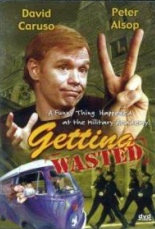
Getting Wasted (1980)

Near-albino Brian Kerwin (clearly the Jeff Daniels of his day) has to join a military academy after getting expelled from high school. The year is 1967, where there’s a long-haired hitchhiker on every corner and cars have bumper stickers reading “GOD IS ALIVE … AND HE LIVES IN A SUGAR CUBE!”
Kerwin and his roomies smoke banana peels, dump manure confetti on a gym full of dancers, and meet a hippie artist with a fake parrot on his shoulder wearing a button that reads “STONED” (the parrot, not the artist). One of Kerwin’s roommates is traumatized by trains, so he tries to derail one by smearing pats of butter on the tracks.

Stephen Furst (Flounder from Animal House) sits on a toilet filled with gasoline and it explodes. While home for Christmas vacation, Kerwin throws flaming tires from a moving car with elfin pal David Caruso, and his mom cooks their family dog in her new microwave.

If you’re looking for a story arc, don’t; that requires having a story first. The soundtrack boasts actual hits from The Box Tops, Steppenwolf, The Mamas and the Papas, The Rascals and Booker T, among others. Getting Wasted is a framework rather than an actual movie, but then, most movies don’t have a grade-school drug dealer, now, do they? —Rod Lott

Buy it at Amazon.

Sisters (1973)

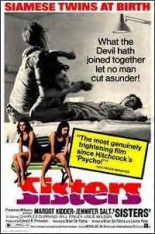
Brian De Palma sure loves exploring the idea of doubles, duplicates and just plain dupes, and Sisters is one of his finest and earliest such ventures. Opening with a sly trick pulled on his viewers, the psycho thriller centers on French-Canadian model/actress Danielle (Margot Kidder, so good I temporarily forgot she was Superman’s Lois Lane), who’s struggling to make it in New York.

She’s also struggling with the guilt piled upon her by her twin sister, Dominique, especially when Danielle brings home a date (Lisle Wilson, The Incredible Melting Man), which also irks Danielle’s jealous ex-husband, the odd-looking (to say the least) Emil (Bill Finley, Eaten Alive).

It’s difficult to discuss Sisters without spoiling the story’s several twists, so I won’t go beyond details further than Danielle’s across-the-street apartment neighbor, journalist Grace Collier (Jennifer Salt, TV’s Soap, saddled with horrible ’70s hair), witnessing a murder through the window. This allows De Palma to explore his other cinematic obsession: voyeurism.

Call him a Hitchcock rip-off artist if you like, but to do so would be to short-change yourself from a gripping mystery made all the more disturbing by Bernard Herrmann’s score. De Palma established his split-screen storytelling device here — not just a gimmick, but an effective tool to tighten the screws of suspense on his audience. And that he can wield a considerable amount of tension out of a simple act of icing a cake is … well, icing on the cake. —Rod Lott

Buy it at Amazon.

Tarzan and the Valley of Gold (1966)  

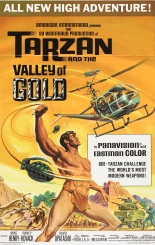
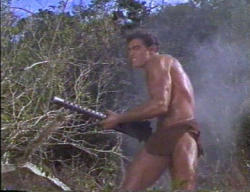
The poster for Tarzan and the Valley of Gold shows Tarzan taking out a helicopter with bolas made from hand grenades. Since this actually happens in the movie, it is a perfectly acceptable thing to put on a poster. It is not, however, the most awesome thing to happen in it. That would be in the first 10 minutes, when Tarzan kills a henchman with an 8-foot bottle of Coke.

In the ’60s, the franchise ran out of ways to have white people plunder the jungle so Tarzan could stop them. Actually, they ran out of new ways to tell that story in the ’40s; it just took them another 20 years to do something about it. And it took Sean Connery to show them how.

The popularity of the James Bond movies created countless rip-offs and spoofs, but none more awesome than the 007-influenced Tarzan films, especially the ones starring former pro linebacker Mike Henry, in which a dapper, literate Tarzan visited the jungles of the world, making friends and fighting crime. Valley of Gold was the first of such films and opens with him arriving in Mexico, suited up, and met at the airport by villainous goons à la Dr. No.

It’s a short trip from there to giant beverages, grenade bolas, forming a tracking team of wild animals, discovering a lost civilization, and swinging through the trees to a tune that would make Austin Powers jealous. —Michael May

Buy it at Amazon.

Random Genre & Cult Movie Reviews