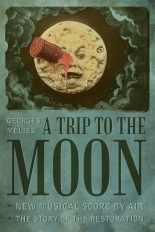
 With roughly 14 minutes, no sound and the barest of film technology, Georges Méliès sure did pack a ton of stuff into A Trip to the Moon (Le Voyage Dans La Lune if you’re French), the world’s first science-fiction film.
After a wizard demonstrates via chalkboard the path their rocket will leave Earth and land on its near-instant journey to the lunar body, laborers build the metallic capsule. Once complete, with much pomp and circumstance, it’s loaded into a giant phallus of a cannon by chunky ladies in short pants and Buster Brown hats. With half a dozen rich, old white men as passengers, it lands with a bloody thud into the right eyesocket of that creepy, creepy moon face.
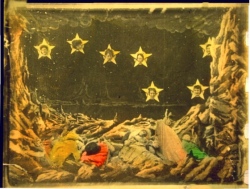 The would-be astronauts climb out — clutching canes, but no oxygen tanks — and wave to their friends back on Earth. Then, being white-haired and all, they bunk down and sleep, wake up to a storm of stardust, and climb into the moon’s underground garden of oversized mushrooms, where hopping demons scoot their butts across a log like a dog with troubled anal glands does to your carpet. Our Earth warriors beat the crap out of them (they go up in puffs of smoke) and high-tail it home, only to land in the ocean. They get a parade in their honor, and probably got crazy laid.
Kidding aside, Méliès’ imagination is as off-the-charts as his ingenuity. Repopularized by Martin Scorsese’s Oscar-winning Hugo, the cinema classic is best viewed in its 2011 restored form, containing its original, hand-colored images and with missing frames mimicked. It also now boasts a score by Air that’s — dare I say it — out of this freakin’ world. This Trip truly is one. —Rod Lott

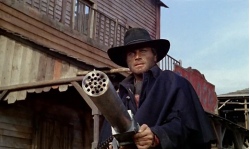

 As Gilles in


 Maybe I’ve seen too many gory horror flicks (guilty, your honor!), but
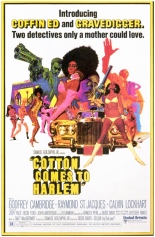
 Although often lumped in with the blaxploitation films of the period, Ossie Davis’