
Exorcismo (1975)

Exorcismo may not have existed without The Exorcist, but it’s hardly a rip-off. Only in the final minutes does it feel like an imitator, with Paul Naschy’s Father Dunning tossing streams of holy water and Scripture at the babe in the bed amid smears of puke, but he actually spends more time battling a German shepherd (Gero, per the end credits).

The Regan MacNeil of this Spanish bedeviler is Leila (Grace Mills, Night of the Howling Beast), a young woman whose family believes hasn’t acted the same since her archeologist fiancé, Richard (Roger Leveder), returned from Africa. He’s the kind of guy whose apartment is decorated with voodoo masks and a blue cabinet on which red-paint letters read, “ALL YOU NEED IS TO FUCK.”

Once cast members are found with their heads rotated at a clean 180˚, Dunning investigates. Leila exhibits flashes of tempers and contorts like a seizure victim, but only Leila’s sister (María Kosty, Night of the Seagulls) brings up the possibility of possession. That certainly would explain Leila’s attendance at fully nude funk-sex-occult parties in the ruins of a nearby castle!

Viewers hoping for a satanic shocker are likely to be disappointed. Overly talky, Exorcismo offers few big moments, but they are there. In one, Naschy hallucinates a snake emerging from the faucet; in another, Leila shows up all milky-eyed, pustule-skinned and crusty-lipped at the bedside of her smokin’-hot mom (Maria Perschy, The Ghost Galleon). Atmosphere comes less from director Juan Bosch than composer Alberto Argudo. Watch up to the final split second for a puzzling quick trick. —Rod Lott


Buy it at Amazon.

The Watcher (2000)

The Watcher is not good. Forgive the unoriginality of that opening sentence, but it’s far more original than the film itself.

Acting druggy as ever, Keanu Reeves is a serial killer who taunts cop James Spader (whose lazy eye I’d never noticed) by sending him photographs of his next victim, giving Spader and crew 24 hours to try and locate the intended murderee in time. Hardly figuring in to the instantly forgettable plot is Marisa Tomei, looking uncharacteristically puffy and tired, as Spader’s psychiatrist.

You see, Spader is haunted by a particular murder committed by Reeves in the past that he was unable to stop. This has caused him to become some sort of drug addict, resulting in one of the film’s many clichés — namely, that swallowing pills is really hard and requires one to throw his neck back to a perfect right angle and grimace uncomfortably as if the capsules were laden with porcupine quills.

The Watcher also dredges up the equally tired and unrealistic scenes of phone calls that end without the person saying “Bye” or any farewell of the kind; car chases where the one automobile that whips into traffic never gets hit, but causes several crashes; and tape recorders that always rewind to the exact point needed, and never in the middle of a sentence. Slick and glitzy, yet still workmanlike, The Watcher smacks of a director who got his start in music videos, and sure enough, Joe Charbanic did. Thus, you get hilarious, slow-mo scenes of Reeves dancing while holding a gun, not to mention enough photography flashes to cause seizures. —Rod Lott

Buy it at Amazon.

The Toy Box (1971)

The Toy Box is an utterly bizarre mix of sex and horror, and I fully admit to watching it only because Uschi Digard is in it, as I’ll see anything to which she and her charms lent time. Uschi isn’t the star, but she does have the film’s most memorable scene. (Seriously, have you seen her? How could she not?)

The story is about an old scraggly guy who looks not unlike Burl Ives. He has no eyes, sits in a dark room and telepathically has various young people carry out his most twisted sexual fantasies. Said fantasies include having a woman pleasure herself with a new dildo (“It turns on easy,” she says. “Hopefully it will do the same for me.”); having a fat guy butcher and copulate with dead women; and having a bunch of partygoers have an all-out orgy, despite the severed heads that pop up from nowhere and bodies that fall dead without explanation.

In Uschi’s aforementioned scene, she goes to bed, only to have the bed come alive to feel her up and before you know it, she’s screwing the sheets.

Reportedly, The Toy Box boasts a must-be-seen-to-be-believed twist ending, but unfortunately, the copy I was watching pixelated and froze before I could reach it. If what I did see was any indication, I’m sure it’s wild. But if you’ve seen the ending and can fill me in, please do. In the meantime, I’m on to more Uschi … —Rod Lott

Buy it at Amazon.

Warlock: The Armageddon (1993)

Watching this sequel to 1991’s Warlock, I started to wonder if maybe a young Michael Bay had seen it before debuting with 1995’s Bad Boys. The third film by second-generation director Anthony Hickox (Waxwork), this second entry in the Warlock mythos not only shares part of a title with one of Bay’s films, but displays all of the same stylistic hallmarks that have made Bay both one of the successful and hated filmmakers of his generation.

Filled with pointless close-ups shot at strange angles, hilariously dramatic pull-ins and a complete sacrifice of character in favor of constant momentum, Warlock: The Armageddon, like most of Bay’s work, plays less like an actual movie than an abridged version of one with all of the potentially boring bits cut out.

And that is so not a bad thing.

For those of you concerned about the plot, the film features a returning Julian Sands as the titular villain, an Antichrist who rises in anticipation of a long-awaited lunar eclipse and who must find a collection of ancient stones in order to help his father, Satan, escape from Hell and take over the living world. Stopping him are Chris Young (TV’s Max Headroom) and Paula Marshall (whom you know from a dozen cancelled shows … and my dreams), the youngest descendents of a tribe of California druids, whose deaths and subsequent resurrections make them the only warriors powerful enough to halt Sands in his tracks.

More goofy than scary, the movie features a lot of dated effects, but is made highly watchable, thanks to the game cast and Hickox’s stubborn refusal to give you enough time to dwell on the film’s many absurdities and enormous plot holes. Consider it a film for those of you who wish a certain “director” would stop wasting his “talents” on racist toy-robot sequels and get back to the gloriously stupid basics. —Allan Mott

Buy it at Amazon.

Nancy Drew and the Hidden Staircase (1939)

Being the most pure mystery of the bunch, Nancy Drew and the Hidden Staircase is arguably the most enjoyable entry of the four-film franchise, even if the leads’ antics are entirely rote by now. The important thing is, they still amuse, and go out on a high note. It’s kind of a shame there weren’t more.
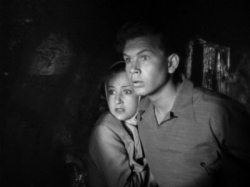
In this adventure, two sister spinsters announce plans to donate their estate to a children’s hospital. The catch is their father once upon a time designated they must live in it every night for 20 consecutive years, and now, they have roughly two weeks to go. When their chauffeur turns up dead, it’s obvious to us someone’s trying to scare them away by murdering the man and, thus, foil the old maids’ good intentions.

To the loony, incompetent authorities, however, led by Capt. Tweedy (Frank Orth, The Lost Weekend), it’s a long jump to a conclusion of suicide. Luckily, Nancy (Bonita Granville) and platonic pal Ted (Frankie Thomas, whose lower register suggests dropped testicles post-Nancy Drew … Trouble Shooter) appear on the crime scene to fiddle with pieces of evidence and plant a false one. Oh, kids!

When Nancy learns the twist — the one we get from the start because, oh, y’know, it’s in the title — she exclaims, “Boy, isn’t this a pancake!” And that sums up the clean-behind-the-ears appeal of this picture, strengthened by anachronistic plot devices as ice delivery and telegrams. At an hour long, Staircase is hardly taxing. To borrow another two dated exclamations that could sub as a review, “Swell!” and “Hot diggity!” —Rod Lott

Buy it at Amazon.

Random Genre & Cult Movie Reviews