

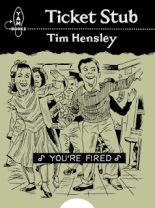
 Tim Hensley’s Ticket Stub is a collection of the cartoonist’s now-defunct zine, but that zine was really pages from his sketchbook. Don’t let that deter you in any way, however, because it has a theme and a point.
The backstory: For 10 years, Hensley worked as a closed-captioning typist for movies and TV shows. In his sketchbook, he would draw random scenes from said programming. Those pages became Ticket Stub the zine, and all eight issues now stand united like conjoined twins in Ticket Stub the book.
For those who love indie comics, oddball ideas or the medium of film — or, better yet, all three — the paperback will bring many a smile, and not just for its charming, wholly appropriate die-cut along the bottom edge. (That had to be an unnecessary expense for Yam Books, especially for such an upstart publisher, but damn, am I glad they sprung for it — a creative decision that just feels right.)
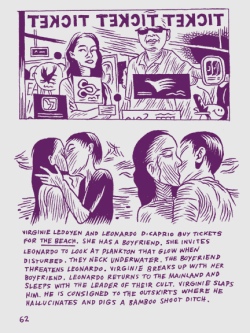 The scenes Hensley illustrates are not iconic; they appear to be chosen as haphazardly (if “chosen” is the correct term) as the films, which range from highbrow to lowbrow, classic to trash, beloved to obscure, Butterfield 8 to Big Momma’s House.
Each is accompanied by a few lines of Hensley’s own contribution. Some double as actual description, such as this bit on Hercules in New York: “A bear costume escapes the zoo and meets their carriage. Hilarity ensues — an Olympian in a taxi, or rather, a chariot, flexes. He kicks the shit out of sailors, drivers, mobsters. He cracks ribs.”
Most, however, read like bad poetry on open-mic night, and in this case, that’s a good thing indeed. Witness his words for The Care Bears Movie: “Bereft of pals, gather a gumshoe, a cigar between the plush pandas, a black widow knit near the wagon wheel and share — the clouds and rainbows mar with crevice. The witch concurs.”
The final issue takes a detour by stringing the panels together into a comic, but with invented dialogue. Why else, where else, would Casper the Friendly Ghost greet a girl with, “I was shot in my crib. Do I give you goose flesh?”
If you’re only familiar with Hensley — as I was — through his retro-teen-comics work à la Wally Gropious, note that this art does not resemble that art. The drawings here — far more fleshed-out than the word “sketchbook” suggests — demonstrate a different skill set and wider range. The witch concurs. —Rod Lott
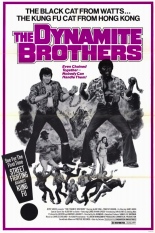
 Leave it to schlock director Al Adamson (
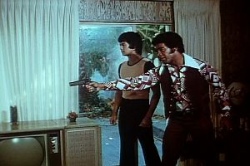 The duo gets mixed up in a drug war too complicated for the film to adequately explain. Needless to say, the cop after them (Aldo Ray,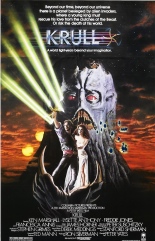
 Even as a kid, I knew
 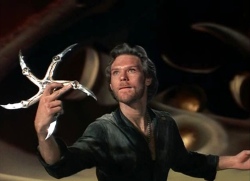 If nothing else, I would love Krull just for its part in one of my favorite geek jokes of all time, a quick visual gag on TV’s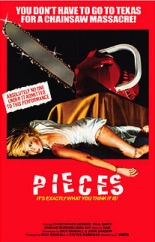
 A young boy is caught by his mom working on a nudie jigsaw puzzle. She threatens to burn all the porn she finds in his room and asks him to get a trash bag; he returns with an ax and chops her to pieces, digging out a saw for those extra-pesky bones. Then he returns to his puzzle.
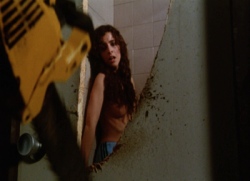 Who’s the culprit? Is it the burly groundskeeper? The university’s anatomy professor? The mousy British dean? The killer is mostly cloaked in shadows or shot from the ankles down, yet the gore is indeed gory, with limbs and noggins lopped off before your very eyes. One girl pisses herself before her torso gets cut in two. Following each kill, the murderer retreats to adding more pieces of that nudie puzzle, working his way down from the top. (And here I was always taught to the do the borders first and work inward.)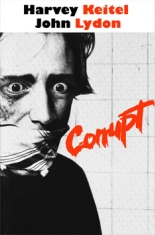
 Before he was the
  Corrupt is one of those psychological cat-and-mouse games where the tables are continually (but not surprisingly) being turned. Unfortunately, when the fortunes shift from Keitel’s character to Lydon’s, the movie grows tiresome (not to mention confusing, as their interaction borders on a homosexual relationship, as does the one between Keitel and his secret live-in cop roomie).