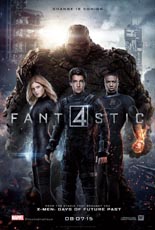

Fantastic Four (2015)

fantasticfourIn the X-Men films, you know when the opening 20th Century Fox logo fades to black, how the “X” is held for a fraction of a second longer? Well, Fantastic Four pulls the same trick, except it calls out a different letter: yep, the “F.” I couldn’t help but take that as a grade.

Following 2005’s Fantastic 4 and its 2007 sequel with Silver Surfer, this franchise reboot from Josh Trank (Chronicle) errs from the start — not necessarily by giving us the third screen telling of the quartet’s origin as much as by recasting our heroes as mopey, obnoxious, entitled teens. Reed Richards (Whiplash’s Miles Teller, toning down the smug) is the genius kid scientist who’s been toiling on teleportation since the fifth grade, with the aid of blue-collar pal Ben Grimm (Jamie Bell, Snowpiercer). Their work brings them to the attention of the Baxter Foundation, which recruits them to help the institute crack the riddle of interdimensional travel.
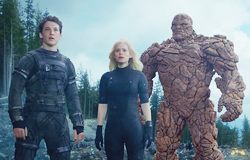
fantasticfour1With further assistance from fellow student Victor Von Doom (Toby Kebbell, Dawn of the Planet of the Apes) and Storm siblings Johnny (Michael B. Jordan, Creed) and Sue (Kate Mara, The Martian), they succeed and make a unsanctioned trip to “Planet Zero,” where these supposedly intelligent youngsters take Instagram selfies and touch mystery goo. This mutates all of them into, respectively, a living Stretch Armstrong doll, a pile of talking rocks, a crispy-burnt mummy, a flying fireball and an invisible woman who digs the trip-hop tunes of Portishead.

“We can’t change the past,” says Sue, who can create a force field, yet not a smile, “but we can change the future.” And so can you, by avoiding this needless iteration of the Marvel Comics mainstays, infinitely more of an embarrassment than Roger Corman’s infamously unreleased The Fantastic Four adaptation of 1994. Gripe at the aforementioned pair of mid-aughts adventures if you must, but at least they got the tone of the source material right, with bickering and in-fighting abound. Trask’s switch to making the team members morose and gloomy benefits no one; in fact, it compounds the movie’s problems, because in aiming for realism, the foursome’s realization of their changed bodies strikes viewers as worthy of ridicule. And it is.

Even before this Fantastic Four do-over opened, the clock struck clobberin’ time. Is it as bad as you’ve heard? No, but also yes — “no” because the sci-fi superhero tale is far from unskilled garbage, and “yes” because it is astonishingly leaden and as dull as it is expensive ($120 million). —Rod Lott

Get it at Amazon.

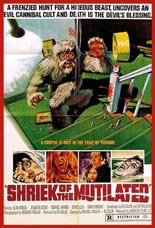
Shriek of the Mutilated (1974)

shriekmutilatedIn Shriek of the Mutilated, one of the few films in which director Michael Findlay does not indulge his psychosexual kinks, college professor Dr. Prell (Alan Brock) takes four of his students on a field trip to Boot Island, in hopes of finding and capturing a yeti. Seven years earlier, a similar sojourn ended in tragedy, but in the immortal words of the great philosopher Shoeshine Boy, aka Underdog, if at first you don’t succeed, try, try again.

Their mission’s HQ is the home of Prell’s fellow academic, Dr. Werner (Tawm Ellis), who employs a mute and “harmless old buzzard” American Indian, Laughing Crow (Ivan Agar, 1968’s Behind Locked Doors), to do his bidding. (His tasks include the preparation of meals; one Laughing Crow recipe is human head stew.) With Prell barking orders, the armed students venture into the woods to rustle up a yeti; I am spoiling nothing by noting that not only do they find their prey, but become the prey.

shriekmutilated1Shriek will make you do just that, with the kind of delight only offered by the well-meaning Bs. While I’m not sure what was up with the decapitation prologue since it has no bearing on the film that follows, Findlay lucked into an actual story — not his usual playing field — but it’s still rife with goofiness. For example, scored by Hot Butter’s novelty hit “Popcorn,” an early party scene has Spencer (Tom Grail), a survivor of Prell’s previous yeti hunt, flip the fuck out when he learns his old prof is still obsessing over such an abominable quest. So naturally, Spencer goes home, slits the throat of his wife (Luci Brandt) and, still clothed, hops in the tub with a can of Coors. While he soaks and scrubs and burps, his not-quite-dead spouse manages to crawl into the bathroom and toss a plugged-in radio in with him. Why this sequence merits inclusion is not worth pursuing.

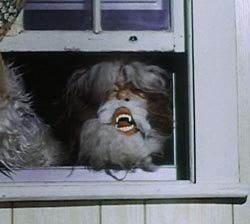
Anyhoo, that yeti: Despite initial camera tricks (Findlay’s wife, Roberta, handled cinematography) to keep him obscured, Shriek of the Mutilated gives viewers plenty of plain-sighted views of the creature with “a rank, foul odor,” so worry not about being gypped. (Worry plenty about amateurish performances, since few cast members have a filmography that goes beyond a credit of one.) The monster looks like Disney’s Shaggy Dog standing upright. The uncredited man within the hirsute suit is producer Ed Adlum, who co-wrote with his Invasion of the Blood Farmers partner, Ed Kelleher, and the two deserve some sort of recognition for their laughable twist ending. I mean, how often can one say it would satisfy the disparate fan bases of Martha Stewart and Herschell Gordon Lewis? —Rod Lott

Get it at Amazon.

Hitchcock/Truffaut (2015)

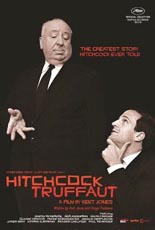
hitchtruffautHowever one pulls off a successful documentary about the making of a book, Kent Jones has done it with Hitchcock/Truffaut. Borrowing its title from the now-seminal film text published in 1966, the feature chronicles the unprecedented week of interviews between the two filmmaking giants (and their unheralded interpreter) and examines the volume’s unprecedented decades of influence ever since.
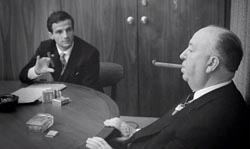
On one side of the table, we have Alfred Hitchcock, the undisputed “master of suspense” and arguably regarded today as cinema’s greatest director — thanks in part to the man at the other side of the table: Francois Truffaut. The French New Wave pioneer questions Hitch at great length about each of his pictures, which, of course, comes to extend to the broadest scope of cinema as a whole. At the time, Hitch had only a few films left in him, whereas Truffaut was just getting started; while at different points in their respective careers, they found equilibrium in their love of the movies, which Jones renders infectious.

hitchtruffaut1Although film cameras ironically were not present for the men’s talks, an audio recorder was; Jones lucks into having their actual voices at his show-don’t-tell disposal, along with a smattering of behind-the-scenes photographs. Without these, the doc would lose what makes it special. He doesn’t rely solely on his subjects, either, opening the floor to such celebrity admirers as Martin Scorsese, David Fincher and Wes Anderson, all avowed fans of the classic book, which has inspired and informed work of their own.
The middle stretch of Hitchcock/Truffaut ceases to be about the book per se and becomes about Hitchcock’s films and his style. That’s not a knock against the doc, as such exploration is on-topic. Naturally, a wealth of clips is employed — with a heavy emphasis on 1958’s Vertigo — so the audience can see exactly the points being discussed; the result is like a crash course in Introduction to Film Theory. (Hitch’s stated position on an “erect” James Stewart as Kim Novak emerges from the closet is priceless.)

All of these tools grant Hitchcock/Truffaut a significant coat of polish; the film exhibits more flair than the Hollywood documentary for which Jones (an ace critic for Film Comment and elsewhere) heretofore was best known: 2007’s Scorsese-produced and -narrated Val Lewton: The Man in the Shadows. That said, there is something Hitchcock/Truffaut’s construction that gives it the feel of being made for cable or a Blu-ray box set vs. the big screen; however, that does not make the hour and a half any less absorbing or delicious. —Rod Lott

Airport ’77 (1977)

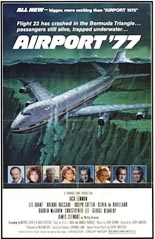
airport77In Airport ’77, the third in the Airport series, a private Boeing 747 is transporting the art collection and friend of multimillionaire Philip Stevens (James Stewart, Vertigo) to the opening of his new museum. Says Stevens to a throng of reporters, “It’s going to be a real wingding.”

Based on that jet alone, the old man ain’t joking! Under the control of Capt. Gallagher (Jack Lemmon, Glengarry Glen Ross), the aircraft boasts three luxurious levels that include bedrooms, office space, tabletop Pong, copies of Ebony magazine and even a blind lounge singer/pianist (motivational speaker Tom Sullivan) whose dark glasses look specially designed for Elton John to wear for an hour after getting his eyes dilated. Unbeknownst to Stevens, Gallagher or Gallagher’s mustache, the night flight also hosts a cadre of art thieves who gas the crew and passengers asleep so they can take over and make off with the priceless paintings. But art thieves do not double as ace pilots; a clipped wing sends the Boeing to the bottom of the ocean, square in the Bermuda Triangle — for no reason other than Trianglesploitation was a trend at the time.

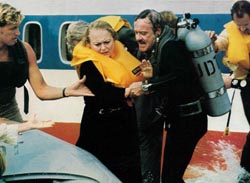
airport771With the submerged plane taking in water, Airport ’77 appears to be cribbing from The Poseidon Adventure of five years earlier. No stranger to the disaster genre, director Jerry Jameson (Raise the Titanic!) spends ’77’s second hour detailing and depicting the rescue efforts of Gallagher on the inside and the combined might of the U.S. Navy and Coast Guard on the outside. However, this removes focus from the most fun part of these exercises in cinematic calamity: the all-star cast. This TV-looking sequel is as overstuffed as the rest, with faded idols (Olivia de Havilland, Joseph Cotten), up-and-comers (Kathleen Quinlan, M. Emmet Walsh) and then-current leading ladies (Brenda Vaccaro, Lee Grant — the latter cutting the largest slice of the overacting pie). Returning as Joe Patroni, George Kennedy shows up just long enough to allow ’77 a direct connection to the previous two pictures.

Many of the actors’ clothes sport gaudy, checkered prints that create moiré patterns on your TV screen. Those have more life than poor Stewart, so folksy and noncommittal that one half-expects him to recite that poem about his dead dog. Haven’t heard it? Oh, it’s a real wingding. —Rod Lott

Get it at Amazon.

Saving Christmas (2014)

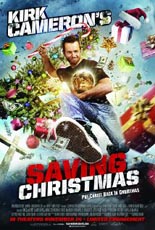
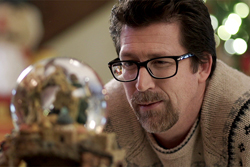
savingxmasTrue or false: The movie Saving Christmas begins with a three-minute lecture to the audience from Kirk Cameron.

The answer is “false.” It takes up four.

In that prologue — scooch, Alistair Cooke! — the erstwhile ’80s teen heartthrob of TV’s Growing Pains sits in front of a glorious fireplace next to a glorious Christmas tree in a glorious living room and, with awkward pauses to sip from a glorious prop mug, relays all that he appreciates about the most wonderful time of the year: “I love the cookies. I love the fire. I love the fudge. … And I love hot chocolate!” he exclaims. “But some people want to put a big, wet blanket on this.”

Yes, Virginia, Cameron’s talking about the nonexistent “war on Christmas.” And he’s here to narrate and star in a high-definition sermon all about it. Playing himself (and producing), Cameron attends a glorious Christmas party for wealthy people at the glorious home of his big sister (real-life sibling Bridgette Ridenour). The problem — other than Sis’ apparent addiction to Hobby Lobby kitchen decorations — is that Kirk’s brother-in-law with the punchable face (the movie’s writer/director, Darren Doane) isn’t feeling the spirit; he just can’t get over all the people partying because he’s too busy moping about how Christmas trees and Santa Claus aren’t in the Bible, for God’s sake.

savingxmas1True or false: The bro-in-law’s character name is Christian White. The answer is “true”; I’m guessing Christian Aryan was deemed too on-the-nose.

I won’t fault the Liberty University-funded Saving Christmas for its religious beliefs — not even the one justifying material things as being “right.” I fault Saving Christmas because it’s lazy and deceitful. Narrates Cameron toward the beginning, “Stories are tricky things,” which must be why Doane didn’t adorn his project with one. For an hour, Kirk and Christian sit in a car while the former reassures the latter that the Christmas symbols he worries about are indeed holy. Then they rejoin the party so a hip-hop musical montage (complete with Doane breakdancing) can extend the running time into a feature; Kirk jumps in to scream, “Let’s feast!”; the end.

That’s not a plot; that’s a commercial, essentially for itself. (Choir, you have been preached to!) I feel sorry for well-meaning people who paid good money to see “wholesome family entertainment” and soon realized they were hoodwinked into an audiovisual presentation, considerable stretches of which have no movement in them — just inanimate objects shot from rotating angles. If Doane’s digital camera and editing equipment didn’t allow for scenes in slow motion, Saving Christmas would be half the length, but interminable all the same.

Thou shalt not laugh, either, because Doane’s idea of comedy is summed up by an end-credit “blooper” in which the stereotypical black friend improvs, “I’m just gonna keep talking and move my hands until your camera gets what it needs.” Hell, even Cameron’s 2008 hit Fireproof is more accidentally funny.

True or false: I can achieve the same wonderful feeling that Saving Christmas wishes to espouse from Bill Murray’s epic monologue at the end of Scrooged. The answer is “true.” And I can get legitimate jokes with it! —Rod Lott

Get it at Amazon.

Random Genre & Cult Movie Reviews