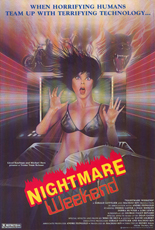
 Nightmare Weekend’s making may qualify as the cinematic equivalent to the child’s party game Telephone: What you say on one end may arrive at the other in a garbled state — perhaps even mutated. In this case, a French crew attempted to make an English-language film, and on the all-American soil of Ocala, Fla. That they failed so spectacularly is exactly why you should watch their doomed enterprise.
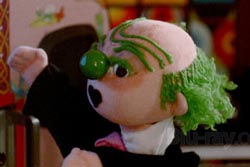
Edward Brake (Wellington Meffert — what a name!) is a widowed scientist with 212 patents to his name, including a supercomputer and George, who operates it telepathically and from whom Edward’s hot teenage daughter (Debra Hunter) solicits love advice. George, by the way, is a talking, green-haired hand puppet. Let that soak in before advancing to the next paragraph.
 Edward’s cunning business associate, Julie Clingstone (Debbie Laster, Bad Girls Dormitory), invites three college girls to the Brake estate for a weekend of research in a personality-reversal project — or so I gathered. The movie is so impossibly incoherent, it is open to the interpretation of Hermann Rorschach’s inkblots. All I know for sure is that Ms. Clingstone makes these Phantasm-sized metal balls pop up at inopportune times (coitus especially), jam themselves into people’s orifices and turn them into murderers. Again, or so I gathered, because to bear witness to Nightmare Weekend is to remain in a narrative haze. Things happen for no reason and then confound further by going without remark, like a tough guy having full-tilt sex with some skank against a pinball machine at the local bar.
That lucky sumbitch is played by Robert John Burke, who would go on to bigger, better parts, like the lead roles of Thinner and Robocop 3. In fact, Nightmare Weekend hosts an inordinate amount of future names, including Dale Midkiff of Pet Sematary, Andrea Thompson of TV’s NYPD Blue and Karen Mayo-Chandler of Jack Nicholson’s bed. On the spectrum’s opposite end, Nightmare Weekend also hosts an inordinate amount of one-and-doners who never had a credit before or after this.
Credited here as “H. Sala,” French director Henri Sala possesses a filmography littered with erotica (e.g. Emanuelle e Lolita), which could explain why so much attention is paid to writhing nude bodies, but Nightmare Weekend resists — if not defies — explanation. That very slovenliness makes it entertaining. Vive le balderdash! —Rod Lott
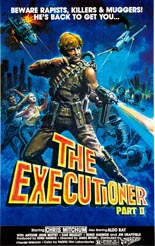
 First things first regarding The Executioner Part II: There is no part 1. Well, there is — it’s just that as a
 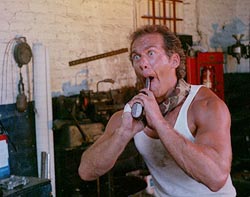 That said, I feel like none of these leads did much; O’Malley mostly sits in chairs. Not enough forward motion exists in this supposed main plot to justify referring to the rest as “subplots.” But what else to call them? The most prominent has O’Malley’s gap-toothed, cash-strapped high school daughter (Bianca Phillipi) jonesin’ so hard for “dope” that she follows her ever-giggling BFF (Marisi Courtwright) into part-time hustling. There’s also a street gang that seems straight out of Sharks and Jets territory, talk of a dreaded “Tattoo Man,” and a sex fiend with a bowl haircut and a habit of ripping open the blouse (sometimes the same one) of his lucky partner. Talk of The Executioner Part II isn’t complete without mentioning “Big Dan” (Dan Bradley, director of 2012’s
 In conjunction with the mighty
 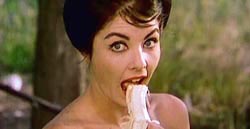 But wasn’t it fun while it lasted? Henenlotter is out to prove that with an emphatic “hell, yes!” With a cup-runneth-over wealth of clips, the doc beckons you through the entire tits-a-twirlin’ timeline of subgenres: morality scares (