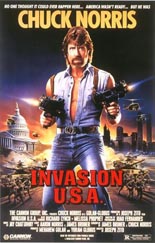

Invasion U.S.A. (1985)

invasionusaIn Florida, it’s beginning to look a lot like Christmas everywhere you go: Families are decorating their trees on the front lawn (huh?); Phyllis Diller is on the tube, shootin’ the shit with Merv; and Porky’s Revenge is playing at the local bijou. And then some Russians have to unload grenade launchers and machine guns into suburban homes and Mexican fiestas and ruin it for everybody. Call it an unprecedented act of terrorism — in fact, call it Invasion U.S.A.

Leading the charge is Mikhail Rostov (a reliably sniveling Richard Lynch, Bad Dreams), and he’d likely win his little war, if not for the CIA recruiting a bearded ex-agent — and Rostov’s longtime archenemy — back into all-American action: the Coors-drinking, alligator-rustling swamp rat Matt Hunter (Chuck Norris, The Delta Force). This Hunter dude is good, saving the stars and stripes with an assist from an ostensible sixth sense; wherever Rostov hatches an attack — even inside a crowded shopping mall — Hunter and his Ford 4×4 suddenly appear, as if he can predict the future … or just happens to be a block away gassing up the truck. Either way, this skill is rather convenient, given our infallible hero insists on being a one-man army.
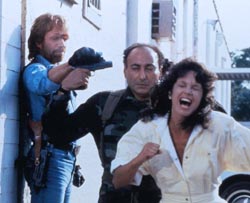
invasionusa2Friday the 13th: The Final Chapter’s Joseph Zito directs, but with Norris co-writing the screenplay with frequent collaborator James Bruner (two of the three Missing in Action pictures), one can’t help but wonder if some of the star’s personal politics creeped into the script. Or perhaps it’s mere coincidence that much is made of Hunter saving an entire congregation of good Christian honkies in church, whereas a boatful of dirty foreigners seeking refuge from Cuba becomes a ship of human Swiss cheese — kids included! Unsubtle touches like that and a hooker getting a coke straw kicked up her nose contribute to an all-around bad taste … and I wouldn’t have it any other way.

Now a time capsule of Reagan-era America, Invasion U.S.A. knowingly ditches pesky things like “backstory” to hoist itself into that territory of unadulterated, over-the-top action cinema, all the while all but deifying its lead as the personification of patriotism with a mullet and a belt buckle. Compared to his peers/rivals (and eventual fellow Expendables) Sylvester Stallone and Arnold Schwarzenegger, Norris was a second-rate brand of screen he-man, but No. 1 for those crazy Golan-Globus cousins. For their fondly remembered Cannon Films, this box-office Invasion is considered trash canon. —Rod Lott


Get it at Amazon.

Hitman: Agent 47 (2015)

hitman47An intended reboot of 2007’s Hitman, itself adapted from the eponymous video game, Hitman: Agent 47 trades Timothy Olyphant for Rupert Friend of TV’s Homeland to fill the title role of the assassin in the Italian wool suit. Bad move, 20th Century Fox — with a distracting pointy bump, he looks even stranger with a shaved head than Olyphant. Friend, despite his last name, has a fraction of the charisma as well. Not that much magnetism is called for when you’re playing a killing machine programmed to possess zero emotions, but enough to get viewers partially invested in the exploding spectacle would be nice.

The UPC-coded Agent 47 spends the film as a human variation on Arnold Schwarzenegger’s good-guy Terminator robot, terrifying a beautiful woman until she learns he’s actually around to protect her. She is Katia (Hannah Ware, Shame); she has ESP, which proves confounding for her own sanity; and she is searching for her orchid-loving, cancer-ridden father (Ciarán Hinds, TV’s Game of Thrones), for reasons that are fairly convoluted, even for a tale rather thin on story. More important than who our two leads are seeking is who is seeking them, with intent to kill: Zachary Quinto basically reprising his villainous Sylar character from TV’s Heroes, but with the added benefit of subdermal body armor to make him bulletproof. That enhancement hardly stops Agent 47 from trying to shoot him anyway.

You know your action film is in trouble when the aural appearance of the Wilhelm scream incites more passion in the viewer than any of the stunts. Same goes for when said viewer is more interested in finding out where a scene was shot (Singapore’s Gardens by the Bay) than what is happening in it. The plot doesn’t hold up to scrutiny of logic, but it’s not supposed to, as this is not that type of movie; this is the type of movie where an on-the-run character lives in a virtual hovel, with an entire wall covered by a map littered with newspaper clippings, photographs and thumbtacks to hold the string criss-crossing this way and that. Making his directorial debut, Polish filmmaker Aleksander Bach delivers Hitman: Agent 47 in the tidy facade of a magazine layout highlighting homes unattainable to members of your tax bracket, meaning it looks clean to the point of sterility, yet houses no soul. —Rod Lott

Get it at Amazon.

Angel (1984)

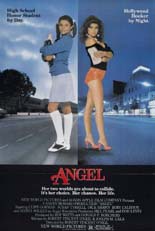
angelAs Angel’s notorious tagline says (and says it all), “High school honor student by day. Hollywood hooker by night.” Played with babyfaced conviction by Donna Wilkes (Jaws 2), the straight-A Molly ditches the pigtails and shortens the skirt for her extracurricular activities, turning tricks as “Angel” on Hollywood Boulevard. More or less orphaned, she feels she has no other choice. It’s a living …

… until it’s not. Currently, the nighttime streets are a feeding frenzy for a necrophiliac serial killer (John Diehl, Jurassic Park III) who slays only hookers, and a couple of Angel’s pleather-wearing colleagues already have fallen prey to his twisted desires, going from the mattress to the morgue. Assigned to crack the case is Lt. Andrews (Cliff Gorman, Night of the Juggler), who becomes something of a father figure to our title character in the process.

angel1Forming a surrogate family along the Hollywood Walk of Fame is Angel’s greatest asset, particularly with the amusing performances from comedian Dick Shawn (1967’s The Producers) as a cross-dressing prostitute and Rory Calhoun (Motel Hell) as an aging, possibly mentally ill cowboy who roams the sidewalks as if he were El Lay’s unofficial deputy sheriff.

But family schamily — Angel ain’t no touchy-feely drama. Directed and co-written by sleaze specialist Robert Vincent O’Neill (The Psycho Lover), the crime thriller soaks in a general malaise of sickness, sin and dysfunction, and is energized by bursts of action. (Surprisingly, almost all of its bountiful female nudity takes place in the girls’ locker room at school than with the ladies of the night at work.) In other words, Angel, which spawned three sequels, is a quintessential ’80s product of New World Pictures. I miss the times when trash like this earned a wide release, even though I was too young at the time to see it. Luckily, its themes are still relevant because the world’s oldest profession … well, let’s just say its product remains in high demand. —Rod Lott

Get it at Amazon.

On Her Bed of Roses (1966)

onherbedWTFAlbert Zugsmith’s On Her Bed of Roses begins with a wordless, 15-minute prologue that rivals the surrealism of Vincent Price’s drug-fueled dream sequence in Zug’s own Confessions of an Opium Eater from 1962: In his backyard, the handsome, but shy Stephen Long (Ronald Warren) grabs a rose so hard that its thorns pierce his skin. With bloodied fist wrapped around that plucked flower, the totally clothed, totally dazed young man walks into a swimming pool and emerges at the other side, then retrieves an instrument case from the garage and gets behind the wheel of a car. Paying no attention to the rules of the road and still clutching that rose — hey, hands at 10 and 2, son! — he drives willy-nilly until he comes to a hillside, removes a rifle from the case, and picks off a few wrong-time-wrong-place motorists from his perch. When the police arrive, Stephen turns the gun on himself.

Annnnnd scene!

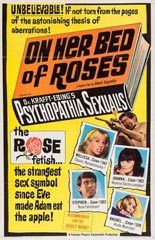
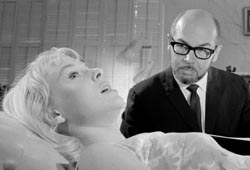
onherbed1What, pray tell, triggered this college dropout (“I didn’t fit in with the rah-rah boys”) to zonk out and exercise his trigger finger? We learn the answer through flashbacks as Melissa Borden (a breathy Sandra Lynn, Zugsmith’s 1966 Movie Star, American Style or; LSD, I Hate You), tells her shrink. Not only was she Stephen’s nymphomaniac next-door neighbor, but also his kinda-sorta girlfriend. Theirs is the oddest of romances, if Roses can be called that — after all, its alternate title comes from the psychology text from which it is loosely based, Psychopathia Sexualis. That classic 19th-century study on deviant sex was written by Dr. Richard von Krafft-Ebing, here portrayed by actual psychologist Dr. Lee Gladden (who plays himself in 1965’s The Incredible Sex Revolution, also written and directed by Zugsmith), to whom Melissa spills all secrets.

Those include sexual abuse by her father (“A Taste of Honey” songwriter Ric Marlow) and having her mom (Barbara Hines, The Three Stooges Meet Hercules) steal the boys Melissa brings home to bang. Stephen has “mother troubles” of his own, being smothered by his domineering mom (Regina Gleason, Revenge of the Cheerleaders). Melissa tells the doctor it’s her belief that she and Stephen could have saved one another, and the funny thing is, you want to see them do just that. However, going into the film at Stephen’s suicide, we know that’s futile, so we settle for wanting to see how events A and B and C led to the tragic Z.

Now, don’t mistake that engagement for eminence; we’re still talking about a Zugsmith production — one whose narrative halts in the middle to make way for extended scenes of nude dancing just for the sake of nude dancing (similar to his “hot” cut of 1960’s Sex Kittens Go to College). His dialogue, when he gets around to it, remains histrionic and hysterical, such as the lines exchanged between our Cupid-struck teens during their meet-cute:

Melissa: “Do you like peanut butter?”
Stephen: “Gosh, how’d you know? I like it best on apples!”
Melissa: “I like grape jelly on mine!”

That’s true love. —Rod Lott

Get it at dvdrparty.

House of the Long Shadows (1983)

houselongshadowsWhile on a book tour in Great Britain, author Kenneth Magee (Desi Arnaz Jr., 1977’s Joyride) is challenged by his publisher, Sam (Richard Todd, Alfred Hitchcock’s Stage Fright), to write something different from his string of bestselling political thrillers: something epic and all human conditiony, like Emily Brontë’s Wuthering Heights. No prob, says Magee, who bets the Englishman $20,000 that he can turn around a complete manuscript within 24 hours. Ever the gentleman, Sam even offers his client conducive solitude in the House of the Long Shadows, aka Baldpate Manor, a Welsh estate in which no one has resided for 40 years.
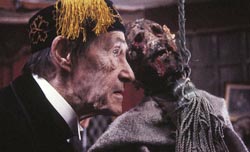
Magee arrives, predictably, on a dark and stormy night. But for an abode so empty, there sure are a lot of creepy old people lurking about its unlit hallways and stairwells. None should be there; all reek of sinister motives. With so much distraction and danger, the bad news is that Magee looks to lose that bet; the good news is he won’t notice the financial impact, because he’ll be dead.

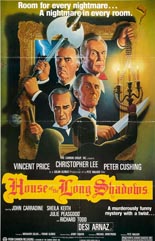
houselongshadows1More prestigious than the average Cannon Films release of the early 1980s, this House finds inspiration in the oft-adapted Broadway classic Seven Keys to Baldpate. It also represents the one and only big-screen meeting of fright-film titans Vincent Price, Peter Cushing, Christopher Lee and John Carradine — sort of like an Avengers for the Famous Monsters of Filmland generation. That alone makes Long Shadows worth a look, but don’t expect much to come of your stay.

The final bow for UK cult director Pete Walker (House of Whipcord), the PG-rated production means well in its old-fashioned adherence to the creaky Old Dark House subgenre and all the Gothic trappings that accompany it. Good intentions do not automatically translate into a good movie, and such is the case here, with a mystery that doesn’t try hard enough to pique audience interest and elements of horror defanged enough for telling ’round a Webelos campfire. It’s as if Walker, never one to shy away from sex or violence, was so out of his element with being inoffensive that he overdid the undercooking. Overall shoddy construction is to blame for the “twist” ending being obvious by the film’s second scene. —Rod Lott

Get it at Amazon.

Random Genre & Cult Movie Reviews