
Two-Minute Warning (1976)

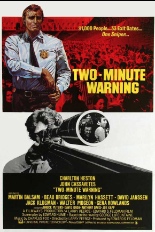
2minwarningNearly a quarter-century before he famously dared Washington, D.C. to pry his rifle “from my cold, dead hands,” Charlton Heston tried to separate a sniper from his weapon of choice in the sports-world thriller Two-Minute Warning. Talk about a political flip-flop!

In his fourth disaster film (following Skyjacked, Airport 1975 and Earthquake), Heston stars as Capt. Peter Holly, in charge of the LAPD’s plan to foil a gunman’s plot to open fire on the L.A. Memorial Coliseum’s crowd assembled for a championship football game. Perched atop a scoreboard and in preparatory mode, the sniper (Warren Miller, Married to the Mob) is glimpsed first by the camera blimp overhead. Cops are alerted, and enter Holly and SWAT Sgt. Button (John Cassavetes, Rosemary’s Baby). The two talk strategy and mention no fewer than three times the unfortunate maintenance man who got “butt-stroked off the ladder.”
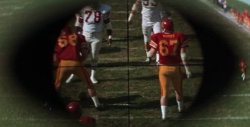
2minwarning1The sniper’s target? Oh, just about 100,000 pigskin fans, but to guess who will bite the bullet(s), place your bets on the bleachers’ numerous famous faces, including Walter Pidgeon (Forbidden Planet) as a pickpocket, Jack Klugman (TV’s Quincy, M.E.) as a gambler and Beau Bridges (Max Payne) as a hothead father who slaps the shit out of his young son for revealing Dad’s employment status (read: not) to the pennant salesman. Playing themselves are Howard Cosell, Frank Gifford, Merv Griffin and Andy Sidaris, then an Emmy-winning sports director vs. the Russ Meyer of action flicks he would become.

Per disaster-genre regulations, director Larry Peerce (1989’s Wired) continuously revisits the dozen or so subplots like so many spinning plates. It’s tough to tire of a film that walks that tightrope in double time. It is easy, however, to tire of Two-Minute Warning’s maddeningly repetitive musical cue. I forgive Peerce for dropping the needle on it so often, because the eventual melee triggered by the villain’s squeezed trigger is a smorgasbord of fallen (and falling) spectators. —Rod Lott

Get it at Amazon.

Monstrous Nature: Environment and Horror on the Big Screen

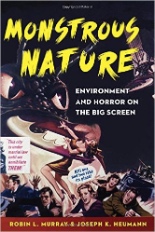
monstrousnatureIt took one childhood viewing of William Shatner taking on a small town’s Kingdom of the Spiders to make me an instant, lifelong fan of the horror subgenre of animal-attack films. Widening the scope to nature overall fighting back against an unappreciative and oblivious populace, Robin L. Murray and Joseph K. Heumann explore how these movies reflect how our culture grapples with our uneasy co-existence with flora and fauna, in their new essay collection from University of Nebraska Press, Monstrous Nature: Environment and Horror on the Big Screen. While I was primed for a highbrow take on a lowbrow topic, I was ill-prepared for how much fun it can be.

It’s important, however, to point out what this book is not: a reference guide, a few of which already exist, including William Schoell’s recently reprinted Creature Features: Nature Turned Nasty in the Movies. What it is is a sharply written, fiercely intelligent examination of their subject, which the co-authors approach from 10 angles and on many more films. It is likely the only book in existence that dares to straw a straight line from Darren Aronofsky’s Noah to Troma’s Toxic Avenger series.

Right away, Murray and Heumann surprise with their unique choices for chapters, contrasting the 1971 Oscar-winning documentary The Hellstrom Chronicle, which warns of insects inheriting the earth on an apocalyptic scale, with the 2009 experimental doc Beetle Queen Conquers Tokyo, a look at Japan’s quirky reverence for the bug; in both cases, the insects are ascribed human traits, but only in the former do they represent our worst. From the 1975 William Castle production Bug to 1988’s Roger Corman-produced The Nest, cockroach cinema — able to take a shortcut to present the vermin as evil by exploiting our collective disgust — goes under the microscope as well.

Monstrous Nature is hardly 100 percent insect-driven, as subsequent sections delve into parasites (e.g. Barry Levinson’s 2012 slapdash found-footage project, The Bay) and cannibals (à la Antonio Bird’s 1999 mismarketed flop, Ravenous, which the authors convincingly brand as “feminist”). From comedic takes on toxic waste (Troma’s Class of Nuke ‘Em High franchise) to body-modification tales (the Soska sisters’ American Mary, whose heroine’s actions earn an interesting comparison to the Cyclosa spider), the book is full of discussions that engage the mind as they trigger your six- and eight-legged fears. —Rod Lott

Get it at Amazon.

Kung Fu Trailers of Fury (2016)

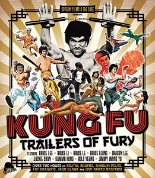
kungfutrailersA summary of Severin Films’ Kung Fu Trailers of Fury compilation can be found in the superimposed titles from the opening coming attraction for 1978’s The Ways of Kung-Fu: “There are fights! There are laughs! There are surprises! … We are not afraid of imitators, because we are the real deal!”

Comprised of a full two hours of trailers, the program presents martial-arts mayhem at its 1970s pop-culture peak, when public fascination with superstar Bruce Lee extended far beyond his untimely death to a flooded market of “chopsocky” imitations. Aside from the same “whoosh” sound effect to indicate appendages and/or limbs in motion, on their way to making contact with an opponent, the 31 clips collected here share another element in common: hyperbole.

kungfutrailers1Often rendered in broken English, the genre’s peculiar brand of ballyhoo is responsible for half the fun. When you have projects as insignificant as 1978’s Shaolin Iron Claws calling itself “a stunning production in Chinese cinema history” or as transparently money-grubbing as the same year’s Bruce Le’s Greatest Revenge claiming that it “reinvents action cinema,” one thing is undeniable: Embellishment and exaggeration are all over this like snot on a salad bar sneeze guard during flu season.

Think about the Don Draper pitches that resulted in these indelible ad lines:
• “Intrigue! Mystery! Intrigue and mystery!” —Fists of Bruce Lee (1978)
• “He must fight the YIN YANG SHEMALE!” —Kung Fu vs. Yoga (1979)
• “100 minutes of pure, nonstop sensory explosion!” —The Happenings (1980)
• “It has both the fights and the laughs! … It’s hardcore! It’s Ring vs Pole like you’ve never seen before!” —Enter the Fat Dragon (1978)
• “More exciting than the Western! More suspenseful than European films!” —Blacklist (1972)
• “A COMEDY WITH ACTON [sic] … GOLDEN NEEDLE PEERING [sic]” —Chinese Kung Fu (1973)
• “Chinese bumpkin wreaks havoc in Europe!” —Chinese Kung Fu Against Godfather (1974)

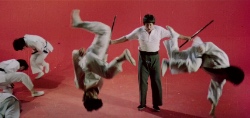
kungfutrailers2So from where does the other half of the fun come? The visuals, coward! Primarily, I speak of the fights that utilize bamboo poles, rice bowls, playground equipment, baby powder, Q-tips, flying logs, legs wrapped behind one’s head, sewing supplies, ramen noodles, human urine, erect nipples, Dutch windmills, firecrackers, yo-yos, slippers with pop-out saw blades, stolen 007 scores, and something called the Golden Turtle Fist — just not all at once.

And “all at once” is not how I recommend taking in Trailers of Fury, however kick-ass (literally and figuratively) it may be. While the promo for Lee’s 1972 film, The Way of the Dragon, may be the only spot the average viewer is likely to have seen before, martial arts pictures are not known for variety. You have to sit through, say, several punched testicles before getting to the novelty of, say, an earlobe getting torn. Or a snake doing battle with a pussycat (from the ’78 Jackie Chan vehicle Snake in the Eagle’s Shadow). Or acupuncture needles stuck into a dude’s eyes — a cringe-inducing feat worth more exclamation points than I’m willing to type! —Rod Lott

Get it at Amazon.

Runaway Car (1997)

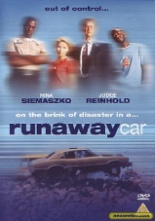
runawaycarImagine Speed with a lazy mechanic in place of a mad bomber, and congrats! You’ve got yourself a pretty good grasp of what the made-for-TV movie Runaway Car is all about.

As nurse-in-training Jenny, Nina Siemaszko (Airheads) takes over the spunky Sandra Bullock role when her clunker of a Sedan — fresh from a half-assed lube — won’t quit accelerating as it glides down the highway. Beverly Hills Cop sidekick Judge Reinhold is Ed, the simpering computer nerd of a passenger, to whom Jenny has offered a ride. Children are put into mortal danger and Jenny even has to deal with a section of missing road.

runawaycar1For all its cinematic theft, Runaway Car is damned entertaining. More telefilms should be like this, and being steered by Jack Sholder (The Hidden) sure helps. See if you don’t feel a slight case of frazzled nerves as they try to remove an infant from the titular vehicle by hooking the tot to a rope dangling from a news helicopter! And then try not to laugh when said chopper nearly swings the baby into a highway overpass! By balancing dangerous situations with altogether ridiculous ones, this Fox network flick keeps your interest cruisin’ right along. —Rod Lott

Get it at Amazon.

Doomed!: The Untold Story of Roger Corman’s The Fantastic Four (2015)

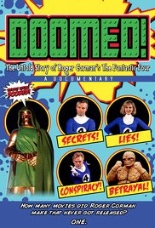
doomedRightfully tanked, Josh Trank’s Fantastic Four reboot is so awful, it may be the worst Marvel Comics movie made. On the eve of opening weekend, the sophomore director of the sleeper hit Chronicle famously tweeted his way out of the studio’s favor, not to mention a lucrative Star Wars gig, by basically disowning his Four in 140 characters or less: “A year ago I had a fantastic version of this. And it would’ve recieved [sic] great reviews. You’ll probably never see it. That’s reality though.”

Somewhere, Oley Sassone shook his head and mutters to himself, “You want to talk reality? Hey, at least your movie got released.”

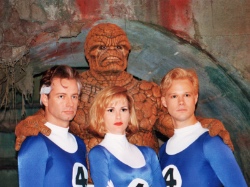
Sassone should know. He directed the first film version of The Fantastic Four. Not the 2005 summer smash with Jessica Alba and Chris Evans, but the 1994 one made with no stars and little money, but a lot of heart. That one, produced by Roger Corman, was shelved permanently and might never have been intended to see the light of day, depending upon whom you ask.

doomed1Well, Marty Langford asked, and the whole sordid affair is recalled and revealed in his documentary, Doomed!: The Untold Story of Roger Corman’s The Fantastic Four. While crowdfunded docs rarely rise higher than the level of “glorified DVD bonus” (assuming they aim that high at all), Doomed! is pretty polished and unexpectedly moving. Yes, that’s right: moving.

As conveyed through their candor, the ill-fated Four’s cast and crew were pumped about this project, in an age where not only did superhero cinema barely exist, but the entries that did were DC Comics properties: Richard Donner’s Superman, Tim Burton’s Batman and Wes Craven’s Swamp Thing. Marvel, meanwhile, was stuck to the small screen, where The Incredible Hulk spent five years in prime time, roaming town to town.

Yet here was what they all considered to be Their Big Break: one with a larger budget than any Corman project in history. On one hand, they shot on recycled sets from the thrifty producer’s Carnosaur; on the other, a 40-piece orchestra was performing the score. The end result was not perfect (Doomed!’s principals exercise healthy self-deprecation in detailing the flubs that made it to final cut), but they believed in it and couldn’t wait to share it with audiences.

Bootlegs aside, they’re still waiting. And while they may have given up on that dream, they have not given up on the movie itself. Alex Hyde-White, who played the elastic Mr. Fantastic, feels Sassone is the person most owed, having worked so hard to deliver a picture that would propel him out of the low-budget world of straight-to-video sequels to Bloodfist and Relentless: “He deserved this film.” Stuntman Carl Ciarfalio, who donned faux orange rock to play The Thing, is literally owed, having sunk $12,000 of his own money into promoting the film nationwide … while it’s entirely possible the financiers had specific plans not to release it, ever.

Why? Well, that’s a long story — and a damned good one, as Langford’s film tells it. His Doomed! stands strong as a compelling case study of the tributary of commerce flowing into the river of art; it investigates the executive-suite machinations as it celebrates the creative process. Stan Lee even makes his usual cameo, this time playing Two-Face. —Rod Lott

Get it at Doomed!

Random Genre & Cult Movie Reviews