
Delusion (1981)

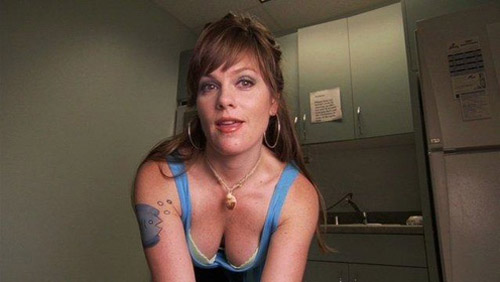
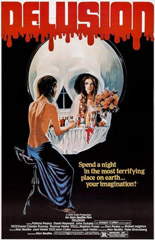
No sooner has live-in nurse Meredith Stone (Patricia Pearcy, Squirm) joined the payroll of cranky old paraplegic inventor Mr. Langrock (Joseph Cotten, Shadow of a Doubt) than she’s told only a single room of his estate is off-limits. Specifically, the one that’s locked up. The same one she spotted someone in, standing at its window, upon her arrival via Yellow Cab. The one she should never, ever enter under any circumstances whatsoever. 

“Ooh, how Gothic: a locked room!” coos a minor character played by Death Race 2000’s Simone Griffeth, and she’s not wrong. But whereas most movies of this ilk would spin such a setup across three dark and stormy acts, Delusion unlocks that riddle in its first 15 minutes, which is to say of course Meredith enters the room.

The real mystery kicks in after Mr. Langrock’s teen grandson (Jaws 2’s John Dukakis, son of Michael) arrives from being raised on a commune. That’s when people at the estate start to die, in classic whodunit fashion. Certainly a kid so far removed from society that he doesn’t recognize a skateboard must be the culprit, right?
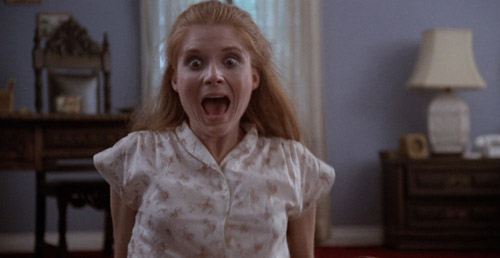
Unassuming in nature (especially when shorn of its alternate, oxymoronic title, The House Where Death Lives), Delusion is two-thirds Agatha Christie, one-third Michael Myers and all-around quietly nifty, marking a promising debut for director Alan Beattie. However, some of its advantages might be accidental. For example, the abode’s small doorways lend a discomforting, cramped feel … but that’s how the house was built. For another, the main actors’ unfamiliarity to viewers (the legendary Cotten excepted) mean audiences’ preconceived notions can’t apply … likely a budgetary necessity than a calculated play.

Supporting my theory, the only other movie Beattie helmed, Stand Alone, is as formulaic as you’d expect from a mid-’80s Death Wish imitation. That sophomore slump lacks the well-constructed script first-timer Jack Viertel delivered for Delusion: tense and peculiar, with the kind of kink Brian De Palma would’ve maximized for a field day of a film. Strange that Viertel never wrote another movie, abandoning La-La Land for enormous success on the Great White Way.

Most cruelly, Pearcy doesn’t waste her leading-lady opportunity, yet her face hasn’t graced a screen any larger than a television — a mystery in itself. —Rod Lott

Get it at Amazon.

Bunny (2025)

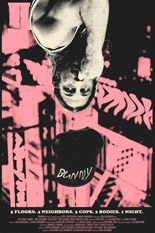
Happy birthday, Bunny! To celebrate, your boo, Bobbie, has bought you a threesome and some Molly. But that’s a package you don’t have time to open, what with the one you’re trying to keep closed around the cops: that suitcase packed with a bad guy’s folded corpse.

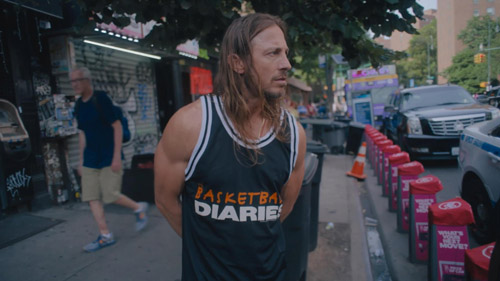
Played by a heretofore unknown Mo Stark, Bunny is a hustler in New York’s East Village. And Bunny is a shaggy comedy of errors that captures 12 hot and hectic hours in a melting-pot microcosm of a tenement. The film is a streetwise farce of slamming doors and unforgiving stairwells among potheads and sex workers, like if Sean Baker adapted Noises Off.

In his directorial debut, the person actually behind the camera is in front of it, too: Ben Jacobson (Blink Twice), who plays Bunny’s fast-talking best bud — so close, they sport matching promotional Basketball Diaries jerseys. Plus, this is the first feature screenplay for Jacobson, Stark and Stefan Marolachakis, making it all the more remarkable the film is able to sustain a relentless pace and impeccable comic timing.

Their jokes aren’t setup/punchline — just so sharp and knowing, they take you by surprise. For example, to an ultra-orthodox room renter (scene stealer Genevieve Hudson-Price, HBO’s The Deuce), Bunny assures her of his Jewish bona fides: “Yeah, my mother was, Bobbie’s father [is], I love Albert Brooks …” Several other lines seem destined for immortality due to their quotability, none more launch-ready than “I do love a good Smashburger!” (Trust me: It works wonders in context.)

None of Bunny would work if the characters weren’t believably authentic. Essentially, Jacobson and Stark have made a Real Movie with all their friends, and it shows. Not in the usual way of, “Well, at least it looks like they had fun” — although that, too, is true — but in they understood how to use nearly everyone in just the right part, at just the right moments, for just the right dose. (It all feels so genuine, I didn’t even recognize Mission: Impossible’s Henry Czerny in his brief role as a rabbi making house calls.) I’d say Jacobson and Stark delight in moving the many characters around a chessboard, but it’s evident they prefer to mischievously tip said chessboard to watch all the pieces slide and struggle and smooth-talk their way back into good graces.

So their ending is a bit too quick, too pat, too easily resolved. To echo a character’s statement in those closing moments, haven’t they earned it? —Rod Lott

Get it at Amazon.

Safety First: The Rise of Women! (2008)

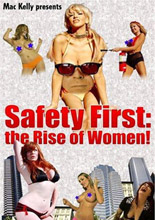
Purportedly a spoof of corporate training videos, Safety First: The Rise of Women! looks at the peculiar predicaments faced by attractive women who work in skyscrapers in California. That’s awfully specific. And Safety First is specifically awful.

Over and over for 50 agonizing, mishmashed minutes, ostensible writer/director Greg McDonald exhibits an imbecilic sense of humor to depict how those females should respond in various life-or-death situations, from medical emergencies to natural disasters. Most of what pass as punchlines can be paraphrased as, “ROFL, women have boobies! And they bounce, whaaaaaaat!”

Not a second of it qualifies as funny, but that doesn’t stop McDonald from thinking all of it is. Quite possibly, the scenarios are crowdsourced from a seventh-grade gym class.

For instance, trapped in an elevator? Just imagine you’re at a private beach, so you can rip open your blouse and clutch dem titties. Should an earthquakes occur, ensure your prep kit is stocked with dildos of unusual size, and be prepared for your hanging breasts to shake and shake and shake. And in case of fire, getting oxygen is of utmost importance, so doff that bra before running down the stairs — and don’t forget to breathe through your diaphragm. (Re: that last advice nugget, you get one guess what the woman places over her mouth to demonstrate.)

Although tit and dick jokes rule The Rise’s low-bar roost, not every gag involves erogenous zones. Why, in the segment on bomb threats, a woman gets the upper hand by covering her opponent’s eyes with two Forever stamps (the original Liberty Bell design, for any curious philatelists).

Woe be to the actresses, strip club performers and other ladies who deigned to appear in Safety First: The Rise of Women! They’re front and center, while McDonald gets to hide not only behind his video camera, but also a “Mac Kelly” pseudonym, as he ADD-edits his way through go-go dances, catfights, cloth dummies, disembodied limbs, lesbian couplings, goat milkings, hula hooping, iMovie explosions and male rape by a Village Person (the fireman, for any curious cosplayers). On the list of things to watch before you die, Safety First should come in last. —Rod Lott

Get it at Amazon.

Die My Love (2025)

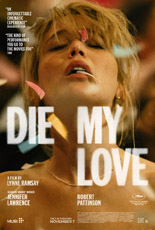
Within minutes of Die My Love, Jennifer Lawrence is clutching a butcher knife as she crawls through the grass, stopping only to give in to an urge to masturbate under the golden sun. So if you didn’t believe it before, let’s make it really, really official: Those Hunger Games have ended for good.

Strike that — they’ve ended for the great, because this film is a vehicle for Lawrence’s finest performance to date, besting even her Winter’s Bone breakthrough. She’s fantastic. Her role as Grace, a young mother in the throes of postpartum depression, frees her as an actress; she isn’t afraid to be unlikable, to shed her inhibitions, to cry without knowing why, to take extremely dangerous actions, and more.

As the mother (Sissy Spacek, 1976’s Carrie) of her baby daddy (Robert Pattinson, The Batman) tells her, “Everybody goes a little loopy the first year.” But in the hands of director and co-writer Lynne Ramsay (We Need to Talk About Kevin), Grace’s loopiness is anything but small, much less something carrying a 12-month expiration date.

Just as Ramsay crafted You Were Never Really Here into an ice-cold revenger beyond what one would expect from Joaquin Phoenix hammering bad people, she’s stripped this follow-up project of any disease-of-the-week trappings any surface-level synopsis might imply. (FWIW, she’s also gutted the source novel’s comma from the title.)

Die My Love is an outlandish, unconventional psycho thriller that doesn’t just flirt with horror, but fucks it. Quite apropos for the exceedingly horny nature of its main characters, colors cast in otherworldly shades, comedy darker than the most bitter chocolate, a timeline twisted into knots, and visions of the abstract that would do David Lynch proud, perhaps most notably a drop of breast milk dissolving into the night sky. —Rod Lott

Get it at Amazon.

Under the Cherry Moon (1986)

WTF

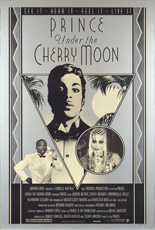
In between 1984’s utterly transcendent Purple Rain and 1990’s much-maligned Graffiti Bridge, Under the Cherry Moon is the 1986 outlier that Prince fans forgot. That being said, I’ve always thought it’s the better Prince movie. Its soundtrack is a brilliant companion piece I often play as well. Does anyone agree with me? Anyone?

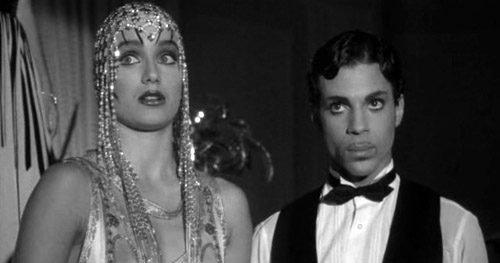
In the glam retaliation of the French Riviera at an unspecified time, Christopher Tracy (Prince) is a stylish piano player at a swanky nightclub. He and his ambiguous partner/roommate, Tricky (mirror master Jerome Benton), are high-priced gigolos, methodically preying on the wealthy women of the lavish coast while homoerotically playing in their shared bathtub.

Either way, while crashing a party, they meet spoiled socialite and spicy ingenue Mary (Kristin Scott Thomas) in her birthday suit. Spasmodically, they play the drums at her coming-out party. True to form, Christopher gives her the searing eye while she does the cha-cha and kicks him out of the party but

As their relationship forms, it becomes a constant battle of wills and wiles, barbs and beauty, will they or why they shouldn’t, with him calling her a “cabbage head” in a paralyzing sneak attack of words.

They fall in tragic love that’s more chaste than expected, filled with more dirty talk than actual realized sex, giving more pomp (pump?) than penetrative circumstance. In a weird way, Cherry Moon is a truly romantic film that only become more endearing with its taut strangeness.

The soundtrack is one of my favorite albums, one where the grooves are about to be blown out from constant play. The same thing can be said for the actual movie, where Prince’s style and grace are fully encapsulated in a funky 100 minutes.

After the movie bombed, Prince made one more film (the aforementioned Graffiti Bridge), but it was too late; he was culturally dead until he was actually dead. But, in my opinion, Under the Cherry Moon is his pinnacle in a career of high points, dramatic and otherwise, and should be re-evaluated.  —Louis Fowler

Get it at Amazon.

Random Genre & Cult Movie Reviews