
Category Archives: Kitchen Sink

Cry Wilderness (1987)

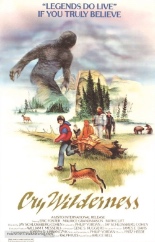
crywildernessWTFAs a love story between a boy and his Bigfoot, Cry Wilderness is the cryptozoological equivalent to a nerdy teenager’s story about his supposed girlfriend in Canada (you don’t know her). Little Paul (Eric Foster, Death House) attends a boarding school where nobody believes his wild tale of hanging with Bigfoot the previous summer. After they met by a waterfall, Paul apparently introduced the hairy giant to Coca-Cola and rock ’n’ roll; in return, Bigfoot gifted him with a wooden-knot necklace that the kid wears as if he were the Webelos version of Flavor Flav.

One night, Bigfoot (Tom Folkes) appears in a vision to warn the child that his father, a forest ranger, faces grave danger, so Paul escapes the safety of the school and heads for the trees. A more effeminate Grizzly Adams, Dad (Maurice Grandmaison, Savage Journey) is not too happy to see his only child, especially when he hears Paul’s reason. “I wish their was a Bigfoot,” Dad scolds with improper grammar, “so I could strangle him!” Although the two generations differ on the point of sasquatch validity, they do share one thing: bowl haircuts so hideous, they would be unbecoming on the bowl.
crywilderness1But Bigfoot really isn’t the focus of Cry Wilderness, an utterly neutered family-friendly adventure from Night Train to Terror director Jay Schlossberg-Cohen; an escaped tiger is. To locate the carnivorous animal, Paul accompanies his pop, a Native American pal (John Tallman, Class of Nuke ’Em High Part 3: The Good, the Bad and the Subhumanoid) and a swarthy hunter in a net shirt (Griffin Casey); we meet the latter as he grabs and chokes an alarmed raccoon with his bare hands. The PG pic is full of questionable behavior where nature is concerned, suggesting to its young audience that it’s perfectly fine to taunt a bobcat and/or wrestle a bear. There’s also a wolf named Shasta (but no Cragmont to be found).

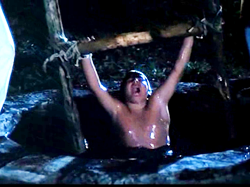
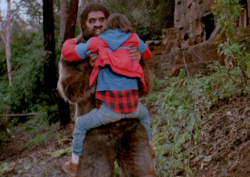
At the end of this rather tiresome expedition, Paul and Bigfoot are reunited; uncomfortably intimate hugs ensue. Also, Paul’s father becomes trapped between fallen rocks and rafters in a mine, and just when it seems that the seasoned ranger will have to Aron Ralston his way outta this bind, Bigfoot puts his skill of moving heavy things to use. Then, back at school, Paul calls upon the satanic forces contained within his crafts-class amulet to open a portal into a smoky, crimson-hazed zoo.

Cry Wilderness? Cry mercy. —Rod Lott
Get it at Amazon.

Guyana: Cult of the Damned (1979)

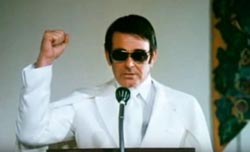
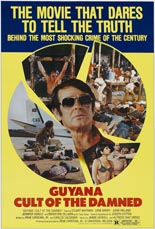
guyanaWTFStuart Whitman is the Rev. Jim Jones in Guya … wait, what? Okay, if you say so.

Take two.

Stuart Whitman is the Rev. Jim Johnson in Guyana: Cult of the Damned!

Yes, the inch-high-eyebrowed Treasure of the Amazon star plays the real-life deranged and delusional cult leader who convinced nearly 1,000 of his followers to commit mass suicide by drinking poisoned Flavor Aid in 1978. Dubbed “the Jonestown Massacre,” the tragedy quickly beget two screen adaptations. Hollywood went prestigious with the 1980 telefilm Guyana Tragedy, for which Powers Boothe won the Emmy; Mexico, however, struck sooner with 1979’s Cult of the Damned (aka Guyana: Crime of the Century), for which Whitman won … well, nothing, but maybe he got to keep his character’s omnipresent, They Live-style sunglasses? One can dream!

guyana1Hey, at least Whitman’s film, with Tintorera: Killer Shark’s René Cardona Jr. at the helm, played theaters. It aimed for pure exploitation, which might be why its subject is named Johnson instead of Jones. (Make no mistake: He’s totally playing Jim Jones.) Whatever the reason, Cult of the Damned opens in San Francisco as Jones Johnson preaches fire and brimstone from the pulpit. Clad in all-white, cape included, he hammers and yammers for six minutes before unveiling visual aids: a map of South America, with which his parishioners kinda need to familiarize themselves, since he’s just all but ordered them to ditch their possessions and move there to live and work at the Jonestown Johnsontown compound, as God supposedly has instructed. (Disclaimer: The Lord does not appear in this motion picture. But The Munsters’ Yvonne De Carlo does.)

Ostensibly, Johnsontown is established as a farming community, yet the only crops his highness seems interested in yielding are human slavery and total submission. Disobey and there’s hell to pay … and shock value for viewers. For instance, a man who attempts to leave finds his back whipped to bloody shreds. A little boy who swipes food from the kitchen is tied to the ground and tortured with live snakes, while an accomplice is strapped to a wooden contraption and dunked underwater. A young man caught fornicating with his girlfriend must endure rape by a big, scary black man Johnson hand-picks from his congregation.

guyana2That last bit proves Cardona’s trip to Guyana was charted solely for ruthless purposes. The reverend’s teachable moments might carry more dramatic weight if they happened to people we cared about, much less knew who they were, but every Johnsontown resident who isn’t Johnson is poorly delineated; Cardona and co-scripter Carlos Valdemar (1978’s The Bermuda Triangle) have sketched them so lightly, it’s as if they were created from a dot-to-dot puzzle with four points at best.

Guyana: Cult of the Damned may “just” be a classic case of headlines-torn exploitation, yet the movie is disturbing all the same, particularly in the section focused on the ill-fated exploratory visit/rescue attempt by a congressman (Gene Barry, 1953’s The War of the Worlds). Lucky for us, either no one told Whitman this flick was a cash-grab or he just didn’t care that it was, because the man delivers a performance that goes for broke … and, yes, a plate of ham. There’s kitsch in its grip. —Rod Lott

Get it at Amazon.

Director’s Commentary: Terror of Frankenstein (2015)

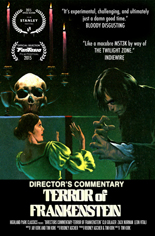
WTFDCterrorfrankNo matter the budget or number of cooks, film shoots are a bitch. Think of Werner Herzog’s Fitzcarraldo or Francis Ford Coppola’s Apocalypse Now. Odds are you haven’t thought of 1977’s Terror of Frankenstein, but oh, how you should. The Swedish/Irish co-production proved to be a highly peculiar farrago, with one of the actors murdering several fellow cast members!
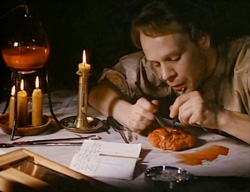
Now, decades later, all is revealed by director Gavin Merrill and screenwriter David Falks — always heard, never seen — through a DVD commentary track, of all things. To hear it is to witness a mind-boggling, historical record of an unfortunate nexus of cinema and crime, talent and tragedy.

DCterrorfrank1Except that it never happened; Director’s Commentary: Terror of Frankenstein is bogus. Given that premise, you can be forgiven if you assume the cheap-looking film at its center to be fake as well — otherwise, I’d be a hypocrite — but Terror of Frankenstein is the real deal, albeit rightfully obscure. The merry pranksters behind this put-on, director Tim Kirk and producer Rodney Ascher (collaborators on Ascher’s Room 237 documentary), have taken great pains to preserve the facade, including starting this meta project with the familiar FBI warning of home media, tracking issues and a shoddy menu our omniscient viewer navigates, taking a gander at the special features’ two-bit slideshow before selecting the filmmakers’ commentary.
From then on, speaking for the entirety are the opportunistic Merrill (Clu Gulager, A Nightmare on Elm Street 2: Freddy’s Revenge) and irascible Falks (Zack Norman, Cadillac Man). At first, we’re in the dark that the ’77 Terror has a tortured backstory, but it doesn’t take long for their conversation to grow contentious, with an uncomfortable Falks blaming Merrill for the deaths, as well as exploiting them for financial gain. Even if Gulager and Norman can’t quite carry the illusion to total legitimacy, they hook you from the start and are a hoot to hear — especially Norman’s sour-puss portrayal of the guilt-stricken scribe. As information is doled out in small chunks, the story builds and builds toward a payoff that Kirk can’t help but fumble because of Commentary’s confining structure. However anticlimactic, Kirk’s unique experiment is as devious as Victor Frankenstein’s in the film within the film. —Rod Lott

Wild Guitar (1962)

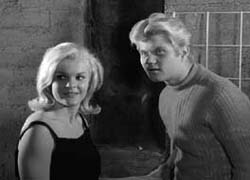
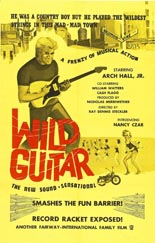
wildguitarWTFIn Wild Guitar, Arch Hall Jr. is Bud Eagle, a hopeful musician from Fuckstink, Texas, who takes off for Hollywood with (literally) 15 cents in pursuit of his big break. As with any such case, Bud becomes an overnight sensation in about an hour.

There are lots of bad, warbly-sung Arch songs, like the kind you’re probably still humming from Eegah (“…oh, Vickieeee”) and Bud immediately falls in love with an almost pretty girl, conveniently named Vickie (Nancy Czar, Winter a-Go-Go). Hall Jr. also gets to show off his gift for physical comedy, poolside. Thanks, Dad — er, I mean, Mr. Producer who is not my dad.

wildguitar1But I have to say, this is a very well-made movie. There’s some zingy dialogue, some beautifully shot photography and a biting, cynical view of the music industry (especially for 1962). And Arch Hall Jr., dare I say, is actually pretty good.

This was directed by Ray Dennis Steckler, best known for his really messed-up later works like the superhero comedy Rat Pfink a Boo-Boo and the marquee-busting The Incredibly Strange Creatures who Stopped Living and Became Mixed-Up Zombies. Even in a black-and-white film, Arch still looks pink, yet Wild Guitar is a solid movie by any standard. —Richard York

Get it at Amazon.

Trailer Trauma (2016)

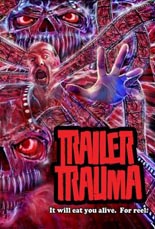
trailertraumaWTFPackaging for Garagehouse Pictures’ Trailer Trauma makes the dubious claim that while it’s far from the only coming-attractions compilation on the market, “only [it] contains the ultra-rare titles that you absolutely will not find anywhere else.” And dammit, with the likes of Ironmaster, Dr. Frankenstein on Campus and Smokey and the Hotwire Gang — to name only three — the Garagehouse gang actually makes good on that promise!

Elsewhere on the back cover, the consumer is warned that the 137-minute collection “is going to hurt.” This, too, turns out to be true; in the immortal words of John Mellencamp, it hurts so good. For lovers and mistresses of B-movie advertising, this disc is essential.

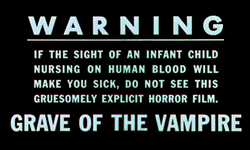
Speaking of dubious claims and immortal words, the program overflows with gems of taglines and selling points. In this category fall The Incredible Torture Show (aka Bloodsucking Freaks) as “the show that will make anyone retch”; Grave of the Vampire’s dire warning that “if the sight of an infant child nursing on human blood will make you sick, do not see this gruesomely explicit horror film”; and, best of all, the announcer for Nine Deaths of the Ninja proclaims, “A cat has nine lives … Sho Kosugi has nine deaths!”

trailertrauma1Not all of that ballyhoo works as intended, which is half the fun of revisiting trailers of the grindhouse era. For example, Sunn Classics’ Beyond and Back, a 1978 “documentary” about death and the afterlife, presents itself “an exciting experience for the whole family.” Little kids love mortality, right? Meanwhile, Stoner promises “the most dynamic kung fu team ever!” And yet the 1974 actioner pairs that Deadly China Doll Angela Mao with one-time 007 George Lazenby — one of these things is not like the other.

Found among the 65 trailers are early roles for Mr. T (Penitentiary II) and Jean-Claude Van Damme (No Retreat, No Surrender), as well as cinema’s only teaming of Brigitte Bardot and Claudia Cardinale and the onscreen comic-book sound effects of TV’s Batman (The Legend of Frenchie King).

Where else can the discriminating viewer find a tribeswoman breast-feeding puppies, Dabney Coleman as a blaxploitation heavy and an ad for Oliver Stone’s Seizure dubbed into French (because, hell, why not), all in a single source? Nowhere, of course! But speaking hypothetically, even if there were, I’d still bet Trailer Trauma bares a higher BPM (breasts per minute). In this realm, that counts for everything. —Rod Lott

Get it at Amazon.