
Category Archives: Kitchen Sink

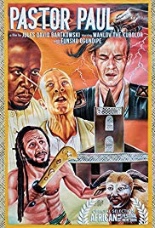
Pastor Paul (2015)

WTFThe cinema of Ghana and Nigeria — referred to colloquially and collectively as Nollywood — is best known for its low-budget goofy actioners and laughable melodramas, but there is very much a frightening side to their filmmaking: the ominous atmosphere and existential dread of their many demon-possession films. Forget The Exorcist, Rosemary’s Baby, whatever … Ghana and Nigerian filmmakers have them beaten and beaten brutally.

Maybe it’s because they still fear Satan in a way that Westerners (lamentably) don’t anymore, but regardless, their horror epics featuring demonic witch doctors, torso-shaking, eye-rolling vessels and sweaty preachers calling on Jesus to get rid of that vile creature tend to leave audiences praying for their own soul by the time the credits roll.

But then you’ve got to deal with a sequel … or two … or three …

It’s a trend that I’m surprised took American filmmakers so long to latch onto, but auteur Jules David Bartkowski, armed with a camera, a white suit and about 100 bucks or so traveled to this foreign land, gathering the biggest names in (regional) African cinema — Wanlov the Kubolor, Funsho Ogundipe and Lady Nancy Jay, to name a few — and actually made a pretty good first attempt at introductory cinematic diplomacy.

Bartkowski is Benjamin, a mathematician working on African drum rhythms and their supposed equations. When sitting in a bar one afternoon, he’s talked into starring as a white ghost in a film called Pastor Paul. During the filming, however, he goes into a strange trance and when the eccentric director yells cut, Ben can’t remember anything. People tell him he’s possessed, so he travels to a nearby town to hook up with the area witch doctor, and then it gets truly bizarre — but in a financially responsible way, making it even more scary.

While many fish-out-of-water films use a certain sense of xenophobia to get their paranoid feelings of danger and despondency across, this film mostly avoids that; surprisingly, mostly everyone in Pastor Paul, from the little kids following the characters around to the long stretch of Christian preaching, is just doing their thing and Benjamin is caught in the middle of it, walking along, letting them tell their stories, letting the audience experience what he does.

Sure, he’s shaking and convulsing around them, stricken by evil creepy crawlies, to bring it all back to the main story, but it’s the moments in between that are infinitely more interesting, to explore the souls of the friends (and enemies) he’s just made, sitting around talking and enjoying bowl after bowl of fufu with his grimy fingers.

But even more interesting is instead of bringing American techniques to Ghana and Nigeria, the filmmakers used theirs, the Africans, as a way to tell a compelling enough story, filled with plenty of strange tangents and obscure jokes to keep both Hollywood and Nollywood viewers both intrigued and waiting for parts two, three and four, which we’re promised is coming, to great terror and foreboding.  —Louis Fowler
Get it at Amazon.

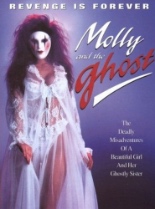
Molly and the Ghost (1991)

WTFIn Molly and the Ghost, which sounds like the greatest ’80s NBC sitcom premise that never was, 30-something Molly (one-and-done Lee Darling) finds her happy life as a successful California Realtor and loving wife turned tail-over-teakettle by the unexpected arrival of her “barely 17” sister, Susan (Ena Henderson, 1989’s Fatal Exposure), at her doorstep. Claiming an epic row with Dad, Susan needs a place to crash; Molly happily offers the guest bedroom since it’s just for a night …

… until it’s not. And until Susan pockets her older sister’s cash and jewelry, then attempts to do the same to Molly’s husband, Jeff (Ron Moriarty, Silent Night, Deadly Night Part 2), once she finally meets him. From our vantage point, Susan first plots to get her paws on him when — fresh from emerging topless from an afternoon Jacuzzi soak — she walks in on him in his tighty-whities, ready to rub up against his spouse’s loins on the living room couch. The teen girl’s motivation would click with viewers if Jeff were some ripped, abs-aplenty hunk, but ummm … he’s not. No offense to the photo clerks of ShopRite, but Jeff looks like a photo clerk of ShopRite, whereas his wife, even with her 1991 hair, looks like Anne-Marie Martin of TV’s Sledge Hammer! To be clear, that’s not a bad thing. (But that Darling never acted again is; she has some talent!)

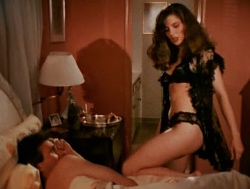
One night, while Molly’s out showing a house to prospective buyers, Susan’s in showing her goods to prospective semen depositor Jeff. Despite her best efforts in black lingerie, he’s just not into it, but to Molly, it looks like a compromising position all the same when she walks in on it. The next morning, Molly gives her immature li’l sis a good talking-to; Susan retaliates as all siblings in this situation would: by hiring a hitman. She finds the freelance assassin in the back pages of a shoplifted copy of War magazine. (Actually, the camera closes in on classifieds advertising military collectibles, but writer/director Don Jones either hoped no one would notice or assumed, not without merit, that his 16mm film’s intended audience could not read.)

The ponytailed hitman, John (Daniel Martine, 1989’s Cage), accepts the phoned-in assignment for $5,000, the downpayment for which Susan acquires by borrowing it from Molly (!) under the pretense of needing it “for computer school.” Beyond the dough, all John requires to get started is the mark’s name and photo. Susan eagerly complies — too eagerly, as it turns out — by tearing a photo of the sisters in two … and sending him the wrong half! Effectively ensuring her own demise, she realizes her mistake much too late.

Ergo, the Ghost portion of the title comes into play.

It is here that Jones (Schoolgirls in Chains) takes his thriller on a turn: a hard left into the supernatural, because, yeah, why the fuck not? Stuck-up even in death, the wraith Susan is given a second shot at sister sabotage when a matronly spirit (Carole Wells, The House of Seven Corpses) allows her to haunt Molly and Jeff rather than rest eternally. “You are so young to be so spiteful,” the boss-lady spirit tells her pupil. “You have much to learn and I fear it will be a painful process for all involved.” In other words, Heaven Can Wait for hussies.

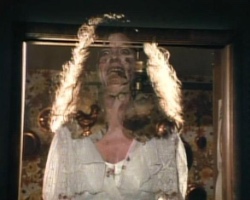
Because skinflint filmmakers like Jones can’t foot the bill for fancy hauntings, much of Susan’s from-the-grave shenanigans amount to her laughing in mirrors. Now, there is a scene that depicts worms crawling from holes in her cheeks, but this animation is so chintzy, it really just looks like her face is pooping. At any rate, our wedded heroes don’t know what to do about this imposition. Then Jeff recalls the VHS copy of Ghostbusters, and just as suddenly, Molly and the Ghost becomes a comedy as well — and a body-switching one, at that! — before settling down as a drama. Maybe it’s best not to ask. Just watch! For all its shortcomings and corner-cutting, it’s never boring. —Rod Lott

Get it at Amazon.

After Last Season (2009)

WTFI’m deeply concerned about you, After Last Season. Are you all right? I fear that something is really, really wrong. Please know that I am here for you. What can I do to help?

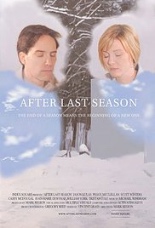
After Last Season is written, directed, shot and produced by mystery man Mark Region, although those verbs do not accurately describe his actions. His movie is independent, in financing and of logic. Cineasts who salivate over random, static cutaways to improperly framed pieces of furniture are in for a real treat. Everyone else risks an aneurysm. Here are just five reasons why:
• All of the scenes — whether set inside an apartment building, a medical facility, a college classroom and a corporation’s headquarters — appear to have been staged in someone’s house.
• Walls, doors and objects are covered in so much paper, the movie is environmentally unsound.
• Some of those sheets of paper are signs or printouts, suggesting that a healthy line item in the budget was reserved for Kinko’s.
• Several props were constructed from cardboard (and then wrapped in more paper, natch), including an MRI scanner.
• Region claims his budget was $5 million. The only way that figure can be true is if one or more parties, wanting nothing to do with the project, priced themselves way beyond the boundaries of reason, and Region said, “Okay.”

Once Region realizes his story perhaps should at least resemble one, if only tangentially, here is what “happens,” although it takes a half-hour to reach this point: Matt (Jason Kulas, Slaughter Weekend) and Sarah (Peggy McClellan, The Pink Panther 2), meet to conduct a psychology experiment. We know this because Matt makes good on his assurance to Sarah that he will put a sign on the door, and it reads, “PSYCHOLOGY EXPERIMENT.” I mention that detail only because with Matt’s action, viewers are gifted with an actual moment of lucidity. (Unrelated, one of dozens of signs to be glimpsed throughout announces, “PINEAPPLE CLUB.” Rule 1: Do not talk about Pineapple Club.)

In the experiment, Matt and Sarah each affix a computer chip resembling a yellow Chiclet on their right temple. This connects them psychically, or something. As long as Sarah keeps her eyes closed, Matt can see what she’s thinking, or something. He attempts to guide her, like telling her to think of a letter; she answers, “From the alphabet?” Her thoughts give way to lonnnnnnnnnng stretches of rudimentary computer animation depicting slowwwwwwwwwwly floating shapes that, if I didn’t know any better, could come from stock footage tagged “Geometry on Parade.”

Sarah mentions she can see murders before they happen, or something. Before long, we’re shown animated visions of a pinball-faced man with a knife emerge from the wall, as if The Sims: Homicide Edition existed. Then, back in the experiment room, Matt and Sarah hear a Voice from Beyond; a ruler floats; furniture moves on its own; they get sliced by an unseen force; and then a real guy with a real knife enters, but he’s felled by a flying office chair, or something. I suppose I could have had a psychotic break.

It is ironic that a movie so concerned with the scientific topic of brain activity can have none of its own. Bearing a title that doesn’t even make sense, After Last Season operates from a plane of reality different from our own, because I suspect Region may do the same. Characters aren’t established; they simply appear, and most of them serve no purpose, unless Region simply wanted society to absorb his viewpoints on seafood allergies, lecture the audience on magnetic resonance imaging and/or bear witness to the painstaking, real-time conflict of two people trying to agree upon a weekday to meet: Dammit, Tuesday or Wednesday, hmmm?

Like an unmeasured mix of Minority Report, delusional disorder, Poltergeist, a schizophrenia diagnosis, The Invisible Man and Rohypnol dreams, the film may be an anti-film; in fact or in theory, it comes as close to that as my near five-decade existence has encountered. Blessedly Region’s lone effort to date, After Last Season is indescribable psychobabble, a masterstroke of stroke symptoms, the 35mm equivalent of an anus, incompetence cranked to 11 and, finally, Tommy Wiseau’s The Lawnmower Man. Or something. —Rod Lott

Get it at Amazon.

Salsa (1988)

WTFSalsa, sadly, isn’t a film about the ins-and-outs of the breakneck world of competitive hot sauce divining — for that, Hollywood producers, please email me to take a look at my unproduced screenplay, Días de Salsa Caliente, Noches de Salsa Más Calientes — but instead a semi-musical based around the steamy art of competitive salsa dancing, made years before this beloved activity became co-opted by middle-aged gringos in an attempt to inject some hot Latin flava into their limp Caucasian marriages.

Former Menudo heartthrob Draco “Robby” Rosa — who always looks like he’s about one step away from turning into a werewolf — stars as Rico, a Puerto Rican mechanic in East L.A. with a burning, salsa-based fire in his Latino loins that, in the first five minutes of film, are thrusted directly in our faces, not only via an awkward, opening-credits dance in his neon-lit, DayGlo garage, but later and even more awkwardly, while he is fresh out of the shower performing Elvis’ “Blue Suede Shoes” clad only in a washcloth. It’s more queso than salsa, but still delicious!

Of course, Rico loves to salsa dance and spends most of his time in a hot nightclub that regularly is host to such big-name, big-ticket guests as Celia Cruz, Willie Colon and Tito Puente. Aye Dios mio! Either way, once you get past the hour and a half’s worth of concert footage and dance numbers, we’re left with about five minutes’ worth of a simplistic-enough plot lifted from any random telenovela, one where Rico’s loyalty to his friends and family is tested when his ego overtakes him in an effort to win the big dance-off (a plot thread left strangely unanswered, mind you) when the sultry cougar club owner Luna (Miranda Garrison, The Forbidden Dance) uses his skills as her attempt to reclaim her throne as the Queen of Salsa.

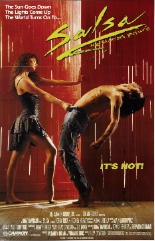
Subtitled “It’s Hot!” — and boy is it! — the barely remembered Salsa was directed by Boaz Davidson (The Last American Virgin), choreographed by Kenny Ortega (that video that ruined Billy Squire’s career) and made on the muy barato by the Cannon Group. It was also another entry into the action mavens’ niche of jumping on any ethnic dance craze that came their way, including Breakin’ (Break it to make it!), Lambada (Set the night on fire!) and Kinjite (Forbidden subjects!) — something which I appreciated in the ’80s and still appreciate today.

And by the way: If anyone can find a copy of the soundtrack, please send it and a bag of Tostitos my way! ¡Cómpralo ya! —Louis Fowler 

Get it at Amazon.

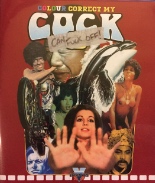
Colour Correct My Cock 2 Can Fuck Off! (2017)

WTFThose “kings of Canadian grind house trash” are at it again in Colour Correct My Cock 2 Can Fuck Off!, Vagrant Video’s follow-up to the 2013 party-ready, potty-mouthed trailer compilation. Following a markedly improved intro that find our hosts luxuriating in the heart-shaped bubble bath of a tacky motor inn with hourly room rates, James Bialkowski and Jacob Windatt expunge their latest load of 35mm-film finds, many of which already have succumbed to the dreaded vinegar syndrome, and are all the better for it. Because I don’t want to see a drive-in ad for Schneider’s red hots in high-def (even if it is scored by the resplendent “Love Is Blue“) — among, um, other things that, er, “pop up” here and there.

Like that idiotic quote from Forrest Gump about the unpredictability of the goddamn candy oozing with all sorts of factory-injected filling, you never know what CCMC2CFO! will hurl your way. It does so at whiplash speed, often not even warning you to “Think fast!” a split-second before your retinas are exposed to … to … well, a clip from an Asian film that forever has altered my stance on peacock feathers and baby powder, and footage of hobos chowing down on bread topped with caviar. And by “caviar,” I mean sizable glops of black shoe polish.

But mostly, as with the original Colour Correct collection, movie trailers are the menu item du jour. Whether consciously or not, sequels are well-represented, with Breakin’ 2: Electric Boogaloo (under its Canuck title of Breakdance), Porky’s II: The Next Day and The Return of Swamp Thing. Pairings figure even more prominently, as you get double dips of:
• Fred Savage (The Wizard and Vice Versa),
• killer thrillers (Relentless and Overexposed),
• illicit relations (The Sister-in-Law and The Step Daughter),
• animal stars (Won Ton Ton: The Dog Who Saved Hollywood and Namu, the Killer Whale),
• star-spangled heroes (Evel Knievel and 1990’s Captain America),
• endowed-and-empowered vixens (The Working Girls and Ginger),
• the massive breasts of a career-nadir Angelique Pettyjohn (left and right)
• and spots for sugar water (Sprite and Pepsi).

Meanwhile, Charles Bronson fronts three trailers — St. Ives, 10 to Midnight and Telefon — because he’s Charles Motherfuckin’ Bronson.

All of the above merely scratch the irritated, possibly infected surface of this feature-length showcase of sleaze. Oddball moments abound, rarely in context, from the handwritten credits for something titled (and gloriously so) Franchesca’s Sexual Whirlpool to the German trailer for Lucio Fulci’s “Der” New York Ripper, whose quacking strikes the ears as even more WTFy surrounded by the world’s ugliest spoken tongue. Don’t miss the theater ad shilling supposedly “sizzling” hamburgers, which, I kid you not, look uncomfortably similar to the shoe-polish sammich. —Ed Donovan