
Category Archives: Kitchen Sink

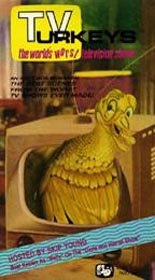
TV Turkeys: The World’s Worst Television Shows (1987)

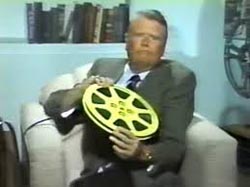
tvturkeysWTFWith dumb host patter supplied by Ozzie & Harriet supporting player Skip Young, TV Turkeys: The World’s Worst Television Shows is an hour-long compilation of moments from purportedly the pits of programming, although many of the segments are not so much “the worst” as they are just dull.

Hank McCune was a big-eared comedian who sounded like Elmer Fudd (because he once was). Or maybe he’s the straight man of the piece. Either way, it’s slapstick at its suckiest. The Buckskin Kid is an all-kid Western, starring children with glued-on facial hair playing with guns and knives, and having their voices dubbed by overacting adults. The ambush scene is great, with Indians “riding” on stick horses. The Motor Sports magazine show interviews amateur road racers, but the only thing fast and furious about it will be you reaching for the FF button.

tvturkeys1Penny to a Million is a game show in which all the questions were related to sponsor Raleigh Cigarettes. Up on Cloud Nine follows the daffy misadventures of two stewardesses who humiliate each and every passenger and wrongly inform the cabin that the plane is going to crash. Equally as inappropriate today is The Arnold Stang Show, which relies on footage of a man hitting his wife to the ground for laughs. But that cruelty pales next to The Meanest Man in the World, who pushes down the handicapped, steals clothes from the elderly, knocks glasses of milk from the hands of a little girl and severs a patient’s IV!

The “best” bit among the Turkeys is Suicide Theatre, in which Mr. Lembeck (DeForest Kelley, pre-Dr. Bones on TV’s Star Trek) can’t pay his rent or find a job, so he decides to gas himself to death with the oven. But then he gets a notice in the mail that his gas has been turned off due to nonpayment. He finds this O. Henry turn of events hilarious, laughing to the camera, “Whaddya know? I can’t even afford to die!” At a time when TV couldn’t show a married couple sharing a bed, this was okay?

Most enjoyable are the advertisements, including a disturbingly catchy spot for Belly Bongo, a terribly racist mattress ad and the most suggestive Dole banana commercial I’ve ever seen: “If you feel it, peel it!” —Rod Lott

Get it at Amazon.

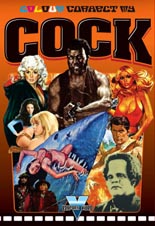
Colour Correct My Cock (2013)

colourcorrectWTFVagrant Video’s Colour Correct My Cock is unlike any trailer compilation on the market … in that I hesitate to utter its title in mixed company. In an insufferable six-minute skit that opens the program, we learn that the name is essentially James Bialkowski and Jacob Windatt’s petty “fuck you” to an unnamed DVD label that declined to release the collection, partly for reasons of image quality.

Yet that company’s perceived negative is actually a positive for the intended viewer: The more “grindhouse” grimy it looks, the more welcome it is. With little exception (i.e., that sour-grapes intro), Colour Correct is indeed welcome; it’s two hours of “trailers hand selected through years of audience testing on drunken Canadian vagrants.” It worked even on this sober American.

If we nicely shove Scorchy and Blackenstein aside, Colour Correct excels at presenting coming attractions of movies you’re unlikely to see represented elsewhere — not even on Synapse Films’ excellent 42nd Street Forever line. Hell, it is doubtful cult diehards will have heard of all the films whose ads bump (and grind) against one another here — flicks like Dagmar’s Hot Pants Inc., The Thunder Kick, The Godmother II, Cracking Up.

colourcorrect1Highlights among the lowbrow include:
• A leering, jeering Tony Curtis, ostensibly at the bank to cash in his last batch of Some Like It Hot credibility, in the alleged 1977 comedy Sex on the Run.
• Death on the Run, a 1967 spy thriller that tries to sell itself as a Django sequel, just because they share a director in Sergio Corbucci.
• Disney’s infamous football-playing mule, Gus, of course starring Don Knotts.
Killer Condom, an eventual Troma pickup stateside, here under its original German title (and denying viewers the money shot, so to speak, of the rubber rascal).
• Tomas Milian and Susan George as, irrespectively, Sonny and Jed, in a comedic Western sold with the very ’72 line, “In the Old West, an outlaw woman stood behind her man … three steps behind!”
• In 1977, Mexico does Jaws — and poorly — in René Cardona Jr.’s Tintorera: Killer Shark.
• The Seven Dwarfs to the Rescue, a 1951 live-action oddity from Italy that promises to be “Brimming with Laughter!” and “Enchanted with a Magic that will live Forever After!” I call bullshit.
• 1970’s Josefine Mutzenbacher, which just proves my theory that German porn is the most disturbing porn. (Lord, may the coin used in this trailer never circulate to these hands.)
• The 1965 Marco Polo epic, Marco the Magnificent, starring Orson Welles, Anthony Quinn and, per the narrator, “Elsa Martinelli as the girl with the whip!”
• Tom Laughlin in his post-Billy Jack Western, 1975’s The Master Gunfighter.
• And lots of women being punches for laughs in the 1976 Lee Marvin vehicle The Great Scout and Cathouse Thursday.

Even with that strong lineup, Colour Correct My Cock overflows with a wealth of vintage drive-in ads — pushing everything from the Chilly Dilly to Chuckles — and other bits of interspersed ephemera, including a Wham-O Super Ball commercial, a plea to complete the 1981 Canadian Census, an attack ad against the public scourge known as cable TV, a suggestion to give theater tickets “in gay gift envelopes,” a drunk-driving PSA from the Saskatchewan Department of Health and a pleasant thought courtesy of the California Table Grape Commission: “These summer memories have been brought to you by Grapes.”

While all this may seem random, I believe Bialkowski and Windatt actually were rather calculated in their assembly process. How else to explain ads targeting children and churchgoers being followed immediately by clips from an Asian porno? More subversively, a promo for some ungodly, wiener-based concession called Pronto Pops backs up to a depiction of fellatio so brief that while the seam between the source material may not register, thoughts of Tyler Durden manning the projection booth certainly do. —Rod Lott

All Night Halloween Party (2012)

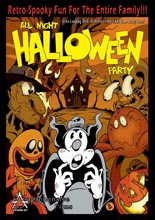
allnighthalloweenWTFWhat better time than the devil’s birthday to show your kids how racist cartoons used to be? The All Night Halloween Party compilation is ideal viewing for such harsh lessons. Oh, and to celebrate Oct. 31, of course … no matter what day of the year.

The Party collects one hour’s worth of rickety, ancient animated shorts — eight total — with vintage horror trailers sprinkled in between. The latter encompasses creaky Bela Lugosi vehicles such as Spooks Run Wild and third-rate monster movies from Reptilicus to Konga — completely harmless fare. The ‘toons, however … ah, there is the rub.

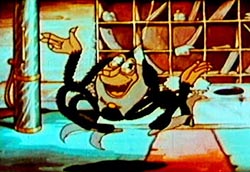
cobwebhotelWe start out innocently enough, with Ub Iwerks’ 1935 “Balloon Land,” about a community of anthropomorphic gallons, whose happy-go-lucky existence is threatened only by the needle-tossing Pincushion Man. This villain is creepy, as is the sinister, shifty-eyed spider running Dave Fleischer’s 1936 classic “Cobweb Hotel” for unsuspecting flies.

Only about halfway through this supposed All Night shindig do things veer toward uncomfortable stereotypes, starting with big-lipped black skeletons singing a spiritual in 1931’s “Wot a Night.” Perhaps the most awkward bit arrives in 1942’s “Jasper and the Haunted House,” a short directed by none other than George Pal (7 Faces of Dr. Lao). In this otherwise stellar example of stop-motion animation, an African-American child literally gets his skin color scared out of him during attempts to deliver a gooseberry pie.

These cartoons were the product of their times; it doesn’t mean they can’t be enjoyed today — especially when we are talking about the concluding segment, Fleischer’s “Bimbo’s Initation,” a ’31 number climaxing with its dog hero slappin’ ass with Betty Boop. —Rod Lott

Get it at Amazon.

Valley of the Dolls (1967)

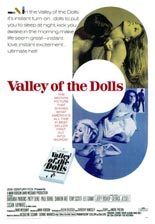
valleydollsWTFAs coined by Jacqueline Susann, the “dolls” of her 1966 breakthrough novel, Valley of the Dolls, were drugs — more specifically, pills: uppers and downers. The resulting ’67 film adaptation, which Susann despised, is nothing but up — a high from which there is no crash, unless you count the point when the movie just comes to an abrupt end. Its reputation as a camp classic is every bit deserved.

“Dolls” also could describe the cautionary tale’s triumvirate of heroines:
• Anne (a bland Barbara Parkins, TV’s Peyton Place), a good girl with bad taste in men;
• Neely (a bonkers Patty Duke, Amityville 4: The Evil Escapes), a scrappy singer who goes from Broadway failure to Billboard chart-domination after performing on a cystic fibrosis telethon;
• and Jennifer (a diabolically gorgeous Sharon Tate, The Fearless Vampire Killers), who has little talent, but lotta breast, and uses it to her advantage.

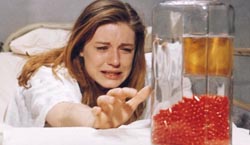
The girls respectively happen to end up, work her way up and sleep her way up to the top. But what goes up must come down, and in this showbiz-minded Valley of trashy entertainment, only the downward spiral counts, of course. Sex and booze sit on the Romper Room shelf compared to the damage done by pills. Catty and caustic, Neely takes to them like orange Tic-Tacs in her blood-, sweat- and tear-soaked bid to earn the title of America’s sweetheart and hold onto the sash, all in an industry more fickle than the public it spoon-feeds.

Arguably playing the most troubled of the trio, Duke bites into her addiction scenes with the intensity of swine flu. More or less a monologue muttered to herself on darkened city streets, her final scene finds Neely complaining through slurs that snowball into shouts (“Boobies, boobies, boobies! Nothin’ but boobies!”); Duke finishes so over-the-top, she’s to blame for the hole in the ozone layer. People talk of Neely’s wig-pulling of her has-been nemesis (Susan Hayward, I Married a Witch) as Dolls’ standout scene of first-degree lunacy, but I’d argue for this one instead.

Helmed with instantly dated style by Mark Robson, who shepherded an equally scandalous blockbuster novel to the screen a decade before with Peyton Place, the film is rushed even at two hours and three minutes; viewers may be confused that the passage of time goes unmarked, yet the trade-off is a breathless pace that staves even the threat of boredom. With fashion shoots, faux porn, Martin Milner, mental illness and a dash of homophobia, Valley of the Dolls is a textbook example of well-dressed melodrama that unintentionally begets comedy — a big, bubbly lather of a soap opera that only Hollywood could churn out: purely by accident. —Rod Lott

Get it at Amazon.

Extreme Jukebox (2013)

extremejukeboxWTFLook at a jukebox — if you can find a pub or pizza parlor that still has one — and peruse its tunes. Among those 45s, you’re likely to find a mix of musical genres from which the automated arm can pluck: rock, pop, country. Fittingly but annoyingly, Extreme Jukebox is every bit as scattered in its DNA.

In the Italian film from first-time writer/director/producer/actor Alberto Bogo, the music industry of Nova Springs is terrorized as its pop stars, rock gods and metal heads are offed by a serial killer or two decked out in quasi- Juggalo disguises. Their gruesome slayings may have something to do with the disappearance of a psych-rocker 20 years ago. Or they may have something to do with a supernatural curse that locks souls within a slab of vinyl.

extremejukebox1Then again, they may not. It’s hard to say for certain, because Extreme Jukebox is an excruciating mess of self-pleasuring slop. Narratively, it just flies by the seat of its (soiled) pants, ending up as confused as any potential audience member — even those who make it all the way to the punchable final shot. It seems that Bogo wanted to salute slasher movies and send up slasher movies, and since neither tone works alone, the approaches are downright discordant sharing the same frames; scenes don’t flow as much as they trip over one another.

Does the movie think it is scary? Does it find itself funny? Are we supposed to laugh or cringe? Scream or smile? Was Bogo aiming for this level of amateurism? Or did he merely settle for it? And why am I not surprised to find the Troma brand affixed to its U.S. release? This shaggy Jukebox arrives at No. 1 with a bullet. Unfortunately, that bullet is right between its eyes, and viewer-inflicted. —Rod Lott

Get it at Amazon.