
Category Archives: Documentary

Jingle Bell Rocks! (2013)

jinglebellSo wide is the appeal for Jingle Bell Rocks! that the documentary can be embraced by Christmas-music fanatics and foes alike. From Thanksgiving to New Year’s, its subject is virtually inescapable to the ears of America’s shoppers, drivers and diners, yet what tickles the tympanic membrane of one tortures another. While lending credence to both groups, the film unmistakably stands on the side of letting such sounds snow.

Its audience surrogate is also its director and producer, Mitchell Kezin. To say he’s (chest)nuts over holiday harmonies is an understatement; the man collects seasonal slabs of vinyl and polycarbonate plastic like a skid-row prostitute does STDs. In this, his first feature, he travels cross-country to talk with fellow collectors, as well as creators of timeless classics and outright obscurities.

jinglebell1Among them are cult filmmaker John Waters, who shared his love for oddball, tinsel-strewn tunes with the masses via the 2004 compilation album A John Waters Christmas; Run-D.M.C.’s Joseph Simmons, who recounts how he wrote the 1987 charity track “Christmas in Hollis” over a spliff and eggs; and The Flaming Lips ringleader Wayne Coyne, whose mother’s unreliable TV memories led the alt-rock iconoclast to birth the 2008 sci-fi film Christmas on Mars (certainly the only soundtrack album to contain such Yuletide gems as “The Gleaming Armament of Marching Genitalia” and “In Excelsior Vaginalistic”).

Bringing a side dish of gravitas to the party is Kezin’s own narrative about how his Christmas-music obsession is fueled by hole-in-his-heart memories of hearing Nat King Cole’s “The Little Boy That Santa Claus Forgot” as a child pining for his absentee father. His bittersweet recollections culminate in a moment that gives Rocks! a climax that can be forgiven for feeling a little forced, because Kezin has accumulated so much goodwill in the interim. With impressive animated sequences and, ironically, no soundtrack disc of its own, it’s a doc as accomplished as it is infectious. —Rod Lott

Buy it at Amazon.

Adjust Your Tracking: The Untold Story of the VHS Collector (2013)

adjusttrackingAdjust Your Tracking is not the only VHS-fetish documentary in the neighborhood. The same year’s Rewind This! beat it to the punch — barely — but whereas that one chronicled the history of the home-video format from birth to death, this one dispenses with such lessons in about 12 minutes in order to devote itself to the almighty collector. Rewind covered that ground, too — just not at this length.

Here, although with overlap, the focus is on VHS enthusiasts — not necessarily among the millions who made every weekend night a Blockbuster night in the video-store era, but those who today pursue those clamshell-encases plastic rectangles with the fervor of a dog to strips of bacon. Yes, I’m talking about the collector, who obsessively scours flea markets, thrift shops and garage sales for tapes. Judging by those interviewed by co-directors Dan M. Kinem and Levi Peretic, the titles hardly matter; in many cases, the movies won’t ever be watched much less freed of factory wrapping. The subjects’ fervor appears to be more about the sheer act of acquiring the objects than viewing them.

adjusttracking1They’re the guys who bid mercilessly on eBay for the shot at proudly proclaiming they own Chester Turner’s Tales from the Quadead Zone — a legitimately terrible shot-on-video effort, but hey, it’s pink-steak rare! Some of the guys consider themselves historians of sorts or cultural archeologists who “save” such relics from landfills because no one else will, yet I’d hardly compare their mission — as one interviewee does — to that of our World War I and II soldiers.

And therein lies my only problem with the never-dull Tracking: the perpetuation — if not glorification — of a VHS-collector stereotype. Almost always male, the collector is arrogant, bearded, overweight, immature, single, poor, likely OCD and possibly removed from reality. Whether or not that’s a legitimate sketch, it’s the one we’re given. —Rod Lott

Buy it at Amazon.

The Revisionaries (2012)

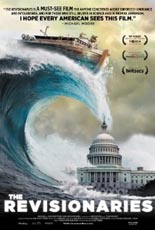
revisionariesIn 2009, I was considering moving to Texas for a job offer. I decided not to pursue it, and Don McLeroy is one reason why — seriously.

His name may not be known to you, but his actions are. He was the Texas State Board of Education member who put his personal ideology before the brains of Lone Star youth, in order to force a number of utterly ridiculous changes to the public school system’s history textbooks. His main target was the theory of evolution, but his beefs didn’t stick to matters best left to the pulpit. For example, whether he realized it or not, his xenophobia was showing in asking to replace a book’s mention of “hip-hop” to “country music.” (Lord forbid the children know the existence of rap! Or colored people!)

revisionaries1Any sane politician would be aghast at what McLeroy proposed; the trouble was, not many of McLeroy’s fellow board members appeared to be. Scott Thurman’s documentary The Revisionaries chronicles the Austin dentist-cum-politician’s crusade — make no mistake; that’s what this was — from inside the board’s meeting rooms. What merely nauseated you on news soundbites in 2009 will sicken you extended to 92 minutes.

I don’t consider Thurman’s film to be an attack on religion — after all, he lets both sides tell their stories — but I do consider it an attack on hypocrisy. Shouldn’t legislators leave the Sunday-school lessons to, you know, church? Time and taxpayer dollars would be better spent working to fix society’s real problems. —Rod Lott

Buy it at Amazon.

Drive-In Madness! (1987)

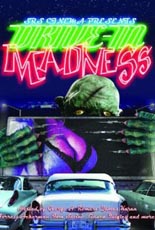
driveinmadnessDrive-In Madness! doesn’t quite earn the exclamation point it gave itself, but it’s a nostalgic look at an American pastime that was well on its way out when this was made: during the home-video boom. And by “look,” I mean a freeform compilation of vintage coming attractions with pointless interview segments serving as glue.

Narrated by Poltergeist real estate agent James Karen, the 84-minute quasi-documentary leans heavy on the films of Al Adamson, with six of his flicks represented with full trailers, from Satan’s Sadists to Naughty Stewardesses — not a complaint. I don’t know if any rhyme or reason were present in director Tim Ferrante’s choices of what clips to include, but for the most part, it’s an unpredictable bunch that touches upon sci-fi (The Human Duplicators), mondo (Macabro), action (Girls for Rent), comedy (The Booby Hatch) and, oddly, made-for-VHS trash that never would play drive-ins (Psychos in Love).

driveinmadness1To no one’s surprise, horror makes up the most, from the overplayed (Night of the Living Dead) to the opposite (Deadtime Stories). None looks as terrifying as what passes for hot dogs in ye olde concession-stand ads.

The aforementioned interviews include scream queen Linnea Quigley, effects master Tom Savini, collector extraordinary Forrest J. Ackerman and Mausoleum MILF Bobbie Bresee, who has no qualms appearing before Ferrante’s camera in an outfit designed to bare at least her left nipple. Only a fraction of what they share is related directly to the drive-in experience; the rest struck me as pandering to the fanboys, albeit before the word existed. Those faults were not enough to keep me away from Madness!, however, nor should they to you. —Rod Lott

Buy it at Amazon.

Ban the Sadist Videos! (2005)

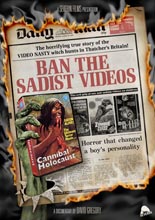
DVD-Insert_templateAs someone who is against censorship in any and all forms, I found the two-part documentary Ban the Sadist Videos! both fascinating and infuriating. Written and directed by David Gregory (Plague Town) for the venerable cult-DVD label Blue Underground, the piece examines the “video nasty” scandal of the early-’80s United Kingdom.

At a time when unemployment was arguably the UK’s greatest problem — resulting in riots and overall societal unrest — the media began a moral crusade to point a shaking, accusatory finger at horror films. Specifically, blame was placed among 72 so-called “video nasties,” including such gory works as Lucio Fulci’s Zombie, Abel Ferrara’s The Driller Killer, Sam Raimi’s The Evil Dead, Jess Franco’s Bloody Moon, just about anything with “cannibal” in the title, and many other flicks that enjoy a home in my collection. (Another is the more obscure House on Straw Hill, on whose Blu-ray package this feature-length doc currently can be found.)

bansadist1While I find Snuff to hold no artistic value, Faces of Death as nothing but irredeemable trash, and SS Experiment Love Camp to be abhorrent in its misogyny, none of them should be banned — then, now or ever. Not in agreement was activist Mary Whitehouse, a humorless biddy who led the movement to prosecute dealers who dare rented these VHS tapes in their uncut form; cuts suggested were completely subjective.

One Sadist commentator compares the circus to the Salem witch trails, which, in hindsight, isn’t an exaggeration. While England no longer has to worry about complying with Parliament’s Video Recordings Act 1984, we sadly still have to deal with politicians who ignore tackling true social problems in order to waste time and money legislating their personal beliefs onto everyone else. People starve and the economy crumbles, and yet we’re arguing over whether gays should marry and if evolution should be taught in schools. To me, that’s far more offensive and damaging to a populace than fake blood squirting from a fake torso after a fake beheading in a fake story. —Rod Lott

Buy it at Amazon.