Category Archives: Intermission

Reading Material: Short Ends 5/1/2016

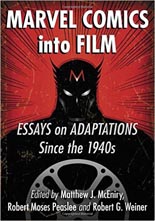
marvelcomicsintofilmYou kids have no idea how good you have it! Avengers fighting Avengers in an all-out superhero melee in Captain America: Civil War? The comics-obsessed, grade-schooler me would’ve cut a bitch to see that! Alas, ’twas the ’70s, when we had to make do with Reb Brown on a star-spangled motorcyclemade for TV, no less! And yet, memories of those “golden years” are what makes McFarland & Company’s Marvel Comics into Film: Essays on Adaptations Since the 1940s such a blast to read. Edited by Matthew J. McEniry, Robert Moses Peaslee and Robert G. Weiner, the collection could just focus on the current Marvel Studios product and have plenty to write about, but luckily casts its net wider, to a point that may put off this generation’s fanboys weaned purely on the Phase One / Phase Two marketing initiatives alone — their loss! Being that kid who had to dream of a world of superhero movies, the standout pieces for me were those by Arnold T. Blumberg, David Ray Carter and Jef Burnham on, respectively, “the First Marvel Television Universe,” the aforementioned early Cap movies (including Cannon’s ill-fated 1990 version) and the “Small Screen Avengers.” That’s not to say other chapters didn’t tickle my four-color fancy, either, whether digging into the Conan the Barbarian franchise, Ghost Rider’s connection to Goethe’s Faust, Japan’s live-action Spider-Man series, George Lucas’ infamously character-misjudging Howard the Duck feature or David Hasselhoff’s turn as Nick Fury: Agent of S.H.I.E.L.D. Look, any textbook that unironically compares the Punisher performances of Dolph Lundgren, Thomas Jane and Ray Stevenson clearly is one kick-ass textbook. ’Nuff said.
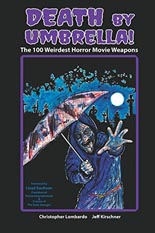
deathbyumbrellaMachetes, finger blades, butcher knives? So passé. Menorahs, breasts and bongs are really where it’s at. And by “it,” I mean the means used to kill guys and gals in terror-tinged cinema. Co-authors Christopher Lombardo and Jeff Kirschner are like an overly morbid Casey Kasem, counting ’em down in Death by Umbrella! The 100 Weirdest Horror Movie Weapons, released by BearManor Media in the indie publisher’s usual dual hardcover and paperback editions. Separated by category (kitchen utensils, sports equipment, etc.), each tool of execution earns its own description of the gory details, but in setting up each kill, the co-authors actually are providing a full-fledged review of the movie in question, thus making the book more than a mere list. Lovingly written with verve for the viscera, Death by Umbrella is fun and funny as it covers scenes both iconic (Happy Birthday to Me’s shish kebab, which doubled as its poster art) and arcane (Discopath’s slabs of vinyl). Only a few times do the guys pull from outside the genre (Paul Thomas Anderson’s Oscar-anointed There Will Be Blood being the most egregious non-slasher), but we’ll forgive. After all, they can sate your curiosity surrounding DTV trash like Super Hybrid in order to save you from sitting through it.
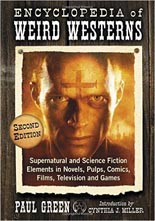
encycweirdwestPaul Green’s Encyclopedia of Weird Westerns: Supernatural and Science Fiction Elements in Novels, Pulps, Comics, Films, Television and Games — Second Edition obviously aims for a niche-of-a-niche readership, and luckily for it, this reviewer happily counts himself among that group and, therefore, welcomes such a project that others may dismiss as “why bother?” waste. First published in 2009, this McFarland trade paperback moseys into your TBR pile with 47 additional pages so now we can read about more recent items, like the Jonah Hex movie. Green is not a critic — at least not within the confines of this book, which is a true encyclopedia as the title claims. Arranged from A to Z, entries are strictly factual in nature, ranging from one sentence to half a page. Success of these highly specialized reference texts is measured twofold: 1) that it includes every test you throw its way (the indie Western Tales of Terror comic book is here, as is NBC’s 1979 anthology show Cliffhangers), and 2) that it introduces you to obscurities so esoteric, they sound invented (Action Comics #311, the issue concerning “The Day Super-Horse Became Human”). Richly illustrated, most pleasingly with comic-book panels and pages, Weird Westerns errs only in the occasional questionable inclusion: Avatar, Mr. Green? —Rod Lott

Get them at Amazon.

The Caped Crusade: Batman and the Rise of Nerd Culture

capedcrusadeShrewdly timed to the theatrical release of Batman v Superman: Dawn of Justice, Glen Weldon’s The Caped Crusade: Batman and the Rise of Nerd Culture takes longer to consume, yet provides far more entertainment. A companion of sorts to his 2013 tome on the Man of Steel, the book excels as a work of cultural history … provided you can overlook the whiplash appearances of the occasional stuffy phrase (“slyphs in organza gowns”) and dropping of hipster lingo (“mansplaining”).

The book traces the Dark Knight’s “life,” from his 1939 “birth” in Detective Comics #27 to anchoring several DC Comics titles today. With the exacting fervor of someone who may consider The Overstreet Comic Book Price Guide as “light reading,” Weldon details Batman’s many, many changes with the times and trends along the way — not just as a four-color character, but one who has leapt beyond the page to infiltrate the media of radio, television and, of course, the movies.

In comparing the Batman co-created by Bill Finger and liar/thief Bob Kane to the Batman of the 1966 camp television series to the Batman of Frank Miller’s 1986 revisionist graphic novel to the Batman of Christopher Nolan’s brooding film trilogy — to say nothing of all the Batmans in between, including Joel Schumacher’s much-reviled “urban-landscape-as-roller-disco” BatmanThe Caped Crusade wildly succeeds. You’ll learn, for example, of an era in which your justice-seeker absolutely used guns and killed people, even on purpose.

Less successfully, Weldon attempts to couch this history of Gotham City’s No. 1 crime fighter as being congruent with the ascent of “nerd culture” from something the mainstream derides to something it now embraces. It’s a theory I’m not 100% subscribed to, and his endless, binary talk of “normals” and “nerds” sends my buy-in down a few notches with each chapter. Still, it makes for interesting reading nonetheless, which is exactly what you hope and expect from such a book, and he is not so beholden to his love of/for comics as to deny that their storylines have grown ridiculously dense.

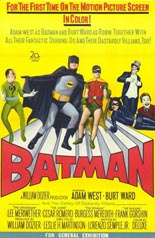
batman1966By and large, Weldon is a fun writer to read, especially when he lets his considerable wit off the chain, whether referring to Boy Wonder sidekick Robin as “achingly kidnappable” or describing Adam West’s line delivery on the aforementioned 1960s TV program — and subsequent cash-in film — as being riddled with “pauses that are not merely pregnant but two weeks overdue.” (Even the footnotes are playful.) The sheer amount of times the author refers to something as “kinda gay” would be troubling if Weldon weren’t gay himself; however, this fact will go unnoticed unless one pays attention to the acknowledgments at the book’s end or has heard him mention his husband on NPR’s Pop Culture Happy Hour podcast.

Which brings us to the book’s elephant-in-the-room caveat: If you have been or currently are a listener of that podcast, for which Weldon appears almost weekly as one of its primary hosts, it is impossible to read The Caped Crusade without hearing his voice in your head. Personally, that’s a negative, as his speaking method strikes me as so overly scripted and prepared to a fault, he often comes off as that smug know-it-all who, enabled by the rush of liquor to his bloodstream, corners people at parties and proceeds to cheerlead his own pomposity via $10 words. It’s not endearing.

And yet, like mines on a battlefield, you never know when his prose will unleash a vocabulary bomb that speaks above his target audience: agar, prolix, Derridean, caesurae, augured, febrile, noisome, tincture, bathetic, mesomorphic, abstruse, eschatological, elide, caromed, biliousness. Worse, several others appear multiple times: fealty, bolus, anodyne, gouaches, Sisyphean, lingua franca, mien, evince, gewgaws. Geegaws! That’s a word so goofy and cringe-inducing, it should only be uttered by preschoolers attempting to get the attention of their grandmother.

I mean, once you’ve read the cowled subject described as “po-faced,” “laconic” and “badass” for the third or fourth time, you understandably ache for a little variety. After all, there is nothing wrong with “disapproving,” “terse” or “intimidating,” is there? Holy Roget, Batman! —Rod Lott

Get it at Amazon.

Reading Material: Short Ends 4/3/16

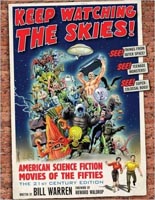
keepwatchingMaybe it’s just me, but the title of Bill Warren’s Keep Watching the Skies! may serve as a warning, i.e., you could get so wrapped up as to lose all sense of time. That’s certainly not a stretch, although arm strain could cut your reading session short. Subtitled American Science Fiction Movies of the Fifties, the book is such a behemoth that McFarland & Company has split it into two volumes (not sold separately) whose 1,000-plus pages collectively weigh nearly 6 pounds! First published in 1982, Keep Watching has been revised cover to cover (to cover to cover) for this 21st Century Edition, as Warren has revisited every film featured — now arranged alphabetically, from Abbott and Costello Go to Mars to X the Unknown — as well as added new entries. To call this massive undertaking a life’s work is not hyperbole. If each movie were represented by a mere pithy capsule review, a thumbs-up would not be automatic; instead, Warren affords each with a full, thought-out essay. Illustrations abound, with color pages of original posters inserted in the center of both volumes, kicking this project into that rarest of recommendations: unequivocally essential for the bookshelf of every cult-film fanatic.

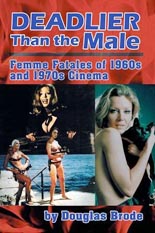
deadlierthanFresh from counting down the subjective 100 Greatest Science-Fiction Films, author Douglas Brode returns — this time with tongue a-waggin’ — to ogle luscious ladies in Deadlier than the Male: Femme Fatales in 1960s and 1970s Cinema. For the BearManor Media trade paperback, Brode profiles more than 100 of not necessarily the silver screen’s most golden goddesses, but those who also played it rough as villainesses. Thus, we get a lot of Bond girls and Hammer vixens, but dozens more hailing from the seamier side of exploitation cinema. Each woman is introduced with quick vital stats, such as her measurements (when available), before Brode digs in for a big-picture overview of her life and career, often with appropriately tongue-in-cheek self-awareness. For example, of Barbara Steele, he writes that “mostly her work consisted of being bound and gagged in old castles.” This goes a long way in mitigating Brode’s crime of misspelling names: Dianne Thorne, Silvia Kristel and Carol Baker, to point out just three errors. Among 522 jam-packed pages, rarely a spread goes by without a photo, almost all of which are dead-sexy. And, like the actresses’ films, several shots contain nudity, so keep away from prying eyes! I read this front to back over the course of several weeknights; if I were 14, it would be embarrassingly dog-eared … and not so much from “reading,” per se. 😉

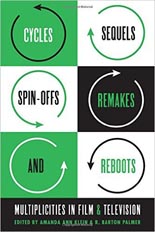
cyclessequelsDon’t let the highfalutin word in the subtitle keep you from Cycles, Sequels, Spin-offs, Remakes, and Reboots: Multiplicities in Film and Television. Edited by Amanda Ann Klein and R. Barton Palmer, this is a highly accessible look at why a franchise-crazed Hollywood is so fond of using and reusing the same concepts and stories. (The short answer: Because audiences pay in droves to see them.) From Dumbledore to mumblecore, this wonderful collection of 17 essays brims with sharp insights; for instance, the practice of capitalizing on familiarity dates back to cinema’s infancy, as Thomas Edison released a film based upon a popular novelty postcard in 1905. Standouts in this University of Texas Press trade paperback include Chelsea Crawford’s piece on American remakes of J-horror hits; Constantine Verevis’ use of the Jaws series to illustrate the When Animals Attack-style trend of the 70s (although calling Steven Spielberg’s undisputed classic a “disaster film” is terminology I take umbrage with); Robert Rushing considers how the waves of peplum, from Steve Reeves’ Hercules to the more recent Brett Ratner and Renny Harlin versions, play with sexuality; and Kathleen Loock’s examination of the major studios’ current fascination with reviving properties of the 1980s. However, another Kathleen — Williams — provides the most interesting chapter, on the YouTube phenomenon of retooled trailers, both by fans and, in the unique case of Snakes on a Plane, by execs.

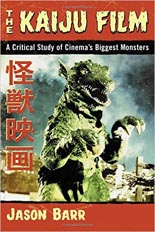
kaijufilmGodzilla, Gamera and all their oversized, radiated ilk: Are they worthy of the intense critical examination afforded to “important” foreign films? Jason Barr sure as hell thinks so, and The Kaiju Film: A Critical Study of Cinema’s Biggest Monsters sure as hell serves as proof. Published in trade paperback by McFarland, this may be the most sober book ever written and that ever will be written on the subject, as Barr takes these films very seriously. Irked at pop culture’s broad view of these movies as greasy kids’ stuff, he takes a slight dig at William Tsutsui’s Godzilla on My Mind for being “flippant” in tone, yet at least that 2004 book was a delight to read. Barr clearly has won the war of expertise, because chapter by chapter, he illustrates an incredible depth of knowledge not just in the aforementioned franchises, but as the giant-monster genre as a whole is informed by Asian traditions predating cinema and interested in making pointed political statements (not all of which lurk as subtext — Godzilla vs. the Smog Monster, anyone?). The Kaiju Film is intelligent, all right. I just wish it also were fun. It’s essentially a thesis, not a reference work; take that into account as you decide responsibly. —Rod Lott

Get them at Amazon.

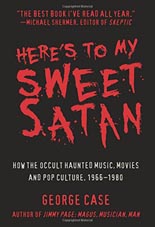
Here’s to My Sweet Satan: How the Occult Haunted Music, Movies and Pop Culture, 1966-1980

heresweetsatanOne of my favorite books from last year, Spectacular Optical’s Satanic Panic, did a thorough job of looking at one 1980s trend as peculiar today as Jams and parachute pants: the widespread hysteria among preachers, teachers and suburban creatures that Dungeons & Dragons and heavy metal and the like were corrupting our children. It is an excellent read that comes at its subject from a multitude of angles.

But that feverous movement is just one portion of a far larger story; full-blown, coast-to-coast delirium doesn’t just happen overnight. After all, tales of devilish temptation are as old as the Book of Genesis, so how did these media items become public enemies? George Case looks at the sordid, start-to-finish tale in Here’s to My Sweet Satan: How the Occult Haunted Music, Movies and Pop Culture, 1966-1980. Don’t let the serial killer-looking cover scare you away.

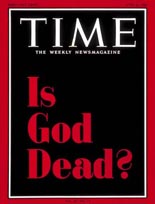
Why jump in at 1966? Because that’s when, on its April 8 cover, Time magazine famously inquired, “Is God Dead?” As Case notes in his introduction, “After World Wars I and II, fascism and the Final Solution, and the atomic bomb, the presence of a benign God watching over humanity became less plausible to the average mind than ever.”

time-isgoddeadAs restrictions on media slowly laxed, especially with regard to the MPAA, creatives increasingly pushed the envelope in turn, resulting in such zeitgeist magnets and game changers as Rosemary’s Baby, The Exorcist and The Omen; the early novels of Stephen King; a host of rock records, from The Beatles’ Sgt. Pepper album to Blue Öyster Cult’s “(Don’t Fear) The Reaper.”

With each piece of media earning its own “making of” story, all of these and more paved the way to “redirect the middle of the road to the occult,” eventually leading to PMRC LP bonfires and hysteric vilification of mazes and monsters — the aforementioned “satanic panic,” to which Case devotes the seventh and final chapter. Structurally simple but effective, the chapters before that segregate the subsets of motion pictures, music and literature from one another. Even greasy kids’ stuff à la Ouija boards, horror comics and Count Chocula cereal earns a section of its own.

No matter the chapter and from the very beginning, the author approaches his main topic for what it really is: one big business. (We could gauge just how big if only we were privy to the tax returns of Alice Cooper, Gary Gygax and Bill Blatty.) He writes, “While Black Masses, evil spirits, and poltergeists continued to bring customers to the Warlock Shop and the Metaphysical Center, they were also ringing up sales at pharmacies, airports, malls, and department stores.”

By now, I assumed that everything there was to be told about, say, The Exorcist, had been told long before. I was wrong. With Case’s examination of that 1973 Oscar-winning blockbuster and other artistic works that leveraged Christian America’s fear of the unholy into big bucks, there’s real heft to Here’s to My Sweet Satan: factually, culturally, intellectually. —Rod Lott

Get it at Amazon.

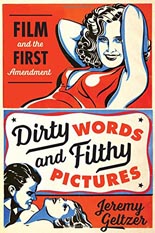
Dirty Words and Filthy Pictures: Film and the First Amendment

dirtywordsSex begins with a kiss, which must be why the 1896 featurette The John C. Rice-May Irwin Kiss — all 47 seconds of it — provoked such a uproar among a puritanical public. Distributed by Thomas Edison’s company, The Kiss (as it is better known) depicted just that and nothing more — a fleeting peck, really, between two completely clothed and consenting adults — yet was viewed as obscene, an affront to Christianity and this country’s very moral fiber.

As Jeremy Geltzer tracks with frightening precision throughout Dirty Words and Filthy Pictures, the then-new art form known as cinema often was targeted as Public Enemy No. 1. This was a time when boxing dramas were perceived as a threat, when courts ruled that film censors did not infringe upon First Amendment rights because the movies were “mere entertainment, not speech worthy of protection.”

Available in both hardcover and trade paperback, the University of Texas Press release finds Geltzer, an entertainment and IP attorney, suggesting that to trace the history of free speech is tantamount to tracing the history of film. He is correct. His story is one of … well, if not good vs. evil, one of good-intentioned vs. evil. As such stories should, the villains bear unique and memorable names like Lloyd T. Binford, Damon Huskey, Judge Michael Musmanno and Maj. Metellus Lucullus Cicero Funkhouser; they just happen to have been real people. The only thing scarier is that they were real people with power, which they wielded to legislate their own narrow worldview and belief system to everyone else.

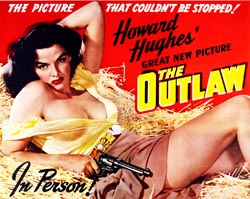
janerusselloutlawFrom film’s infancy to the legal skirmishes still challenging the pornography industry today, Dirty Words and Filthy Pictures by and large chronologically covers each legislative and/or community battle over the so-called “epidermis epidemic,” documenting each slam of the gavel, every swipe of the censor’s scissors. While the hygiene pictures and porno-chic movement obviously play large parts in this true-life account, so do utterly innocuous works as Howard Hughes’ 1943 Western, The Outlaw, for accentuating Jane Russell’s (covered) bust, and 1955’s Son of Sinbad, another Hughes production, for its inclusion of “lust provoking” dance scenes by stripper Lili St. Cyr, here non-stripped.

Not every controversy was over S-E-X, either. Take Curley, Hal Roach’s 1947 attempt at creating another Little Rascals, which dared depict white kids and black kids as social equals in the classroom. Some things have yet to change.

The sheer number of examples is alarming — just one element that makes Geltzer’s book a great, smart read. As eye-opening as it is pulse-raising, Dirty Words and Filthy Pictures entertains as it informs. It also will surprise you, starting with its foreword by Alex Kozinski: Yes, you really will read, enjoy and appreciate a book whose intro comes from the chief judge of the United States Court of Appeals for the Ninth Circuit. It is ordered! —Rod Lott

Get it at Amazon.