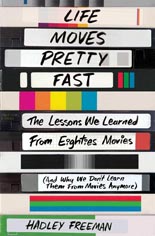
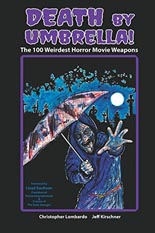
 As recent attacks in Paris have demonstrated, the City of Lights unwillingly can be at odds with its postcard-perfect image propagated by the tourism board. Terrorism aside, Alexandra West examines the “nihilistic forces and presences” at work from within France, and how they have made their way into Films of the New French Extremity: Visceral Horror and National Identity. With a piercing critical eye and a wealth of insight, West takes a long, hard look at about two dozen movies, several of which have become well-known in the States: among them, Baise-moi, Irreversible, Trouble Every Day and the ultra-gory triple threat of Martyrs, Frontier(s) and Inside, all arranged into loose themes. Prior consumption of titles is hardly required; she keeps discussion lively and engaging, whether it’s a movie fresh on my mind (Sheitan) or something I never plan to see (anything else from Gaspar Noé). Published by McFarland & Company in trade paperback, West’s book is so très fantastique that I wish it were a reference guide that covered hundreds of films, while while I remain appreciative of what it is: a well-curated representation of the movement at large, even extends to High Tension director Alexandre Aja’s Hollywood work as a remake machine.
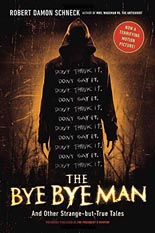 Can’t wait to put some scares into your summer moviegoing with The Bye Bye Man? Well, hate to break it you, but the flick has been delayed to December. Fear not! You can temporarily scratch your urban-legend itch by reading the book on which the film is based. Originally published as 2005’s The President’s Vampire: Strange-but-True Tales of the United States of America, Robert Damon Schneck’s work has been slyly and slickly repackaged as a TarcherPerigee trade paperback tie-in as — hell, what else? — The Bye Bye Man and Other Strange-but-True Tales, with a new afterword so brief, it hardly merits this mention. The title tale is an account of some Wisconsin teens’ terrifying experiences after screwing around with a Ouija board. Schneck approaches it and each of the seven other stories with the doggedness of a journalist, albeit a journalist reporting on ghosts, inexplicably vanishing kids, spirit advisers, mummies and the like. Even if I don’t believe any of them, Charles Fort sure would be proud and potential surely exists for a fun horror film … or eight.
 Literate Orson Welles fans have had it rather good of late, with A. Brad Schwartz’s Broadcast Hysteria, Peter Biskind’s My Lunches with Orson and Josh Karp’s Orson Welles’s Last Movie hitting shelves, to mention just three. Now add Harlan Lebo’s Citizen Kane: A Filmmaker’s Journey, in hardcover from Thomas Dunne Books, to that list. On second thought, scratch that: Move it right to the top. Drawing upon intimidating levels of research, Lebo has crafted what must be the definitive telling of this classic film’s complete story; while many Kane texts are keen to settle on the actual production and the behind-the-scenes war of the words with William Randolph Hearst, Hebo widens the lens on both sides, with particular attention paid to how the movie’s reputation ballooned over subsequent decades, often in disproportion to Welles’ own. The greatest of this type of book is to make you want to revisit its subject yet again while lending your eyes a fresh perspective; Lebo’s Journey does just that. A toast, Jedediah, to love on its terms!
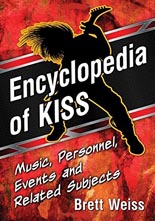 Attention, all members in good standing of the KISS Army, Brett Weiss’ Encyclopedia of KISS: Music, Personnel, Events and Related Subjects is for you. Not being a fan myself of the legendary ’70s shock-rock band, I’m hardly the target market for this McFarland & Company paperback release. Much more than focused on albums and singles, the work catalogues forays into film, TV and comics, yet it strikes me as large in scope and light on detail. For example, the movie nut in me is drawn toward three things: the infamous Hanna-Barbera production KISS Meets the Phantom of the Park and Gene Simmons’ better half, erotic-thriller queen Shannon Tweed. While both are included, information on each is extremely limited; therefore, the band’s legion of hungry followers may find the book ironically wanting. Completists will want it nonetheless.
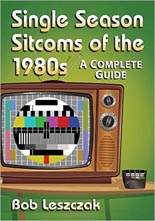 I had a blast perusing page after page of Bob Leszczak’s Single Season Sitcoms of the 1980s: A Complete Guide. A sequel to his similarly named project covering the years 1948-1979 (also published by McFarland & Company), the paperback profiles an entire era-appropriate TV Guide’s worth of ratings-challenged comedies I grew up with (well, for several months, anyway) and loved: It’s Your Move, starring Jason Bateman at his smarmiest; The Duck Factory, with then-unknown Jim Carrey as an animator; the non-sequitur No Soap Radio; the Police Academy-influenced The Last Precinct; and Leslie Nielsen as Frank Drebin in Police Squad!, in color! There are many more that I didn’t like, and those are here, too. (I should note that then, as with today, I had no social life.) Leszczak provides a significant amount of background info for each show, supplemented with comments from actors and creators when available. While lists of episode titles don’t do anything for me, they are here for historical preservation. Who else is willing to do it? —Rod Lott
Get them at Amazon.

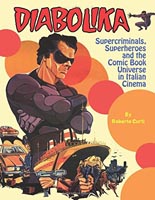 Author and film historian Roberto Curti is such an expert on Italian genre cinema, he literally wrote the books on them: 2013’s Italian Crime Filmography and 2015’s Italian Gothic Horror Films, both published by McFarland & Company. And he’s still writing them! In fact, Curti has two new books out this summer: Tonino Valerii: The Films for McFarland and, through Midnight Marquee, Diabolika: Supercriminals, Superheroes and the Comic Book Universe in Italian Cinema. It is the latter title — lavishly illustrated in full color with film stills, lobby cards, poster art and, yep, comic book panels — that inspires and informs his Guest List for Flick Attack.
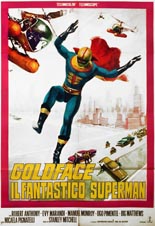 1. Goldface (Goldface il fantastico Superman, 1967)