
If your bucket list line-items “Hear Barney Miller utter the phrase, ‘knee-deep in pussy,'” I come bearing great news: Micro Budget allows you to cross that off. It’s merely one surprise in a movie that qualifies as a surprise itself. After all, “improvised indie mockumentary” doesn’t engender confidence these days, and its generic, Google-challenged title further diminishes hope.
Give yourself over to it anyway, because here’s even greater news: Micro Budget is capital-F funny — enough to threaten triggering a hernia.
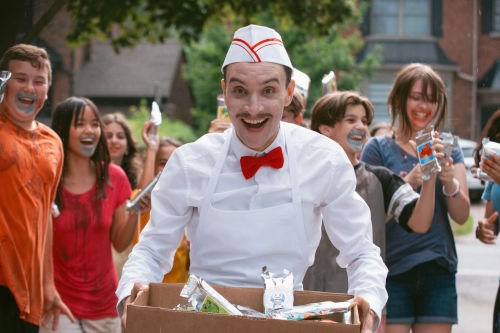
Speaking of do-or-die to-dos, Ohio nobody Terry (Patrick Noth) has always longed to make a movie. His ever-patient, exceedingly pregnant spouse, Erica (real-life wife Emilea Wilson), supports her hubs so much, she’s agreed to uproot their lives to L.A. so Terry can achieve his dream before their firstborn arrives to forever postpone such folly.
Naturally, in tackling an ambitious disaster film, Terry has bitten off more than he can chew, much less get his big mouth around. Lucky for us, his cousin (director Morgan Evans, who co-wrote with Noth) is around to document it all the behind-the-scenes chaos. While shooting in a rented Airbnb home in Malibu, the cast members inquire about their motivation, which Terry answers: “A big, scary meteor coming to Earth.” The dialogue he’s given them is equally clueless: “I can’t believe Toronto’s gone. I can’t believe Drake died.” A running gag hinges on Terry’s inability to understand movies don’t have to be shot in order.
If Terry has no idea what he’s doing, wait until you meet the intimacy coordinator, a skeevy guy (Neil Casey, 2016’s Ghostbusters) whose first question arriving to set is, “Now, who’s porkin’?”
Bawdy and boisterous without slipping into hateful, Micro Budget boasts a solid lineup of comedians both known (Chris Parnell, Maria Bamford, Bobby Moynihan, sitcom legend Hal Linden) and deserve-to-be (Nichole Sakura, Brandon Michael Hall, Carla Jimenez, Jon Gabrus), as well as a superstar cameo I won’t spoil. There’s not a weak spot in the bunch.
If you can’t handle cringe comedy, move along, little ones. Not for nothing does the “Lights. Camera. Asshole” tagline adorn its poster. While Micro Budget isn’t quite as successful as Christopher Guest’s Best in Show, it’s the next best thing. This isn’t Pulp Fiction, Scorsese. —Rod Lott
If beauty is in the eye of the beholder, where does that leave the blind? Im Yeong-gyu (Kwon Hae-hyo, Train to Busan Presents: Peninsula), a sightless stamp engraver in his twilight years, found love with a garment worker he married. It vanished when she abandoned her husband and infant son 40 years prior.
Now an adult, son Dong-hwan (Park Jeong-min, Decision to Leave) receives unexpected news from the police: Not only have his mother’s remains been found, but she didn’t disappear as assumed; she was murdered. This news arrives amid a crew shooting a documentary about the elder Im, so the producer (Shin Hyeon-bin, Beasts Clawing at Straws) helps Dong-hwan discovered what happened to the woman he never knew.
What they find on the surface is unimaginable cruelty from greedy relatives and asshole co-workers who nicknamed her “Dung Ogre.” All insist she was so hideous-looking — hence the film’s title of The Ugly — no photos exist. Most barbarous is the treatment from her piggish employer (Im Sung-jae, Emergency Declaration). Dong-hwan’s father sums it up with “What we see as beautiful, we respect; the opposite, we scorn.
The Ugly represents a departure for filmmaker Yeon Sang-ho, the creative conductor behind the Train to Busan franchise. Not particularly knotty in plotting, his film solves its mystery through simple sequential peeling of layers. With each successive interview, Dong-hwan grows further torn between wanting to know and afraid what he might learn next. Both leads are marvelous, but especially Park. In his incredible final shot, Sang-ho doesn’t leave us with a spinning top, but delivers the closure we need, only to rip open a whole new line of questioning. —Rod Lott
Line 1 of Robert Guffey’s latest, Hollywood Haunts The World: An Investigation into the Cinema of Occulted Taboos, reads: “The secret history of the world can be decoded through film.” Guffey makes good on that thesis across nine chapters (a third of which are new to this Headpress collection), fusing his interest in movies with that of conspiracies, to varying effect. On the plus side, he catalogues Twin Peaks’ extensive references to rocket scientist/occultist Jack Parsons, discusses the real-world government experiments informing such fictions (?) as The Manchurian Candidate, and posits the U.S. military supplied UFO secrets to the makers of The Man from Planet X and The Thing from Another World. You don’t even have to believe it to enjoy it. Elsewhere, a quasi-poem covering the whole of Invisible Ghost, a Bela Lugosi cheapie, baffles for five pages. A few rail-jumpers like that hamper an otherwise enjoyable trip from a tour guide likely (and proudly) on at least one agency watchlist.
As readers of his classic making-of-Psycho book know, Stephen Rebello can write about an old movie like nobody’s business. What’s better than that? Him writing about 152 old movies! In particular, Hitchcockian Thrillers: Must-See Films in the Style of the Suspense Master. Pay no mind to the subtitle’s misnomer, as Rebello pans several entries, but as readers of his classic Bad Movies We Love book know, pleasure abounds regardless of the film at hand. This Bloomsbury hardback groups reviews by a dozen Hitch-ready themes (amnesia, voyeurism, doubles, etc.), IDs the MacGuffin of each and includes titles from the obvious to the obscure to the oddball. Rebello’s deep love for the medium (note the number of times he mentions the cinematographer) throbs on every page, as does his knack for turn of phrase (“a dozen other ‘You in danger, girl’ epics”). Pretty much essential.
Edinburgh University Press’ ReFocus series has examined revered auteurs like William Wyler, Jane Campion, Robert Altman and now … H.G. Lewis?!? Yep! And ReFocus: The Films of Herschell Gordon Lewis is a splendid collection of essays on the Godfather of Gore. I was predisposed to Gary D. Rhodes’ chapter on Lewis’ work in Oklahoma (which our own book interviewed Lewis about), but who knew HGL’s Carving Magic industrial short could merit a fascinating piece on its own (courtesy Jack O’Dwyer)? That’s the type of expectation upender lurking within the contents. Another: Richard J. Hand’s history lesson on the HGL’s Blood Shed Theater, a Grand Guignol-style live venue in Chicago that sounds like a solid argument for time travel. From mannequin heads to chocolate milk, Kate Russell surveys the intentional comedy in Lewis’ post-Blood trilogy pictures, while editor Calum Waddell redeems Blood Feast’s Connie Mason and makes a convincing case for her Final Girl status. It’s refreshing to see Lewis taken seriously, even when he’s taken to task.
After watching Morgan Neville’s brilliant Netflix culture documentary, Breakdown: 1975, two thoughts tore circles through my brain: First, “I really need to see Executive Action and The Parallax View.” Second was, “Shit, I forgot to review Andrew J. Rausch’s The Taking of New York City: Crime on the Screen and in the Streets of the Big Apple in the 1970s.” (My apologies, Andy!) NYC may not have had the greatest of decades then, but those felonious activities and bankruptcy troubles informed some great cinema. And also not-great. You’ll find movies of both types covered, with each year’s crop of art prefaced by Rausch setting the historical stage so the reader has full context of the times, too; after all, the two are inexorably linked. The films you’d expect are here, of course, but so is forgotten fare like Super Cops, The First Deadly Sinand From Corleone to Brooklyn. Rausch’s exhaustive, scrutinize-all scope is the main reason to make room on your TBR pile.
Nearly four summers ago, Jon Lewis knocked my Merino wool socks off with the excellent Road Trip to Nowhere: Hollywood EncounterswiththeCounterculture. Now, with his monogram of 1988’s Die Hard for the BFI Film Classics line, I was prepped to be blown through the theater’s back wall (to borrow the actioner’s marketing promise). I wasn’t. But don’t interpret that as time ill-spent. All in all, it’s yippee ki-okay. The initial section is more interested in global politics than I or the movie ever was; I more appreciated Lewis digging into the casting of Bruce Willis in the Schwarzenegger/Stallone era, then breaking down each and every “whammy” the movie delivers — all 17 of them, per a heretofore unknown-to-me theory of producer Joel Silver. In its closer, the slim volume considers the internet discourse on Die Hard’s merits as a Christmas movie.
And finally, The Novelizers: An Affectionate History of Media Adaptations & Originals, Their Astonishing Authors — and the Art of the Craft: The Slightly Revised and Hugely Expanded Second Edition. Whew! This 644-page behemoth from David Spencer (and BearManor Media) boasts a cover as unappealing as its title is overlong, but also impressive breadth inside. The oft-derided (but not by me!) world of film and TV tie-in novelizations has one of its strongest defenders in Spencer. Whether you enjoy author interviews or author profiles, you’re in luck! That said, I was more drawn to the chapters that dive into the specialized, from tie-ins for Sherlock Holmes and British telly to the possibly counterintuitive novelizations of musicals — all illustrated in full color and detailed with full passion. —Rod Lott
In 2030, the hubbub in America isn’t around the morning-after pill, but the good-morning pill. The drug was developed to cure violent tendencies until its CEO, Addis (Chris Moss), realized the greater windfall stood in having it secretly cause such urges, thus increasing demand. Bwah-hah-hah!
Meanwhile, a former employee named Soul (Daniel O’Reilly) leads a small movement of highly armed revolutionaries against Addis’ greedy, grubby ways. Soul, who looks like John Travolta playing a Ken doll (or vice versa), is so committed to the movement, he initially refuses sex with his hot-to-trot wife (Marnette Patterson) so he can focus.
Like me, Censor Addiction sags in the middle, as each stage of the factions’ ongoing tête-à-tête grows protracted with heavy dialogue. Human action figure Mike O’Hearn (National Lampoon’s TV: The Movie) livens things up for a minute as an Addis fixer who feels no pain, has advanced healing properties and could be the result of entering “bicep but a person” into ChatGPT. Former pin-up model September D’Angelo also livens things up by falling to the ground rather delicately for someone violently plugged with machine-gun fire.
Censor Addiction is basically a reunion of Michael Matteo Rossi’s The Charisma Killers from 2024, right down to the appearances of Vanessa Angel, Vernon Wells, Ana Ciubara, what looks like the same living room, a familiar driveway, and wacko character names — here including Wizard, Pillar and Canvas Jones. The latter is an Addis henchman played by Bart Voitila (David DeCoteau’s The Pit and the Pendulum); he and Moss stand out by acting with the proper sodium level for the ham they’re given. That’s in step with the Addis commercials that open the movie, targeting Big Pharma with satire reaching for RoboCop-style heights. Rossi doesn’t get there, but he should try more of that. —Rod Lott
No doubt as a child of Hollywood, Corey Feldman has seen some shit and experienced no shortage of shit. But for someone who professes a desire to rise above that shit, Feldman sure can’t help himself from stirring it.
Marcie Hume’s fascinating all-access documentary, Corey Feldman vs. the World, shows her (in)famous subject as a bundle of contradictions, the least of which is being in his mid-50s yet still dressed for a Tiger Beat shoot. He believes people are out to scam him, yet guests at his third wedding are asked to pitch in $40 apiece for the food. He accuses others of riding his coattails, yet opens his concerts with a hype video listing every A-list musician he’s seemingly ever shared a room with. The same video prominently features clips of frequent co-star Corey Haim, an awkward nightly spotlight to grant one’s sexual abuser, as Feldman claims the late Haim was.
Perhaps Feldman’s most incongruous element on display is that despite his undeniable skill and likability as an actor (see 2004’s The Birthday for proof from this millennium), the doc finds the erstwhile Goonie pursuing rock-musician stardom. To garner attention, he’s backed by an all-female band in cheap costumes that Spirit Halloween might market as “Sexy Angel.” Like Hugh Hefner minus the mansion, Feldman lets the ladies live with him, his wife and “their” girlfriend, a scenario he presents to interviewers as so noble, you’d think he was appealing to the United Nations. Never mind some of Corey’s Angels have zero experience playing an instrument before embarking on a 10-city tour, because he’s just helping malleable young women achieve their dreams — well, provided they meet his standards of beauty.
As anyone who’s witnessed Feldman trot out his Michael Jackson simulacrum act since his Dream a Little Dream era knows, singing is not among his talents. However, manipulation and narcissism appear to come to him naturally. I’m not saying Hume’s fly-on-wall camera captures Feldman running a cult in between sad concerts, but he certainly exhibits cult-like behaviors, from comparing himself to the Messiah to seeing everything as a conspiracy against him (hence, the movie’s title). The tour bus breaks down; it has to be the bus company trying to make more money. His show gets a bad review; the journalist must belong to “the dark media.” If that weren’t enough, his home is a shrine to himself, right down to the vinyl Barnes & Noble book signing banner.
Corey Feldman vs. the World gives the man every opportunity to set the record straight and rehabilitate his parasitic image. Like everything else he’s been given or earned over the years, he squanders that potential. It’s a shame, because you want to see him succeed. In his explanations (or attempts at such) for transgressions, one recognizes the bullshit-laden patter of someone so high on their own supply, they’re unable to atone, but have deflection down pat. Feldman is his own worst enemy; having cried wolf so many times in the past — several within these engrossing 98 minutes, and its public coda especially — he continues to deplete any built-up reserve of credibility. As a result, he’s the most unreliable narrator of his life — one he sees as an epic poem, if not a revered classic of world literature. Why don’t you recognize his genius?—Rod Lott