All posts by Rod Lott

The Samurai and the Prisoner (2026)

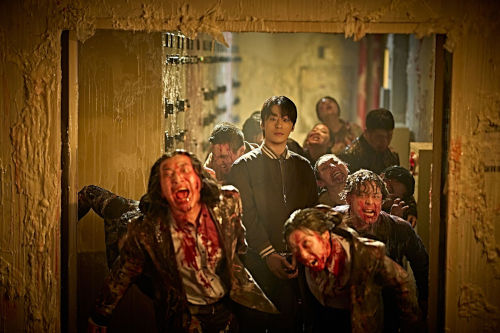
At first glance, The Samurai and the Prisoner, a literary adaptation set in late 16th-century Japan, hardly seems like horror/thriller auteur Kiyoshi Kurosawa’s usual cup of sake. Within a few minutes, when it suddenly reveals itself as a murder mystery, all makes sense.

The film takes place almost entirely at a castle ruled by Lord Murashige (Masahiro Motoki, 1999’s Gemini), who’s already anxious about an imminent enemy siege when a young visitor is found dead. The boy appears to have been shot with an arrow, yet no weapon is located. It’s almost a locked-room puzzle, if not for a mere 3-inch gap.

To crack this case, Murashige leans on his adversary’s envoy, Kanbei (Masaki Suda, Kurosawa’s Cloud), held captive in the castle’s dungeon, to pore over the clues and form a hypothesis. Kanbei’s deductive skills prove excellent — I mean, he’s got the time — and three more devious crimes will confound the castle before the end. If managing all that chaos isn’t enough for m’lord, he does so while grieving the loss of his true love: a precious tea urn. 

Understated humor like that is layered throughout, most notably in an extended bit concerning a slain general’s head; Murashige is uncertain which clan can claim the honor of killing because, as a soldier reasons, “We were fighting in the dark, no names were given.” 

Obsessed with matters of ritual and religion and oneupmanship, the picture is as meticulously crafted as it is purposely episodic. As the weather turns, a new whodunit presents itself for Murashige to pass to Kanbei to solve, making The Samurai and the Prisoner far from an ordinary costume epic, even if those majestic visuals and powerful lead performances suggest otherwise. Its two-point-five hours move quickly, although no pace can completely hide the occasional meandering. —Rod Lott

In theaters, expanding Aug. 7 and 14.

The Man in the Back Seat (1961)

As Batman famously noted, “Some days you just can’t get rid of a bomb.” And some nights, as the crooks of this Brit crime corker learn, you just can’t get rid of the unconscious bookie handcuffed to the briefcase full of cash you just stole from the doggie races. 

A year before playing robbers in Vernon Sewell’s acclaimed thriller Strongroom, Derrin Nesbitt and Keith Faulkner play the robbers of/in Sewell’s The Man in the Back Seat. Harry Locke (The Creeping Flesh) essays the title character, spending almost the entire 57 minutes knocked-out — and likely handing a template to Terry Kiser to utilize nearly four decades later in Weekend at Bernie’s. In contrast, Nesbit and Faulkner, meanwhile, spend much of the movie attempting to find the proper tool to separate the gentlemen from their riches. 

Emerging from the mind of Edgar Wallace, that job is easier said than done, not to mention a fool’s errand. At every turn, their simple quest is hampered by one inconvenience or another, from a flat tire and lack of adequate parking to nosy coppers and a nosier wife (Carol White, Something Big). That qualifies it as a “one crazy night” picture à la After Hours — only not funny. 

Nor is meant to be. It’s a sober example of crime-doesn’t-pay cinema from the bottom half of the bills, with a short detour into British kitchen-sink drama when White is involved. Back Seat bends the rules of reality in its abrupt conclusion, heralded by SUDDEN! BLARING! TRUMPETS! — an unexpected kick to your movie-watching pants. —Rod Lott

Get it at Amazon.

Behind Locked Doors (1968)

Creeper-peeper boobie movies abound in regional ’60s sinema. Charles Romine’s Behind Locked Doors, however, is unique, if only because the roughie’s villain resembles what would happen if Henry Kissinger crawled into Seth Brundle’s telepod without noticing Isaac Asimov curled up in the window.

The hypothetical result is Mr. Bradley (Daniel Garth), a former mortician turned sex researcher. We’re not talking legit and credentialed like Kinsey or Masters and Johnson, but suspicious and self-studying like that one cousin or uncle your family pretends no longer exists.

We meet the binoculars-equipped Mr. Bradley spying on a barn of hipsters frugging to what sounds like Neal Hefti’s Batman TV theme song. In the hayloft, Mr. Bradley saves the pretty, pert Ann (Eve Reeves) from beatnik rape by whacking the guy with a pitchfork. Ever the gentleman, Bradley even re-hooks her brassiere!

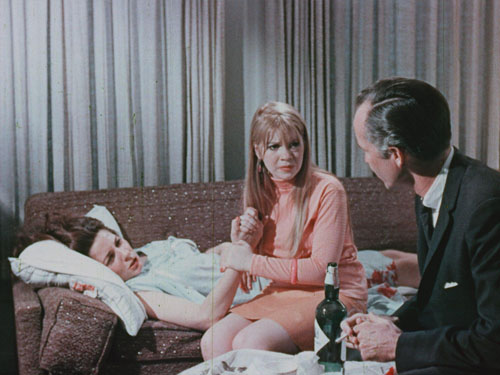
When the party ends, Ann and lesbian co-worker Terry (Joyce Danner) find their convertible mysteriously drained of gasoline. Good thing Mr. Bradley lives nearby so they can stay the night! It’s good only for him, so Ann and Terry can unwillingly participate in his science experiment. It entails being tied to a bed, whipped and subjected to eugenic inquiries such as, “What nationality were your parents?”

Bradley’s unstated hypothesis is if he removes his Hef robe, oils his carpeted chest and Pooh belly, then forces intercourse upon the women … I dunno, they won’t die? And if they do, well, that’s what the basement dungeon is for. There, previous subjects eternally pose topless in unconvincing rigor mortis. Upkeep on their corpses, like daily dusting, falls to the property’s requisite handyman of questionable IQ (Ivan Agar, Shriek of the Mutilated).

With Romine (the Bill Shatner-hosted weirdumentary Mysteries of the Gods) customarily packing in extended sequences of rug-cutting and breast exploration, this horror-tinged Harry Novak production (Hitch Hike to Hell, Rattlers, Kiss Me Quick!, et al.) goes the route of the rote, save for two surprises. One being that, in contrast to the sinister doings, Behind Locked Doors is shot with bright colors; the dungeon is especially vibrant, as if Orgy of the Dead were being shot 10 feet away. The second is Reeves isn’t more voluptuous without clothing. That’s exploitation for you. —Rod Lott

Get it at Amazon.

Dead Media (2025)

Instead of hitting the hay to rest for her grad-school audition, the irresponsible Maggie (Sammi-Jack Martincak, 2024’s Incoming) slums on the couch to watch a movie with her fellow Gen Z friends. I can relate to that desire. I also can relate to them having trouble deciding what to watch. In no way can I relate to Maggie spontaneously inviting her exasperating Uncle Heppy (Sam Landman, 2025’s Good Sport) to join, even over her girlfriend’s protests.

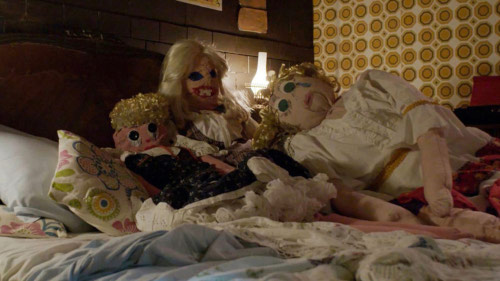
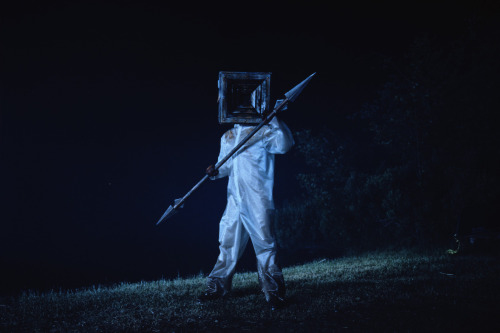
Heppy brings his rare DVD for Night of the Lurchers, an obscure 1999 B movie about zombie-like beings that suck the souls from people until they’re mere husks. The film is known for being cursed, with several crew members having died and the director disappeared, all under the usual mysterious circumstances. (The Venture Brothers’ James Urbaniak and Mystery Science Theater 3000 alum Bill Corbett provide film-in-film cameos.) And when Maggie clicks the proper buttons to unlock the disc menu’s rumored Easter egg, the world of the movie no longer restricts itself to staying on the backside of the screen.

As someone who lived — and purchased his way — through the peak DVD era and watched every disk’s special feature until the pile grew overwhelming, I should get a kick out of Dead Media. There’s no doubt writer/director Joseph Scrimshaw’s heart is in the film; it’s even in the right place. It just never catches a beat, as if biding time for someone to swoop in with the defibrillator paddles.

Like many first features, its rhythms are off. That shows up most in the cast’s overly exaggerated, performative approach, which was anathema to my enjoyment. Something of a calmer Rip Taylor, Uncle Heppy isn’t someone I’d want to be stuck next to in social settings (although he does have a killer Blue’s Clues insult), while Maggie is defined by her trauma — a current crutch of the horror genre. And her pals aren’t given much of a personality, other than that the woman (Jessica Fenton) likes to knit, while the guy (Antonio Teodoro) has a hair swoop that threatens to topple him and, for a split second, can be mistaken for Tig Notaro.

The premise to Dead Media has an analog ancestor in the VHS-oriented The Video Dead. As rinky-dinky as that 1987 rental is, its execution doesn’t annoy because the pic is campy by accident, whereas Dead Media tries too hard to be — until the conclusion, when it suddenly wants to get serious in a shift conducted without a clutch. —Rod Lott

Crosstalk (1982)

In a setup that in no way makes me think of the globe’s current overreaction to error-prone AI, the creator of the I-500 surveillance computer system is under serious pressure to rush his supposed technical marvel to the marketplace. No matter how often Ed (Gary Day, Death Warmed Up) tells corporate his prototype isn’t ready, the head honchos don’t listen because, duh, money.

Yet the I-500 really be buggin’. It forces Ed’s car off the road, paralyzing him below the waist and rendering him wheelchair-bound. Ed’s bosses kindly respond with a demand to finish the project by month’s end. To decrease distraction, they set him up in a swanky, 10th-floor apartment.

An Aussie omelet of elements from Alfred Hitchcock’s Rear Window, Brian De Palma’s Blow Out and Donald Cammell’s Demon Seed, writer/director Mark Egerton’s Crosstalk trips over its own plotting, uncertain of which track to take. The I-500 appears to continue trying to ixnay Ed, yet the creator also uses his creation to spy on a female neighbor — and hopefully solve what he assumes to be her murder by her philandering spouse (John Ewart, Razorback). You’ll never hear “insinkerator” more than within the film’s compact 83 minutes.

In some ways, this jumbled, two-left-feet approach resembles the indecisive, often contradictory visuals. After all, residents of the fancy high-rise reach their floors via an elevator that looks more like a shipping container for human trafficking. Not like the apartment interiors are much more pleasing with design that mimics two schools: New Orleans bordello and Atari-age science museum.

The much-hyped I-500 should knock our socks off, yet it’s an instantly dated, dual-reel mainframe spittin’ ones and zeros while taking up the space of a theater concession stand. I swear one of its monitors is devoted to generating nothing but digital Spirographs. Not even the sudden appearance of a disembodied head in a washer makes Crosstalk worth booting up. —Rod Lott

Get it at Amazon.