
All posts by Rod Lott

That’s a Wrap (2022)

After the success of 1996’s Scream, we were flooded with knockoffs. Now that the franchise has been resurrected with legacy sequels, respectable box-office earners themselves, another (smaller) wave of imitators has hit — few more brazen than That’s a Wrap.

In the movie, piggish director Mason Maestro (The Sex Files veteran Robert Donavan) and his wife (erotic-thriller royalty Monique Parent, Busted) gather his cast members — no plus-1s, no phones — to a premiere party for their new slasher film’s teaser trailer. That’s right: just the teaser trailer.

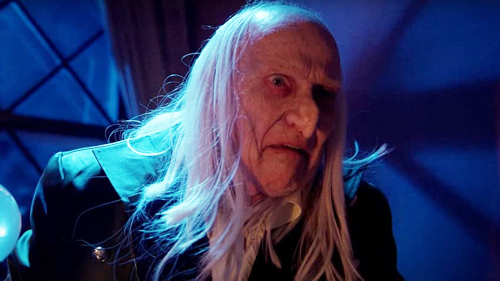
Maestro’s actors include the Black one, the gay one, the weird one, the stoned one, the prude one, etc. — all treated at surface level because they’re just here to be murdered, anyway, between discussions of the casting couch, going full-frontal and dying off-camera. Both in the Maestros’ masterwork of mayhem and then at the shindig, they’re stalked by the bewigged psychopath of the movie they just made.

If the meta-on-meta setup reminds you of Scream 3, congratulations! The difference being, That’s a Wrap is the one where a character jokes, “Girl, by the end of the night, I bet you’ll be getting nailed on a side stage,” and you know instantly and exactly where that’s going.

Among the large cast of partiers, only the always welcome Sarah French (Bermuda Island) is memorable. The others get lost in exchanges of truly moronic dialogue:

Girl: “Get your D-O-N-G hard.”
Guy: “Prepare your T-W-A-T.”
Girl: “It’s already marinating.”

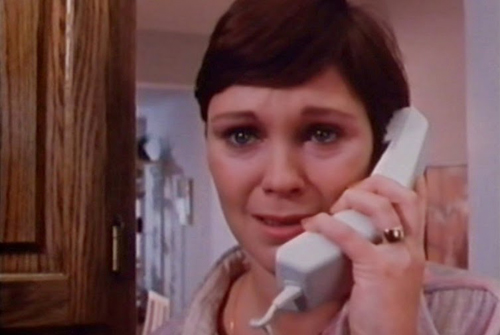
That’s a Wrap is at its most entertaining in the prologue, in which the radiant Cerina Vincent (2002’s Cabin Fever) vamps her way through the Drew Barrymore role. Meanwhile, Dave Sheridan, perhaps best known for the Scream spoof Scary Movie, self-reflexively cameos as the studio’s night-shift security guard.

This sequence whips up a decent chill or two as Blood Feast remake director Marcel Walz tries his best to give this show some stylish suspense. Then he abandons the tone — but not the light gels, oversaturating each setup in a crutch of primary colors. From here, the movie sweats an overt campiness that feels one international cut away from becoming pornographic.

If it’s gore you’re after, Walz will do you proud, staging kill scenes so graphic and suggestive, Carol J. Clover might be rushing to her word processor to crank out yet another updated edition of Men, Women, and Chain Saws: Gender in the Modern Horror Film. It’s often difficult to determine whether we’re supposed to interpret these acts as hellish or humorous. When one of those examples is a guy throwing his own disembodied dick at the killer, off whose head it bounces in slow motion, that’s a problem, That’s a Wrap. —Rod Lott

Get it at Amazon.

The University of Illinois vs a Mummy (2006)

Frisbee! Hacky sack! Sarcophagi! All abound the college campus in The University of Illinois vs a Mummy.

Yes, this is an actual feature.

No, it can’t live up to that incredible title.

But by no means is Chris Lukeman’s shot-on-video flick a case of false advertising. A nerd named Casey (Paul Karpenko) leads a small group of fellow first-year Fighting Illini through the halls of the natural history building to locate the 75-year-old mummy murdering undergrads. Its killer bandages shoot out in all directions — a nifty cheap effect — and no student appears safe. The mummy’s name is Ted.

Heavy in puns and slapstick, Illinois vs a Mummy reminded me a little of Zucker/Abrahams/Zucker’s solo-effort spoofs and a lot of Ray Dennis Steckler‘s misadventures with The Lemon Grove Kids, but using possibly less money. I don’t know whether the movie was made for a grade or just for fun; either way, Lukeman succeeded, even if most of the ingenuity comes front-loaded.

It’s never better than an early scene that gives new meaning to “freshman musical”: an all-out song-and-dance number that’s massively impressive in tune, delivery, choreography and sheer scope. Later, his editing skills are showcased in a video game-inspired fight sequence.

No doubt The University of Illinois vs a Mummy is best enjoyed by the school’s alum, but enough pieces are relatable for any one-time undergrad, what with the awkward first dates, parking tickets, crappy roommates, football rivalries and Egyptian slaughter. —Rod Lott

Get it at Amazon.

Dark Windows (2023)

Following the funeral for their friend who died in an auto accident they survived, pals Tilly, Monica and Peter (Anna Bullard, Annie Hamilton and Rory Alexander) escape to a farmhouse owned by Monica’s grandparents. Quaint, cozy and desolate/rural, the place offers much-needed solitude.

But, hey, who invited the masked killer? I’m no psychologist, but I do know this: The way to process trauma is not to throw more gasoline on the fire.

From awkward passes to alcoholic tendencies, the three friends of Dark Windows speak realistically and act realistically, which is to say they also react realistically. These characters are depicted as just all-around normal people. That’s refreshing for a horror film, particularly for a slasher, which tends to treat its players as stereotypes.

Their pain is real — not just physical, but emotional, adding all the difference. Conceivably, this one could happen. I’d call it a mature slasher if that didn’t sound like such a preachy fun-sapper. So I’ll do the Hollywood pitch thing and say it’s … oh, I Know What You Did Last Summer meets The Perks of Being a Wallflower. Sound good? Dark Windows is great, actually.

Economically staged without sacrificing quality on any level, it’s a gem from Norway, although in English. Aside from Hamilton (The Wolf of Snow Hollow), the young actors were unknown to me, all to Windows’ favor — unlike, say, its moniker, straight from the Spooker GeneroTitle-a-Tron (patent pending).

Norwegian-born helmer Alex Harron (Leave) impresses with an outsider approach to an all-American subgenre. He casts a pallid mood and remains in control of it throughout. He also offers an excellent jump cut; you’ll know it when you see it. And please do see it. —Rod Lott

Get it at Amazon.

Strays (2023)

On one hand, I can count the number of times a movie’s audience burst into applause at the climax:
• In 1981, when E.T. levitates the kids and their bicycles o’er the heads of authorities.
• Six years later, in Fatal Attraction, when Anne Archer shoots Glenn Close dead.
• And now, when four dogs — spoiler — rip Will Forte’s dick off.

Strays, ladies and gentlemen. Whereas singer Sarah MacLachlan famously tugged at your heartstrings in ASCAP commercials to get you to spend $18 a month to rescue dogs, Universal Pictures spent $30 million on a live-action comedy in which dogs’ mouths are animated to say “fuck” a lot. We’re talking Scorsese and Scarface level of “fuck”s. Add all the humping and the pooping — oh, do they ever hump and poop — and Strays is nothing if not filthy.

To be clear, that’s a plus, but only because the doers are adorable dogs instead of asshole adults. Will Ferrell voices Reggie, the canine so clueless he has no idea his ever-stoned, trailer-trash owner, Doug (Forte, MacGruber), has ditched him. Jamie Foxx’s Bug, a Boston Terrier, immediately befriends Reggie to share his street smarts. That includes an intro to his park-hanging pals, a pretty Shepherd (Isla Fisher, 2018’s Tag) and a cone-necked Great Dane (Randall Park, Office Christmas Party) who go all-in for a sausage string of episodic encounters — involving hungry eagles and hallucinogenic mushrooms — accompanying Reggie on his way back home to de-dick Doug.

Is there a normal child in America who wouldn’t laugh their ass off scene to scene? But Strays is hard-rated R on purpose, and that subversiveness often compensates for its narrow range of jokes, much like how Bug talks big to make up for his small size. And I don’t mean his penis, although the movie sure does. Several times.

Like Reggie, the film from director Josh Greenbaum (Barb & Star Go to Vista Del Mar) and screenwriter Dan Perrault (TV’s American Vandal) is cute, scruffy and just dumb enough you can’t resist giving it a little affection. Even if the CGI to animate the mutts’ mouths is often dodgy, like a paid version of your iPhone’s My Talking Pet app. —Rod Lott

Get it at Amazon.

Aesthetic Deviations: A Critical View of American Shot-on-Video Horror, 1984-1994

To consider Vincent A. Albarano’s look at SOV horror movies, Aesthetic Deviations: A Critical View of American Shot-on-Video Horror, 1984-1994, knowing what it’s not is the best starting point. As he makes clear from the outset, the paperback is neither a review guide nor a work of reference; by no means is it complete, restricted to a 10-year period.

The book’s subtitle wasn’t assembled for SEO purposes; Albarano has written a work of true scholarship, conceived as a thesis, which accounts for the use of words like “pugnacity,” “egalitarian” and “simulacrum.” It just so happens to study, in part, a horny ventriloquist’s dummy that looks like Rick James. (If your reluctance needs further calming, remember this one unassailable fact: Guys, it’s published by Headpress, K?)

After a brief history lesson on SOV’s start with such slashers as Blood Cult and Sledgehammer, Albarano combs through an overlooked, often spurned subgenre of “cinematic undesirables” in which “subtext is removed from the equation,” he writes. “They stick with the viewer despite their every wrong move. As a fan of these films, I’ve been puzzled by their very existence as much as I’m transfixed by their unique operations.”

Works from such backyard-and-basement moguls as Charles Pinion, J.R. Bookwalter, Carl J. Sukenick, Todd Cook and occasional punching bag Todd Sheets are examined. Other than the sheer range of titles covered, from the obvious to the unexpected, what I like most about Aesthetic Deviations is the author’s honesty; while he’s a fan of SOV, that doesn’t translate to slavish hyperbole. Instead, he’s unafraid to highlight both the uniqueness and misogyny of Chester N. Turner’s Black Devil Doll From Hell, praise the bravery of the Polonia Brothers’ Splatter Farm as he questions its anal-trauma fixation, or call out Gary P. Cohen’s Video Violence for reveling in the very thing it purports to vilify.

Although I didn’t realize until a footnote mentioned it, I’d read earlier drafts of two chapters in 2020, through Albarano’s one-shot zine on the topic, When Renting Is Not Enough (worth tracking down if you’d rather dip your toe before taking the full plunge). I’ll admit being skeptical of such a serious look at movies that “gain points,” per Stephen Thrower, “for being truly incoherent.” Yet like that lone issue of Albarano’s zine, the book that’s grown out of it is intelligent, thorough and, if you’ll grant it patience to make its case, accessible. —Rod Lott

Get it at Headpress.