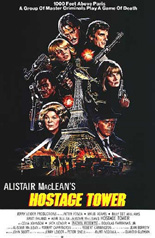
Master criminal and master of disguise Mr. Smith (Keir Dullea, 2001: A Space Odyssey) hatches a master plan to top them all: Take over the Eiffel Tower, befit it with stolen laser weapons, and hold it for a $30 million ransom to be delivered within 12 hours or it’s detonation time.
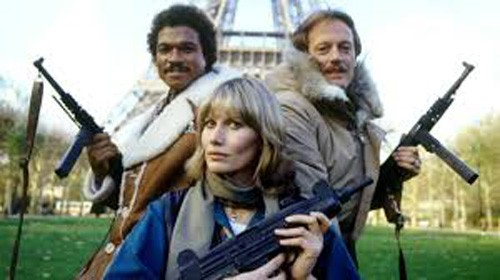
To carry out this felonious feat, Mr. Smith hires three professional crooks, each exhibiting a specialized skill: • a cat burglar (Billy Dee Williams, The Empire Strikes Back) • an ex-CIA weapons expert (Peter Fonda, Race with the Devil) • a woman (Ms. Octopussy herself, Maud Adams) who flees the scenes of her heists on roller skates
Who better to bring Alistair MacLean’s adventure story to the tube than Claudio Guzmán, director of Linda Lovelace for President? Hundreds, I’m sure, but he actually does a great job, yielding high rewards from a small-screen project. Thanks are due to the well-constructed plot and unique setting upon an international landmark. The Eiffel’s geometric compositions are irresistible to the eye, making Guzmán’s job that much easier.
I’m not sure why Fonda and Adams are in The Hostage Tower since their characters barely register once they arrive at Mr. Smith’s chateau for training on some scaffolding in the yard. Of the trio, Williams gets the most to do, from donning a Chef Boyardee hat to scaling down the Eiffel with an old woman (Rachel Roberts, 1978’s Foul Play) on his back. Speaking of the elderly, Douglas Fairbanks Jr. (1981’s Ghost Story) mans the intelligence community’s efforts from the ground, exclaiming “Jolly good, ol’ chap! What a pip!” Not exactly those words, but close enough. —Rod Lott
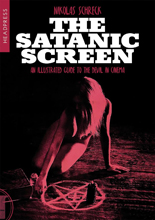
What differentiates The Satanic Screen: An Illustrated Guide to the Devil in Cinema is author Nikolas Schreck used to practice the Black Arts. That granted the original 2001 edition a seal of credibility, but this new, considerable update — courtesy of Headpress — allows him to cover dozens of titles that didn’t exist, like Megiddo: The Omega Code2, in a hilarious review that alone is worth the price of purchase. In his intro, Schreck asks, “Who the hell is the Devil anyway?” then answers with a thorough history lesson spanning the life of cinema. Yes, horror films abound, but Satan pops up in costumed dramas, British comedies, kiddie matinees, mondo docs, animation, pornography and even an “all-Negro musical” from Vincente Minnelli. From Kenneth Anger to Irwin Allen, Ingmar Bergman to Ed Wood, our writer proves to be the authority of the evil one’s vast filmography. Surrender!
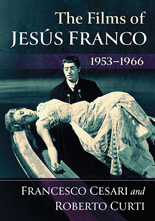
Another year means another McFarland & Company publication from Roberto Curti. As prolific as he is, his subject this time makes him look lazy by comparison: cult icon Jess Franco. Co-authored by Francesco Cesari, The Films of Jesus Franco, 1953-1966 examines the works of the Spanish director from his start — his pre-OB/GYN cinema, one might say. As is Curti’s wont, each pic — from puffery like Attack of the Robots to artistic triumphs like The Diabolical Dr. Z — reliably devotes coverage so in-depth, they may as well be a submersible. What really makes this Jesús text special is how heavily it goes into Franco films we’ll never see, from his university short Theory of Sunrise, a debut “ignored” by other Franco texts, to Treasure Island, an abandoned ’64 adaptation/collaboration with Orson Welles. One Yank’s quibble: The movies are listed in Spanish, so unless you know your Red Lips from your Labios rojos, keep the index bookmarked.
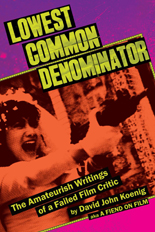
I thought my own book did a decent job of mining some obscurities … then along comes Lowest Common Denominator: The Amateurish Writings of a Failed Film Critic to show everybody up on that front. Written by David John Koenig, aka “A Fiend on Film,” the self-published paperback might review as many movies I’ve never heard of as it has pages! That’s because Koenig’s tastes lean toward the Asian, underground, microindie and black-and-white crime pics as old as my grandparents. Needless to say, my Tubi list grew exponentially as I read. And read. And read! From A to Z, I didn’t miss a word and, as a result, got exposed to a whole new world.
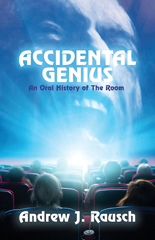
When a movie gains a fervent, coast-to-coast cult, multiple books on it inevitably follow. That’s certainly the case with Tommy Wiseau’s The Room. I reviewed two of them a decade ago, and now it’s time to add a third with CLASH Books’ release of Accidental Genius: An Oral History of The Room. Think the world doesn’t need another? Think again. Andrew J. Rausch, whose workIlove, goes deeper on the topic than any medium before him. With dozens of people weighing in, his task as curator and craftsman couldn’t have been easy, but as a read, it sure is. The anecdotes are as crazy as a Room viewer could hope for, from using Greg Sestero’s facial hair as a guide for editing the nonsensical scenes into something watchable to Wiseau’s desire to perform his sex scenes unsimulated. On purpose, Accidental’s a lot of fun, as entertaining as it is thorough — enough to make you want to exclaim in joy, “Hai, doggy!”
Enjoyed the historical aspect of Vincent A. Albarano’s recent Aesthetic Deviations: A Critical View of American Shot-on-Video Horror, but wish it also had room for reviews and interviews? Then you’re going to love Justin Burning’s Hand-Held Hell: The Outbreak of Homemade Horror. With a title like that, how could you not? Well, quite easily, were we in the hands of a poor writer, but that, Burning is not. Covering a mind-boggling 40 years’ worth of SOV projects, he gives great insight about movies I’ve not only seen (Video Violence), but seen more than once (Black Devil Doll from Hell), wish I could unsee (The Burning Moon) and absolutely never will see (August Underground). Interspersed among these 44 movies are interviews with nearly two dozen directors — including such household Hanekes as Tim Ritter, Bret McCormick and Donald Farmer — and full-color photos, all in a trade-paperback package heavy enough to challenge your wrists’ strength. For the right type of person (like you and me), this trip through Hell feels like heaven.
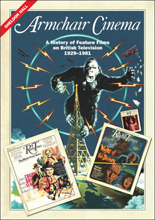
As someone whose film knowledge began on watching movies on UHF channels and read the Sunday paper’s TV listings supplement in full, Armchair Cinema: A History of Feature Films on British Television, 1929-1981 stirred nostalgia in this American. It’s a shame the Edinburgh University Press title costs such a pretty penny, because I suspect like minds would find it catnippy, too. Leslie Halliwell (he of the Halliwell’s Film Guide) emerges as a hidden hero as Sheldon Hall looks back at when the tube saw movies as wasted space, then slowly changed their minds. Yes, the book contains numerous data tables of airdates and whatnot you might find useless, but Hall packs his pages with so many compelling stories. Learn how the Carry On comedies doubled box office after broadcast, how sneaky U.S. distributors passed off Edgar Wallace and Sherlock Holmes flicks as TV shows to get around a limit, and why a UK exec was “utterly revolted” by 1933’s King Kong. King Kong! —Rod Lott
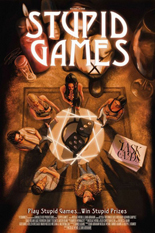
If there’s a saying I wish social media could ban, it’s, well, hundreds. But “Play stupid games, win stupid prizes” vies for the top spot alongside fellow bandwagon comments as “All the feels,” “I’m not crying, you’re crying” and, of course, “This.”
At least the movie Stupid Gameshas good reason for plopping the sentence on a title card, as what follows is a literal depiction of the adage.
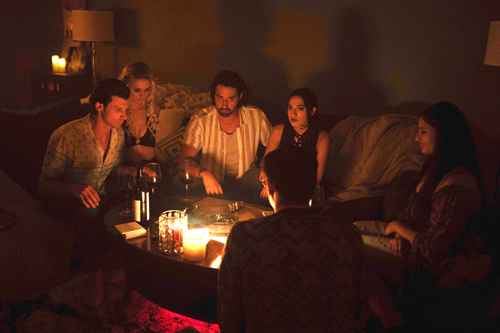
Three young women host a dinner and game night at their apartment. They invite three guys, oddly insisting on the 1:1 gender ratio. We know something is up — we’re just not sure what. By candlelight, the assembled six play a board game whose rules mix Truth or Dare with Two Truths and a Lie; Fuck, Marry, Kill; and a bag of Scrabble tiles.
And by “play,” I mean it, as the flick devotes nearly an hour to watching them do so in real time. As proven, that can make for some serious screen boredom, yet Stupid Games might be the exception. Although the acting is inconsistent and its visual palette overly dependent on blah hues of brown, we keep watching because of Tanner Adams’ script: For nearly two-thirds of the running time, we’re not quite certain where it’s going, but we genuinely want to see the destination.
How co-directors Nicolas Wendl and Dani Abraham (both helming their first feature) handle the eventual “bogeyman,” so to speak, is eerily effective for something so simple. Sometimes, having a $10,000 budget that makes CGI cost-prohibitive is a good thing. —Rod Lott
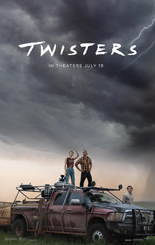
More remake than reboot, Twisters follows the story of 1996’s original Twister beat for beat. To reflect the changing times, it adds drones, influencers and merch. Instead of merely launching those silver data-capturing balls into a tornado, these Oklahoma storm chasers shoot fireworks up its hole and, with any luck, barrels of absorbent-diaper chemicals in hopes of shrinking it.
Filling the void vacated by Helen Hunt and Bill Paxton are, respectively, the British Daisy Edgar-Jones (2002’s Fresh) and the Texan Glen Powell (Top Gun: Maverick). She’s a headstrong meteorology expert with a preternatural sense for anticipating the weather; he’s a hotheaded YouTuber in a pickup truck whose shock absorbers probably get replaced as often as the gasoline. Will the two be able to set aside their differences, survive the suck zone and find love? Only one hour and 57 minutes know for sure.
Actually, that’s not true; everybody knows, sight unseen. And that’s fine. No one will see Twisters expecting complicated and unforeseen plot machinations — starting, apparently, with screenwriter Mark L. Smith (2015’s The Revenant), who resolves two points of non-tornadic conflict between Edgar-Jones and Powell and third wheel Anthony Ramos (Transformers: Rise of the Beasts) with a sentence apiece.
And that’s fine, too, because what we want from Twisters are said twisters, right? Well … although we get them, they swoop down in sloppily staged and edited set pieces. As cheesy as the OG Twister was, its cyclone sequences felt propulsive, viewers were spatially aware at all times and the shots cut together well. Here, in a big leap to blockbusters coming off the excellent, Oscar-winning indie Minari, director Lee Isaac Chung seems out of his element. Oklahoma’s waving wheat sure looks sweet with Chung’s eye for landscapes, and he certainly brings more humanity to this sequel, but at the sacrifice of action.
I equally miss Michael Crichton’s pop-science sensibilities, if only to make the clunkiest of weathersplaining dialogue exchanges swallowable. Edgar-Jones appears particularly at unease with such material, as if she’s better than it — which she is. While I’m not yet aboard Powell’s populist brand of aw-shucksness as the rest of our nation, he knows how to modulate it to fit the vibe.
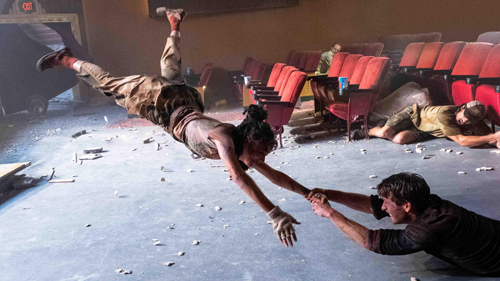
Intended or not, when the F5 bursts through the screen of a movie theater in the climax, it’s hard not to read it as Chung’s subversive metaphor for the death of cinema. Twisters isn’t the nadir of modern studio-tentpole IP, but it qualifies as a disappointing follow-up — and to a movie that, being decent at best, had set a low bar. Warner Bros.’ low-rent Into the Storm (which I’m convinced comes from a rejected Twister 2 pitch) entertained me more than Twisters, and that 2014 movie is so bad, my sisters-in-law remain irate with me to this day for playing it. —Rod Lott
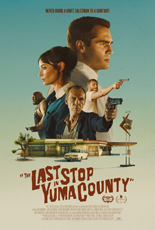
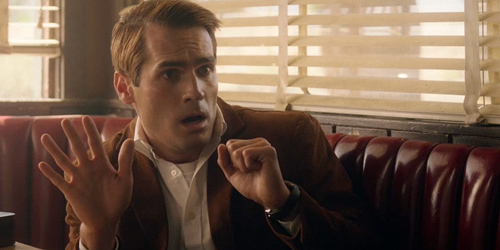
Take one milquetoast traveling salesman. Place him in a diner that’s empty, except for a kindly, beautiful waitress. In another movie, you have the ingredients for the meet-cute of a romcom. In The Last Stop in Yuma County, however, you have a starter kit for a powder keg.
The wonderful and underrated Jim Cummings (The Beta Test) is that salesman; the equally wonderful and underrated Jocelin Donahue (Doctor Sleep), the waitress. Car trouble has him stranded for the near future in the middle of nowhere, Arizona, so he bides his time in a booth at the restaurant next door, even if its A/C is as inoperable as his ride. Coffee and conversation follow. So do crimes, eventually, as more people pass through the door.
To spill the details would deny you the pleasure of experiencing each of the plot’s many about-faces and sudden turns; several surprised me, and one hits as such a rude awakening, it’s the cinematic equivalent of a tasing. Once tension arrives, which is early, it never leaves.
Shocking, sad and funny, the film is nearly a one-roomer, save for a few scenes outdoors and at the local sheriff’s office, which is not too far and also not near enough. Taking into account the arid climate, saloon-style setting and mix of characters of varying savoriness, Yuma County plays like a contemporary Western. I mean, it’s right there in the title, starting with — but hardly limited to — a direct reference to Delmer Daves’ 3:10 to Yuma, a genuine cowboys-and-outlaws classic.
Doing its part to support that theory is the pervasive heat; the oscillating whirs of each electric fan seem immediately defeated, and the audience feels that heavy oppression. (Or, as a lifelong Oklahoman, maybe it’s just me.)
I’ve seen others compare The Last Stop in Yuma County to the Coen brothers, specifically Fargo. That’s perhaps too reductive, although if the TV series‘ next season needed a new creative force, writer, director and editor Francis Galluppi would be a steal.
With Yuma County so assured, it’s difficult to fathom that the list of Galluppi’s previous features is blank, yet it’s easy to see why he’s been snapped up to deliver a new Evil Dead spinoff. The guy knows how to craft, build and sustain suspense. The proof is all here in a tight, taut 90-minute examination of avarice, heartlessness, helplessness and the restorative properties of rhubarb pie. Of all the movies to hit theaters in the first half of 2024, this one remains my favorite. —Rod Lott