
All posts by Rod Lott

Chameleons (1989)

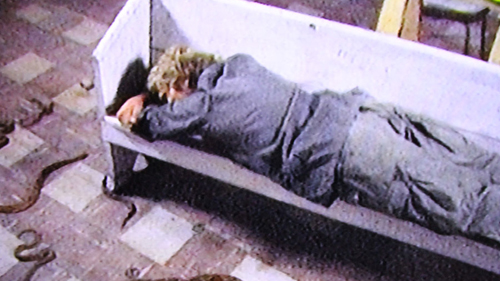
Mere months after Tim Burton’s Batman dominated not just the box office, but American cultural consciousness, ABC responded with Chameleons, a pilot movie for a new superhero series directly influenced by the Dynamic Duo. Just swap out Batman for one Captain Chameleon, replace Robin with the Paraclete of Justice, trade in the Batmobile for the Car-meleon and, well, there’s a reason you’ve never heard of this. 

Dozens, actually — only one of which has the nation wondering what a goddamn Paraclete is. 

In his last feature, swashbuckling legend Stewart Granger (1950’s King Solomon’s Mines) plays elderly publishing magnate Jason Carr, who moonlights as the Paraclete of Justice … but not for long, as black-robed, computer-voiced cult members kill him, staging his death as a heart attack “in bed with a sleazy hooker.” 

Carr’s sanitarium-patient granddaughter, Shelly (Crystal Bernard, Slumber Party Massacre II), investigates with the occasional help of Captain Chameleon (Marcus Gilbert, Army of Darkness). To justify his name, CC dons an invisibility cape and changes his costume’s color with the turn of a belt buckle that looks like a Trivial Pursuit piece with all six wedges filled. Presumably unrelated to lizard camouflage, he also ziplines to jaunty harpsichord music. Meanwhile, Shelly conducts undercover work posing as a prostitute. 

From prolific TV creator Glen A. Larson (Battlestar Galactica, Knight Rider, The Fall Guy, et al.), Chameleons is woefully out of touch. It’s like Larson’s knowledge of superheroes began and ended with Archie Comics’ Pureheart the Powerful. Bernard’s Shelly is all curls and homespun homilies, like a proto-Reba. 

As a result, no one cared; a series did not follow. Karma, Chameleons. —Rod Lott

House of Traps (1982)

Pay no attention to House of Traps’ opening narration, which throws more names at viewers than its actors hurl metal darts and spears. The multigenerational mishmash of backstory gets spewed so quickly, not even Rain Man could keep up.

Ultimately, this is all that matters:
House of Traps indeed features a house of traps.
• It’s a Shaw Brothers production.

At the heavily guarded House of Traps, a stolen jade horse is hidden alongside other purloined treasures of the imperial court. Everybody wants to get their hands on that horsey booty. To do so, they “only” need to ascend the levels of the foreboding abode, so named for such automated amenities as — ADT, take note! — floor spikes, razor stairs, swinging blades, sliding walls, pop-up jails and something called the “deadly copper net trap,” which might send a rush of blood to Jigsaw’s crotch.

Speaking of cocks, one gets slammed onto a bed of nails. Speaking of animals, the fighters all have cool names like Black Fox and River Rat. Sometimes it’s hard to tell whether a character stands on the side of good or evil; if a voice sounds in urgent need of a deliciously soothing Luden’s, that’s a telltale sign for “villain.”

With martial arts movies, I’m most drawn to those with unique concepts. From that standpoint, House of Traps is tough to beat. From Crippled Masters to Five Deadly Venoms, director Chang Cheh made this style his bread and butter. While generously demoing the lethal devices throughout, he saves the bulk for the third-act showdown. Needless to say, it’s a real ass-kicker!

As usual, characters dine at a restaurant where wine is kept in what may as well be an outdoor planter, and there’s also an old man with a beard so uncomfortably long and wispy, it could double as a crumb duster. Unique to this film, he’s terrified by comedy and tragedy theatrical masks, as well as acts of turtle magic. —Rod Lott

Get it at Amazon.

Blind War (2022)

As often happens to the sightless in the movies (Blind Fury, Daredevil, Don’t Breathe, et al.), a positive side of the disability manifests: a preternatural sense of hearing. Such is the case for former Special Forces Capt. Dong (Andy On, Black Mask 2: City of Masks) after he’s blinded by a grenade flash in a courthouse siege. That complicates Dong’s first civilian mission: Rescuing his kidnapped daughter, a violin prodigy, from auction on the dark web. Villains number many, with Jane Wu (Teenage Mutant Ninja Turtles: Out of the Shadows) sexing things up and standing out in a too-brief role as the Dragon King.

Frequent On director Suiqiang Huo (Demon Sealer Bureau) appears to relish in the potential of the script’s setup. It’s Taken ripped from the pages of the Braille book of revenge. However, he fails continuously to give consistency to Dong’s aural power. The guy can dodge bullets by listening for the slightest trigger click … yet somehow fails to notice the oncoming van speeding toward him in an enclosed parking garage. 

Blind War can’t its find way to a satisfying whole. The action sequences can delight, but not all do. Among the most memorable involve a chain-and-dunk-tank contraption that could come straight out of Saw and, at the end, the ol’ ticking bomb our visually impaired hero must defuse. On the downside, not enough story beats exist to fill the gaps, and the back-half inclusion of a bumbling detective (a debuting Dao Dao) sits way too far on the Inspector Clouseau end of the comic-relief spectrum.

All in all, the Chinese film is a case of the blind leading the bland. It’s not the fault of its star, who brings his easy likability and striking physicality to the role. Selfishly, I just wish he’d brought his gorgeous wife (and Zombie Fight Club co-star), Jessica Cambensy, too.  —Rod Lott

Get it at Amazon.

Shantytown Honeymoon (1971)

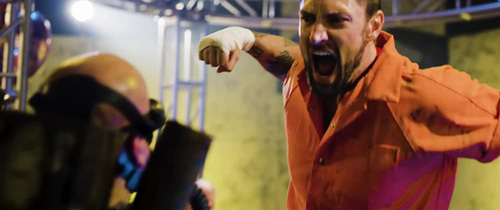
Originally known as Honey Britches, Donn Davidson’s Shantytown Honeymoon is best known under the name Troma slapped on it in the VHS heyday: Demented Death Farm Massacre. Even with Troma’s appended John Carradine prologue, the retitling is misleading for what more or less plays as a feature-length version of a dirty joke.

After a high-profile jewel heist, four criminals — whose erudite leader, Philip (Jim Peck, Pet Sematary II), resembles early SNL fixture Michael O’Donoghue — need to lay low. One downed plane and stolen Jeep later, they stand at the stoop of the rural ramshackle home of age-disparate spouses Reba Sue and Horlan, respectively played by porn actress Ashley Brooks and horror host George Ellis. She’s a real cutie patootie in her sexual prime, whereas he looks like he placed fourth in a Sid Haig lookalike contest he didn’t even enter. 

Philip’s got his hands full trying to keep the hands of a fellow felon (Mike Coolick, Can’t Stop the Music) off Reba Sue’s full bosom, plus the hands of horny ol’ Horlan off their own lovely ladies (one-timers Pepper Thurston and Trudy Moore). This being a sexploitation confection, Philip fails marvelously. This also being a hicksploitation effort, the opening and closing credits are chalked on a wooden fence.

Davison (Blood Beast of Monster Mountain) gives this cheapo Honeymoon doses of crude gore à la H.G. Lewis: a bear trap to a leg, a pitchfork to a neck, a corn liquor jug to a forehead, and so on. Its best effects are the chest objects, but you’d be surprised how Shantytown is more about teasing the T&A than showing ’em — hardly an issue when the redneck romp’s lackluster acting, bathroom-wall scripting and scene-to-scene discrepant pacing amount to a good time, despite your better judgment.

Granted, the movie is about half as much fun as it is stupid. But, folks, this one’s mighty stupid. —Rod Lott

Get it at dvdrparty.

Exhuma (2024)

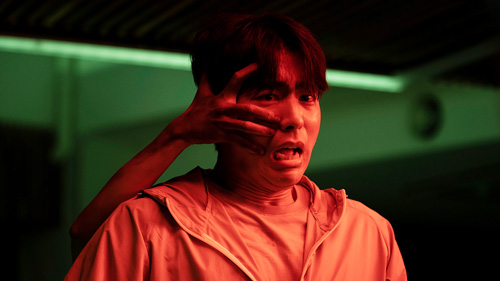
Operating somewhere between science and superstition, a shaman and her protégé (Kim Go-eun and Lee Do-hyun, respectively) acquire the case of a wealthy client (Hong Seo-jun) whose newborn son won’t stop crying. As the shaman determines, the baby and father are part of a lineage in which all firstborns are haunted, thanks to an ancestor having a tantrum.

With assistance from a mortician (Yoo Hai-jin) and an aging, vaping geomancer (Oldboy himself, Choi Min-sik), the solution exists in an exhumation ceremony. Or so they think. 

Told in chapters like a thick, chewy novel, Exhuma is a slow burn of high order, almost to the level of The Wailing. The way writer and director Jang Jae-hyun gets into the story is intoxicating, giving his audience a good 15 minutes to determine on our own whether the principal characters are believers or scammers.  

Following up his first two films, the acclaimed Svaha: The Sixth Finger and The Priests, writer/director Jang Jae-hyun completes an unofficial trilogy of religious-based horror. Rather than merely use the themes as a crutch or entry point, Exhuma positively drips in adherence to rituals, as well as man’s ability to set aside skepticism in times of desperation.

While the movie maintains an ominous vibe for more than two hours’ time, breaking tension only for masterfully constructed scares, its best scene is when our protagonists set out to ease the restless spirit in the excavation rite. We see it in full, step by step, including fire, knives, drums, dance and five impaled pig carcasses — all carefully choreographed in such a massive production it could take Broadway by storm. We accept it because the actors sell that their characters do; their incredible and realistic chemistry goes a long way, too.

Even if my knowledge of Korean culture isn’t up to the level the movie assumes, it doesn’t matter. I also can’t deny the mastery at work. With a few surprises up its sleeve — or in the ground and within mirrored surfaces — this is horror on an epic scale. Resist the urge to pause and rewind to confirm what you think you just saw. At least give yourself over to one full viewing first, the way it’s intended. —Rod Lott

Get it at Amazon.