
All posts by Rod Lott

The Hellraiser Films and Their Legacy

hellraiserfilmsRecently I read Stefan Jaworzyn’s The Texas Chain Saw Massacre Companion, which sets out to cover the entire franchise (up to its 2004 publication date, at least), yet does it in a way that’s lazy, shoddy and unfriendly to the reader. By contrast, Paul Kane’s The Hellraiser Films and Their Legacy shows how a retrospective on a horror-film franchise — or on any genre, really — should be done. It’s not difficult.

Jaworzyn’s book is not new, and neither is Kane’s, but the latter is now available in a reprint — and in a much more affordable paperback edition, at that — from McFarland & Company. Needless to say, any Hellraiser fan worth his or her satanic salt should own it.

Benefitting from a wealth of interviews, Kane recounts Clive Barker’s creation of the world of the Cenobites in The Hellbound Heart and his aim to bring that novel to the big screen himself, having been less-than-enthused about what filmmakers had done with adapting his work prior (see: Transmutations or Rawhead Rex — or don’t, as Barker would prefer).

We now know he succeeded, but in real life, conclusions aren’t so foregone. Turns out, there’s a real story to be told of the 1987 hit’s making, including battles over the budget and its rating. Hollywood’s response was not to give Barker creative freedom on his next project … but to offer him Alien 3.

Kane could’ve stopped there, but instead continues giving the same thorough, behind-the-scenes treatment for each and every sequel (except 2011’s Hellraiser: Revelations, made after the book’s original 2006 publication), whether released theatrically or straight to home video. Among them, the greatest tale of production belongs to the tortured one of the series’ fourth, 1996’s Hellraiser: Bloodlines, the one that sent Pinhead into space and took three directors to complete, if you count the infamous Alan Smithee disowning pseudonym to whom it’s credited.

Smartly avoiding start-to-finish, beat-for-beat synopses, Kane instead follows each film’s story of conception with an exploration into the themes it presents and probes. Luckily, the author does a damn good job of it. Rounding out the book is a brief look at Hellraiser‘s entry into other media, most notably comics.

Jesus wept … for joy! —Rod Lott

Buy it at Amazon.

Wanna Win The Guillotines?

guillotinesUPDATE: Winner is Caleb Forrest!

We’re giving away a copy of The Guillotines on Blu-ray to one lucky summabitch in these United States of America. How to enter? Easy!

Just leave a relevant comment on any review on this site before next Saturday, Aug. 24. That’s when one lucky commenter will be picked at random to have this movie shipped to his or her door. Winner will be notified via email, so make sure the email address you leave to comment is a valid one.

Buy it at Amazon.

Tombs of the Blind Dead (1972)

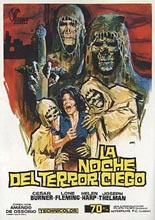
tombsblindHaving recently located her thriving mannequin-manufacturing biz to Lisbon, Betty (Lone Fleming, 1977’s It Happened at Nightmare Inn) reunites with Virginia (María Elena Arpón, The House That Screamed), her roomie from boarding school. Virginia’s square-jawed boyfriend, Roger (César Burner, Green Inferno), immediately suggests the three of them take a train trip to the countryside.
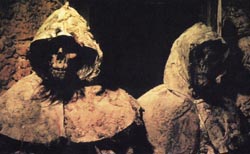
En route, Virginia gets jealous of a growing flirtation between her beau and her BFF, so she leaps off the choo-choo. Instead of walking the tracks back to the station like a normal person, however, she heads off perpendicular to them, through spacious fields to the ruins of Berzano, a medieval town now abandoned for good reason: Because up from its cemetery pop the ghosts of the Knights Templar, depicted here as skeletons in soot-covered hooded robes. (Where the risen knights keep their horses goes unaddressed.)

tombsblind1Yes, Virginia, there is a supernatural force of evil awakened! You’ve disturbed the Tombs of the Blind Dead! The first in writer/director Amando de Ossorio’s four-film series, the Spanish Tombs comes unearthed with a twist on the ol’ zombie conceit: On account of having their eyes pecked out by crows in the 13th century, these guys can’t see a lick; with a thirst for blood, they track their victims by sound, from dire screams to a quickened heartbeat.

Even though the Blind Dead move like semi-frozen molasses, they are terrifying characters. The way their bones pop through graves and shuffle through the maze-like ruins is a dirt-cheap effect, yet highly effective, encouraging viewer cries of “Run, bitch, run!” as they close in on their clueless prey. Other than an ugly rape scene, de Ossorio demonstrates keen instincts on what works, right down to an ending that proves more disturbing by letting your mind fill in its blanks. —Rod Lott

Buy it at Amazon.

Mean Johnny Barrows (1976)

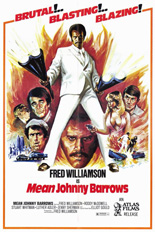
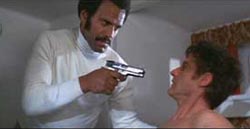
meanjohnnyIn (and as) Mean Johnny Barrows, Fred Williamson (Black Caesar) plays a decorated Vietnam solider dishonorably discharged from the service for punching a soldier who made him step on a live land mine. Back in California, Unemployed Johnny Barrows can’t seem to find a job. I don’t think it helps that all he wears are jeans so poorly acid-washed that it looks like he peed in them.

Eventually he gets tied up with the mob, hired to be a hit man for $100 grand and a piece of land. One of his assignments is to take out gangster Tony Da Vince, played by Roddy McDowall. After watching the Planet of the Apes star attempt to act like an Italian mobster, I now know where Dana Carvey found the inspiration for his Pistachio Disguisey character in The Master of Disguise; McDowall is more convincing kissing the curvy mob moll — and that’s saying something.

meanjohnny1By the finale, Ambidextrous Johnny Barrows infiltrates a mob boss’ hideout with a shotgun in each hand. Minutes later, he’s defeating an opponent with a well-aimed Chinese star to the eye, making him Master Ninja Johnny Barrows.

Directed by Williamson himself, Mean Johnny Barrows also stars slumming white folk Stuart Whitman (Night of the Lepus) and that noted blaxploitation staple Elliot Gould (Ocean’s Eleven). The actioner ends as all actioners should: with the words “Dedicated to the veteran who traded his place on the front line for a place in the unemployment line – peace is hell” superimposed over a freeze frame of a honky bitch getting blown to smithereens. —Rod Lott

Buy it at Amazon.

The Sinful Dwarf (1973)

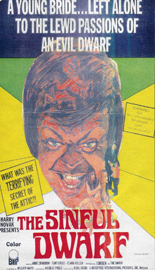
sinfuldwarfTalk about a housing crisis! In The Sinful Dwarf, lovely young female renters of a boardinghouse are locked away in a secret attic room, where they are stripped naked, drugged up and whored out. On the bright side, each woman gets her own dirty mattress.

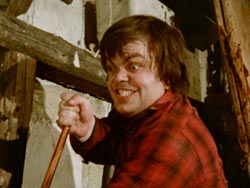
Who’s the landlord of this hellhole? That’d be former showgirl Lila Lash (Clara Keller) and her pint-sized son, Olaf (Torben Bille). He’s the dwarf of the title, but to call him sinful is like calling Hitler mean: a major understatement. With a rapey grin, Olaf does a lot of the luring and administering doses of horse into the girls’ hungry veins via crooked, rusty needle.

sinfuldwarf1Given the vacant, narcotized stares of these sex slaves’ faces, one might assume no acting was taking place. Olaf is eager to add Mary Davis (Anne Sparrow) to the stable; she’s one-half of a newlywed British couple forced by financial difficulties to take temporary residence there. They certainly break in the bed, explicitly.

Shot in Denmark, The Sinful Dwarf marks the directorial debut and swan song for Vidal Raski, and it’s the only credit for several of its stars, including Keller and Sparrow. Ironically, Bille enjoyed a fairly healthy career afterward, despite the horrible things he does with a wooden cane.

Notoriously sleazy, The Sinful Dwarf is every bit as unpleasant and depraved as its rep promises. However, amid all its dehumanizing elements, the worst thing about the film is how dreadfully boring it is. —Rod Lott

Buy it at Amazon.