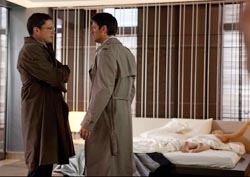
 Rob Corddry does a good job of playing a total jerk. Too good, in fact — like, the Laurence Olivier of assholes — and it makes Hot Tub Time Machine 2 an oppressive experience. Without John Cusack returning to anchor the ensemble, the group dynamic that worked well (enough) in 2010’s original Hot Tub Time Machine is thrown off — way off — and not even the addition of Adam Scott (TV’s Parks and Recreation) can save it.
Ideally, characters should interact with one another in a way that achieves balance, so that those best in small doses remain in small doses. Here, it’s like that jerk kid on the school playground who would jump off the teeter-totter while you were at the highest point in the air, so you would come crashing to the ground with too little notice to do anything about it.
 As HTTM2 opens, fatuous Lou (Corddry, Sex Tape) is swimming in millions from co-opting the best business ideas since the first film’s time trip. Nick (Craig Robinson, This Is the End) is swimming in millions from co-opting all the hit songs since. And Lou’s loser son, Jacob (Clark Duke, Kick-Ass 2), is still a loser, having co-opted nothing. Success-to-excess turns to tragedy when Lou is shot in the penis (ha) by an unknown assailant at his own shindig. To save him and his junk, the trio leaps into the titular dimension-trippin’ Jacuzzi for another rollicking adventure in history.
Immediately, two things go wrong:
1. Instead of going back in time to prevent the violent act, they accidentally jettison 10 years forward.
2. Comedy does not travel with them.
Not everything should be sequelized. The original HTTM was just clever enough in tweaking the collective nipple of 80s sex comedies to surpass being a one-joke movie — with its title being that joke, of course. By contrast, HTTM2 actually is a one-joke movie — one good joke, at least; featured prominently in the trailer, it involves the TV series Fringe.
What returning director Steve Pink and lone credited screenwriter Josh Heald (one of three during the first dip) consider to be jokes simply do not translate as humorous, no matter how many times they trot them out. All of them lazy and low-hanging, these gags fall into three categories:
1. saying “fuck” simply for the sake of saying “fuck”: 145 times in 93 minutes.
2. gay panic and/or fear of anal rape to the point of homophobia.
3. stoner references that assume their mere mention is the setup, delivery and punch line, all in one. —Rod Lott
Get it at Amazon.

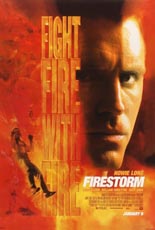
 In what has to be the orangest movie ever made, former NFL defensive end turned Radio Shack pitchman Howie Long has his first — and thankfully only — vehicle as an action hero. He’s Jesse Graves, one of an elite crack team of “smokejumpers,” those specially trained firefighters who parachute into raging blazes in forests and other wildlife sites.
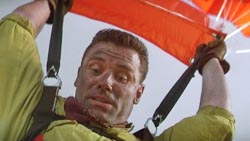 As an action film, Firestorm is as mediocre as it is rote as it is orange. (At least it’s a great-looking orange, being directed by Dean Semler, Oscar-winning cinematographer of Dances with Wolves.) As an action hero, the amiable but insignificant Long is … well, not. In fact, every time he turns toward the camera, you expect to be pitched a cell phone. —Rod Lott
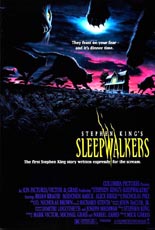
 Where, oh, where would Mick Garris be without Stephen King? The unemployment line? (I’m asking for a friend.) The number could change between the time I hit the “publish” button and this sentence hits your eyes, but Garris has directed seven movies scripted by and/or adapted from the superstar horror author’s work. Although Garris already had achieved mild acclaim with his two first features, 1988’s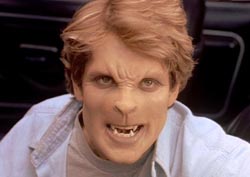
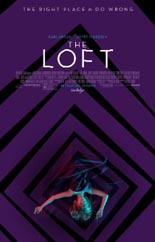
 There must be something to the story of