
All posts by Rod Lott

She Rides Shotgun (2025)

Because career criminal Nate doesn’t pledge allegiance to skinheads when he’s released from prison, the gang puts a hit on his family members’ heads. As She Rides Shotgun opens, Nate’s ex-wife already has been snuffed out, leaving his 11-year-old daughter next in line.

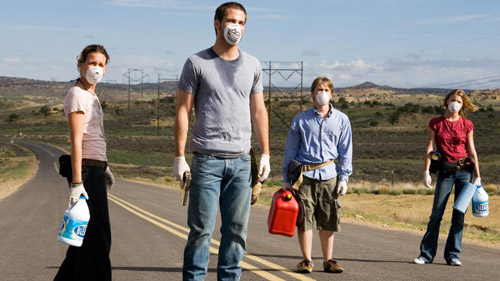
So when Nate (Taron Egerton) zooms up in a stolen car, Polly (Ana Sophia Heger) reluctantly joins her father because she barely knows him. It’s not like she has a choice, but it beats certain death. Suddenly, it’s a hard-knock life for her — on the run, on the lam and getting a crash course in cracking skulls.

A sympathetic police detective (Rob Yang, The Menu) gives Nate a shot at redemption: taking down “the meth house to end all meth houses.” It’s more a village of RVs lorded over by a corrupt town sheriff with a god complex (John Carroll Lynch, Zodiac).
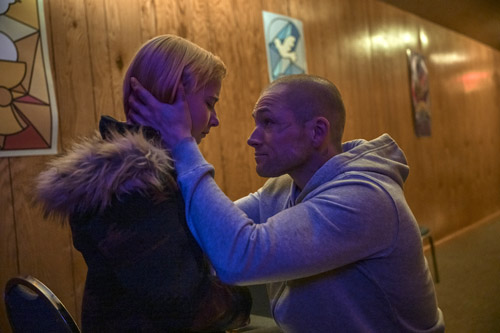
Adapted from Jordan Harper’s Edgar Award-winning 2017 crime novel by Super Dark Times screenwriters Luke Piotrowski and Ben Collins, She Rides Shotgun arrives on screens softly, but carries a big stick — a metal baseball bat, to be precise. You might not believe me given the movie’s unfortunate tagline of “All a father needs is a fighting chance.” Pay no attention to that, as on-the-rise director Nick Rowland (The Shadow of Violence) is able — nine times out of 10 — to avoid the cloying sentimentality that clouds kindred efforts.

Rowland won me over with nail-biting tension in the first scene. A midpoint car chase following a botched convenience store robbery crackles with intensity, too, as Underworld’s “Denver Luna” sets pace. In those instances and more, the movie feels like Luc Besson’s The Professional if Léon and Mathilda shared common DNA.

Onboard as a producer, Egerton has shown real growth as an actor post-Kingsman, most notably on Apple’s Emmy-winning Black Bird limited series. His excellent work there was overshadowed by Paul Walter Hauser, also excellent, in the meatier supporting role. A similar upstaging occurs here by Ana Sophia Heger (Things Heard & Seen) in her theatrical debut. As Polly, she possesses what precious few child actors exhibit: a lived-in authenticity. Without spoiling anything, what she does in the heart-crushing extended final shot — reminiscent of the one closing the Safdie brothers’ Good Time — is nothing short of amazing. —Rod Lott

Get it at Amazon.

Warning Sign (1985)

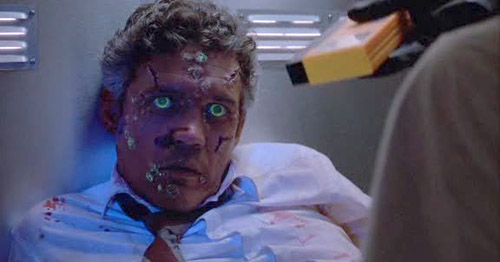
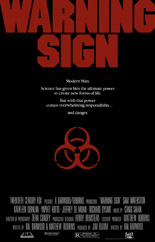
One broken vial of “experimental yeast” at the BioTek Agronomics laboratory triggers a biohazard alarm and subsequent full facility lockdown. After security officer Joanie (Kathleen Quinlan, 1997’s Breakdown) seals the employees — herself included — inside to prevent a public outbreak, the local yokels try to bust their way in from the outside, despite the infection bearing a fatality rate of 80%.

Science vs. ignorance: Good thing Warning Sign is purely a work of speculative fiction that in no way can occur in today’s world.

A technician played by Police Academy foil G.W. Bailey is irate at Joanie for enacting protocol. Her sheriff husband (Sam Waterston, Serial Mom) is peeved their planned Popeyes Chicken & Biscuits dinner will go cold. Choppering into town like a boss is Yaphet Kotto (Alien) as a major for the U.S. Accident Containment Team, ready to take control because he knows the place’s secrets.

The lone feature directed by Hal Barwood, who wrote the film with fellow Dragonslayer scribe Matthew Robbins, Warning Sign begins as an out-and-out virus thriller, then flirts with approximating a zombie movie before settling into siege-picture territory for the finale. That schizophrenic nature all but halts initial momentum and harms any chance of staying power. The conclusion offers one element above average: Waterston aggressively shooting his way through the throng — with an inoculation gun.

Although middle-age Waterston isn’t as effective onscreen as today’s twilight-time Waterston, his supporting cast is a character actor’s dream, with meaty turns from the likes of Jeffrey DeMunn (The Mist), Scott Paulin (1990’s Captain America) and Richard Dysart (1982’s The Thing), who’s never had this much leeway to cut loose.

Warning Sign isn’t so rote to bear its own (other than maybe “CONTAINS MUCH WELDING”), but with as much talent involved, it should have been better. At least three shots are hilarious, which assuredly is not what Barwood and Robbins were going for. Make it a Blockbuster night by pairing it with Alan Rudolph’s loftier-minded, equally iffy and ultimately more bonkers Endangered Species. —Rod Lott

Get it at Amazon.

The Home (2025)

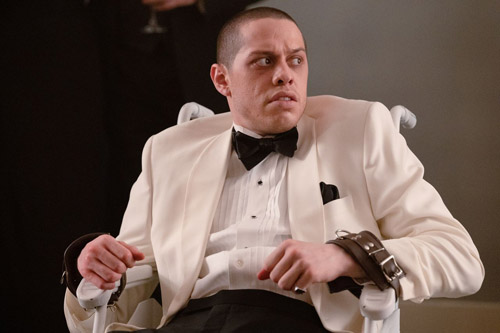
To avoid jail time, troubled young man Max (Pete Davidson) takes a Daddy-arranged temp gig as live-in janitor for Jump Scare Green Meadows retirement home.

“You mean like old people?” Max asks. Yes, exactly that.

On Day 1, Max is told not to breach the fourth floor. Yes, The Home is one of those “something is wrong with this place” movies. (That’s a direct quote, by the way.) Worse, it’s as elementary plotted as the generic title suggests. After a tragic event occurs in the first half, the doctor in charge (Bruce Altman, 2006’s Running Scared) consoles our protagonist with, “I’m sorry, Max. We just didn’t see this coming,” it’s hard not to think, “Seriously? Anyone watching this will.”

The Home may be routine in its telling, but The Purge creator James DeMonaco infuses it with memorable imagery throughout, like thin icicles hanging from the eyes of a statue. Or an anatomical mannequin coming to life. Or the elderly lady engaging in rowdy coitus while wearing a mask apparently borrowed from The Strangers.

Any questions regarding story are usurped by a more transparent concern: Why is Davidson, best known for his eight-season run on TV comedy institution Saturday Night Live, starring as the lead in a horror film? This isn’t a tongue-in-cheek exercise like Bodies Bodies Bodies. He’s just not a fit for The Home, because he’s never not just Pete Davidson. I like the guy, but his tabloid infamy overshadows any performance. It’s not like DeMonaco aims to separate the art from the artist, either; the first thing Davidson does onscreen is light a bong; later, he wears a Staten Island T-shirt; and his tattoos become an actual plot point.

The movie’s final third is the dregs, until Max goes Oldboy in the Green Meadows hallway. And all during a hurricane for no reason other than the storm ups the danger ante. Flying chunks of ceiling acting as Ginsu knives aren’t enough to make a visit to The Home any sweeter. —Rod Lott

Get it at Amazon.

A Viewing Guide to the Pandemic: Depictions of Plague and Pandemic on Film and TV

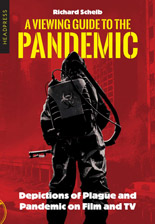
Here’s what I hate about Richard Scheib’s A Viewing Guide to the Pandemic: Depictions of Plague and Pandemic on Film and TV: I couldn’t buy it when I ran across it while honeymooning in London at summer’s start. There it sat on the shelves of the BFI Southbank theater’s store, yet I had no room left in my luggage. At least not any kind of room that wouldn’t bend the book like Beckham.

Now two months later and home in our not-so-United States, I can report the Headpress-published paperback is a pleasure to read. Chalk up another victory for delayed gratification! (And one that’s less frustrating than the pause-and-squeeze method.)

Not far removed from the COVID-19 hellhole that was 2020, one might consider the subject and think, “Too soon?” (Mind you, those people certainly are not the audience for Headpress’ wares of “unpopular culture.”) But it’s not too soon. Like Goldilocks’ preferences of porridges and pillows, it’s just right. After all, measles is currently making a comeback. Measles!

Virus-borne diseases and resulting quarantines/shutdowns aren’t fun. But A Viewing Guide to the Pandemic sure is, plumbing depths of obscurity and wealth of genre. Although you could reference it like an A-Z guide à la Leonard Maltin (“What’s Scheib say about Ebola Rex vs. Murder Hornets, honey?”), it’s not structured that way, nor by release dates.

Instead, the author weaves his way through themed chapters — some strict, some loose — rooted in reality. Think biowarfare, bird flu, the bubonic plague and assorted historical threats starting with letters other than B. Then he pivots to more fantasy-based flights, from vampire curses and zombie infections to further fictional outbreaks, e.g, The Crazies or Pontypool. In the book’s final section, he looks at COVID-era cinema, where sheltering in place forced creative thinking that didn’t always pay off onscreen.

Whether examining Steven Soderbergh’s all-star Contagion or Charles Band’s hasty Corona Zombies, it’s important to note Scheiber isn’t mocking pandemics. That’s not to say the text is humorless, although fairly subtle; on NBC’s Thirst, a bacteria-soaked telepic from 1998, he notes, “there is some rioting, but this only consists of about a dozen people scrabbling to get water bottles from the back of a truck.” 

2023’s recommended Diseased Cinema covered similar ground, albeit limited to American shores and written by three academics. Scheib admits he’s no expert in that regard, but that’s for the book’s betterment. In fact, his introduction details how terrifying COVID was for him and his companion, both at high risk due to respiratory disorders. That vulnerable decision makes A Viewing Guide to the Pandemic personal — and, therefore, relatable. Stay safe! —Rod Lott

Get it at Headpress.

Cloud (2024)

As teased on these pages, I had a first date in 2017 that proved highly memorable for all the wrong reasons. Professing a love for movies, she asked the last thing I’d liked. My answer was that afternoon’s viewing: Kiyoshi Kurosawa’s mystery-thriller Creepy.

“Wait, a movie from another country? Why would you want to watch that?” asked the shrew.

“Because it’s interesting,” I said.

Unconvinced, she continued to deride my viewing choices — plus my car, clothes, hair and more — as a second daiquiri fully revealed her charcoal briquette of a heart.

Watching Cloud, Kurosawa’s newest, I couldn’t help but wonder what she’d say about it. If I knew which bridge she taunts passing goats from, I might venture to ask. I assume her ever-emboldened response would be even more transparently racist and ignorant.

But enough about that hate-filled person. Cloud is full of people just like her: out only for themselves, consequences to others be damned. The protagonist, if by default, is Ryôsuke (Masaki Suda, 2021’s Cube remake) a low-level factory cog. He and his girlfriend (Kotone Furukawa, 12 Suicidal Teens) long for a new life outside Tokyo, but they want it like they want everything else: the easy way.

His side hustle — and it indeed is a hustle — holds the potential to realize their dream: reselling tech devices, bulk collectibles and designer knock-offs at inflated prices online. After chasing profit by any means necessary, Ryôsuke’s misdeeds catch up to him and negative feedback becomes the least of his worries. As his former mentor (Masataka Kubota, 2010’s 13 Assassins) puts it, “Winning streaks don’t last forever.”

The gifted Kurosawa shows instead of tells. He excels at luring us into a scenario with the barest of details. You may not fully gain your bearings before you’re spellbound in its darkness. Cloud is about how the concept of internet anonymity is just that: a concept, a mirage subject to evaporate in a keystroke. Across a too-protracted third act, it depicts an epic battle without honor or humanity, in which every participant lacks redeeming qualities.

Don’t let metaphors put you off Cloud, as Kurosawa still works under the traditional thriller model. That includes chases, traps and brutal acts of revenge best served cold and set to livestream.

Why would I want to watch that? Because it’s riveting cinema with much on its mind and even more blood on its shirt. —Rod Lott

Get it at Amazon.