All posts by Rod Lott

Director’s Commentary: Terror of Frankenstein (2015)

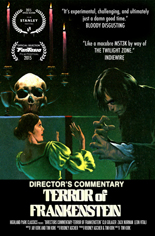
WTFDCterrorfrankNo matter the budget or number of cooks, film shoots are a bitch. Think of Werner Herzog’s Fitzcarraldo or Francis Ford Coppola’s Apocalypse Now. Odds are you haven’t thought of 1977’s Terror of Frankenstein, but oh, how you should. The Swedish/Irish co-production proved to be a highly peculiar farrago, with one of the actors murdering several fellow cast members!

Now, decades later, all is revealed by director Gavin Merrill and screenwriter David Falks — always heard, never seen — through a DVD commentary track, of all things. To hear it is to witness a mind-boggling, historical record of an unfortunate nexus of cinema and crime, talent and tragedy.
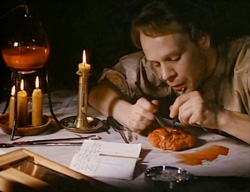
DCterrorfrank1Except that it never happened; Director’s Commentary: Terror of Frankenstein is bogus. Given that premise, you can be forgiven if you assume the cheap-looking film at its center to be fake as well — otherwise, I’d be a hypocrite — but Terror of Frankenstein is the real deal, albeit rightfully obscure. The merry pranksters behind this put-on, director Tim Kirk and producer Rodney Ascher (collaborators on Ascher’s Room 237 documentary), have taken great pains to preserve the facade, including starting this meta project with the familiar FBI warning of home media, tracking issues and a shoddy menu our omniscient viewer navigates, taking a gander at the special features’ two-bit slideshow before selecting the filmmakers’ commentary.

From then on, speaking for the entirety are the opportunistic Merrill (Clu Gulager, A Nightmare on Elm Street 2: Freddy’s Revenge) and irascible Falks (Zack Norman, Cadillac Man). At first, we’re in the dark that the ’77 Terror has a tortured backstory, but it doesn’t take long for their conversation to grow contentious, with an uncomfortable Falks blaming Merrill for the deaths, as well as exploiting them for financial gain. Even if Gulager and Norman can’t quite carry the illusion to total legitimacy, they hook you from the start and are a hoot to hear — especially Norman’s sour-puss portrayal of the guilt-stricken scribe. As information is doled out in small chunks, the story builds and builds toward a payoff that Kirk can’t help but fumble because of Commentary’s confining structure. However anticlimactic, Kirk’s unique experiment is as devious as Victor Frankenstein’s in the film within the film. —Rod Lott

R.O.T.O.R. (1987)

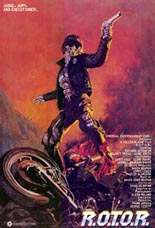
rotorR.O.T.O.R. opens with a title card that in part reads, “Our objective was to build the perfect cop of the future … but, something went terribly wrong.” There is no establishing who “our” is, so one could choose to take it — and I do — as a half-hearted apology from the filmmakers for the movie, for something indeed did go terribly wrong: It was made.

Its poster art may be a blatant horizontal flip of Mad Max, but the sci-fi action motion pictures that R.O.T.O.R. would not exist without are RoboCop and The Terminator. Famously, RoboCop was set in Detroit, yet lensed in Dallas, and R.O.T.O.R. unspools in a way that suggest its makers saw “them Hollywood folk” shooting around Big D and thought, “Well, heckfire, I can do that!” Technically, they did; creatively, they didn’t.

The acronym of the title stands for Robotic Officer Tactical Operation Research — a legally in-the-clear way of saying “robot cop with a porn ’stache.” Heading up this division is police Capt. Barrett Coldyron (Richard Gesswein), a real shit-kicker type of Texan who lives on a farm and smashes the stereotype that robotics experts can’t look like the guy who runs the mechanical bull at establishments where patrons are encouraged to let their peanut shells fall to the floor. English does not appear to come easily to Coldyron, but that could be because Gesswein’s entire performance was dubbed by someone else.

rotor1What Coldyron (pronounced “cold iron”) and his team have assembled is not a finished model, but a flawed prototype that is accidentally jolted into action and unleashed upon the populace when the department’s jive-talkin’, sex-harrassin’ Indian janitor named Shoe Boogie (“Once you go red, you never get out of bed”) drops his switchblade comb into the educated white people’s fancy plug-in machines. A large-scale tragedy set in motion by a hair detangler — that’s a cinematic first, right? I’d like to credit the actor playing Shoe Boogie for his part in history, but he is (wisely) uncredited.

A quick aside: What the hell kind of name — for an Indian or anyone — is Shoe Boogie? R.O.T.O.R. scribe Budd Lewis (the Robert Z’Dar vehicle Dragonfight) appears to be handicapped in that arena, given other characters’ names of Houghtaling, Moulie, Mokie, Buglar, Grotes, Glorioso, Kipster and Statum. Are those Texans or elves and sorcerers from a fantasy epic I’m doomed to loathe?

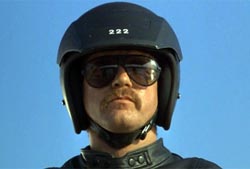
rotor2Back to a project I already do: Rather than cure Dallas of its problem with rapists and robbers, the on-the-loose R.O.T.O.R. (played by three people, including Ticks stuntman Brad Overturf) contributes to it by murdering innocent civilians — “like a chainsaw set on frappé,” quips Coldyron. Luckily, R.O.T.O.R. has a Kryptonite: car horns!

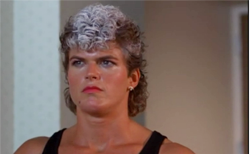
Eventually, Coldyron gets an assist from scientist Dr. Steele (Jayne Smith, Flesh Gordon Meets the Cosmic Cheerleaders), who resembles Tyne Daly as an American Gladiator. I hope I’m not spoiling anything by saying the last shot teases the steroidal-looking, skunk-mulleted Steele as the cyborg at the center of R.O.T.O.R. II. If you own lucky stars, thank them that a sequel never came into existence, because one feature outing from Cullen Blaine was pollution enough. For his single, ill-fated foray into live-action, the animation director brought the imagination, action and suspense from all those episodes of The Get Along Gang. In other words, it is S.H.I.T. —Rod Lott

Get it at Amazon.

Revenge of the Virgins (1959)

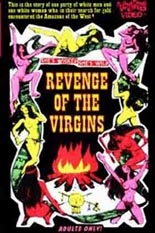
revengevirginsRambles uncredited narrator Kenne Duncan (The Astounding She-Monster) at the beginning of Revenge of the Virgins, not all Old West tales were born from truth. Some of them were “conceived in the minds of grizzled old prospectors … consumed by their one dream … convinced that he’d one day hit the biggest bonanza of all.”
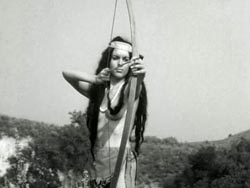
Doesn’t that description sound like good ol’ Ed Wood? It should not surprise you that a picture this boring was written by the wrong-reasons legendary Wood, under the pen name of Pete La Roche; after all, when you hear that the black-and-white Western has a running time of 53 minutes, you automatically assume someone of suspect talents had a hand in its making … because the other hand was busy, as Revenge of the Virgins exists so the members of its all-female Indian tribe can parade around topless. Although led by a blonde Caucasian (Nona Carver, 1963’s Terrified), the tribe of “ornery redskins” hates the white man and his dadgum Christianity.

revengevirgins1Thus, when prospector Pan Taggart (Stanton Pritchard, Like Wow!) guides the greedy Melvin (Charles Veltmann Jr., 1960’s The Alamo) and his harpy wife (Jodean Russo, Airport) into tribal land in hopes of finding gold, the lady Indians stop dancing naked in circles long enough to fling some arrows their way. Incidentally, the girls don’t wear quivers, so where are they keeping those arrows?

And that’s all there is to this quick-buck pic of buck-naked chicks. Directed by sexploitationist Peter Perry Jr. (Kiss Me Quick!), the whole thing looks to have been shot along a neighborhood greenbelt. An attack by a fake rattlesnake stands as the sexless film’s most engaging moment, but that’s because you’re busy seeing if you can spot the wire. You can. —Rod Lott

Get it at Amazon.

Don’t Go in the Woods (1981)

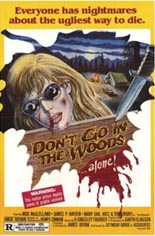
dontgowoods“Something smells,” we hear no more than five minutes into Don’t Go in the Woods. “What’s that stink?” The piece-of-shit indie slasher is the answer to its own question.
Roughly 25 minutes later, we hear, “I wonder if something’s happened.” I’ll handle this one, movie: “Barely a thing.”

An obvious ploy by talent-challenged director James Bryan (The Executioner Part II) to trick Friday the 13th fans, Woods throws a bunch of asshole campers (or camping assholes, if you prefer) into the Utah wilderness. Among them are our eventual heroes, Ingrid (Mary Gail Artz) and Peter (Jack McClelland); since they both look like men, it is possible to tell them apart because Peter is wearing a pink T-shirt advertising Boogie Vision, a Bryan project that is somehow way worse than this one. (Aside: Boogie Vision is supposed to be funny, yet isn’t, whereas Woods is not supposed to be funny, yet is.)

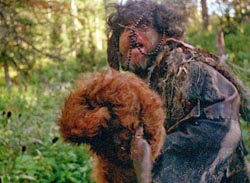
dontgowoods1It hardly matters who’s who, except for the antisocial antagonist who will be narrowing that list to as close to zero as he can get. Per the credits, that freak of nature is Maniac (Tom Drury), a mute mountain man who lives in a booby-trapped hoarder cabin and looks like awards-show banter writer Bruce Vilanch doing Mad Max cosplay after stopping by the crafts fair for beads. He grunts softly and carries a big stick with a pointy blade and a coonskin cap on its stabbing end. No one is safe — not the photographer in the pink beret, not the ’bout-to-boink newlyweds in the VW Bus with the Farrah Fawcett-Majors poster in its ceiling, and especially not the wheelchair-bound guy out for a … what, a rolling jaunt through the mountains and all its rough and uneven terrain?

Amateur actors utter their lines with blundering pauses … as if … they’re reading … from … cue cards. Doing that is well within the realm of possibility, since Bryan shot almost all of Don’t Go in the Woods in that fright-killer you and I and every moviegoer we know call broad friggin’ daylight. —Rod Lott

Don’t get it at Amazon.

Dangerous Men (2005)

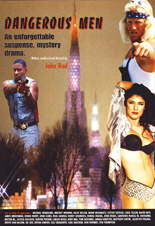
dangerousmenJohn S. Rad’s Dangerous Men does not tell a story in any conventional manner — not because its Iran-born multihyphenate creator had an innovative narrative approach he was itching to impart, but because he did not know how to tell a story. At least his trash can be branded as one-of-a-kind trash. To see it is to disbelieve it, and that should count for something.

When her fiancé (one-timer Coti Cook) is murdered by her would-be rapist on a public beach in broad daylight, Mina (one-timer Melody Wiggins) dries her tears and immediately befriends the evil deed-doer. Mira’s intention is to get this fat, bald biker named Tiger (one-timer George Derby) alone in a hotel room, which she does only after they share a pre-sex steak dinner. Naked, she insists he rub her knees as he kisses her belly button, and as Tiger complies in ecstasy, she retrieves the fenced steak knife hidden between her butt cheeks and stabs him to death. Move over, Ms. 45! Vengeance, thy name is Mina!

dangerousmen1From there, Mina vows to kill — and perhaps even castrate — any male who dare use and abuse a woman. To do this most effectively, she dons the disguise of your common street whore. It’s as if we are witnessing the origin of a feminist vigilante superhero … except that Mina just kinda disappears from Dangerous Men, so the movie morphs into something else — that being the tale of a police detective who would have become Mina’s brother-in-law (Michael Gradilone, Animal Instincts III) out to crack down on a drug-dealing biker gang whose leader is a poodle-mulleted Caucasian named Black Pepper (Bryan Jenkins, 1997’s Riot). Mr. Pepper earns an interminable, Tommy Wiseau-length sex scene with a skank after their strange idea of foreplay: hiring a belly dancer (Roohi — just Roohi, thanks) to perform her hip-shimmying routine while they watch from the living room couch.

It ends with … well, you’ll have to witness this baffler for yourself. Even among all the cinematic detritus I’ve consumed in four decades’ time, I cannot recall a single one wrapping up quite like this!

Rad’s coda should not have caught me so off-guard. It’s not like my eyes didn’t notice the cop’s badge reading “Policeman Police” earlier. It’s also not as if Rad’s own looped-synth score didn’t register with my ears throughout, its plucky mix of Bobby Brown’s “My Prerogative” and the Seinfeld theme incongruent with the tragedy unfolding onscreen. Dangerous Men is consistent only in that it is woefully incompetent for every second. The conclusion is par for the course, considering Rad’s course clocked roughly 20 years from idea to premiere. The wait was worth it, even if none of us knew we were waiting. Again, that should count for something. Shouldn’t it? —Rod Lott

Get it at Amazon.