All posts by Rod Lott

Cards of Death (1986)

Cards of Death answers the burning question of “What did we as a nation do before online gambling?” with a chorus of “We paid to join underground tarot card games in which we all got to bang a hooker as part of our admission fee, got to don rubber Halloween masks to protect our anonymity, and, assuming we won, got to kill the loser with the host’s weapon of choice.”

And character actor Will MacMillan (1976’s The Enforcer) captures the searing tale in his one and only feature behind the camera, albeit a video camera. He directs, writes, produces and delivers — exactly what is up for debate.

MacMillan also acts, opening the movie as police captain Twain, cigarette lighter in hand as he infiltrates the shadowy warehouse serving as the deadly game’s ersatz Bellagio. Quickly snared by the mastermind Hog Johnson (Robert Rothman), Twain is tied up and teased by a topless, swastika-cheeked sidekick (Tawney Berge) who refers to herself in the third person as she demands he suck her nipples. When he defiantly spits on them instead, she slices off his nose, an ear and a couple of fingers with a cheese peeler; a package of these appendages is dropped off at the police department just to fuck with them.

Twain’s enraged close cop friend, Gunny (Shamus Sherwood, a fifth-rate Tom Atkins), recruits Twain’s artist son (Ron Kologie, Iced) to help investigate Twain’s disappearance and the game’s regular trail of corpses. Meanwhile, Hog and his sexy better half, Cat (Carlissa Hayden), have sex twice — once even consensually — and crush a woman with a moving wall — or as much as a penny-jar budget will allow.

Just when I thought Herschell Gordon Lewis really could have done something with this premise, Cards of Death more or less admits to the same by name-checking the Godfather of Gore. Spare though they are, the bloody effects make it clear MacMillan was influenced by Lewis. The primary colors saturating the warehouse scenes suggests MacMillan also aimed for Dario Argento, but landed at Sargento, thanks to a mishandling of story threads and a dearth of narrative focus.

Still, credit where credit is due: MacMillan clearly tried, which is more than one can say of the average shot-on-video project, and although most of the actors never had a role before or after, none half-asses his or her part — not even the elderly street prostitute Grandma (Elizabeth Kingsley). To paraphrase Kenny Rogers, the too-long Cards of Death doesn’t know when to fold ’em; the proof is in the slapstick coda at tonal odds with all that comes before it. —Rod Lott

Get it at Amazon.

Blood on Black Wax: Horror Soundtracks on Vinyl

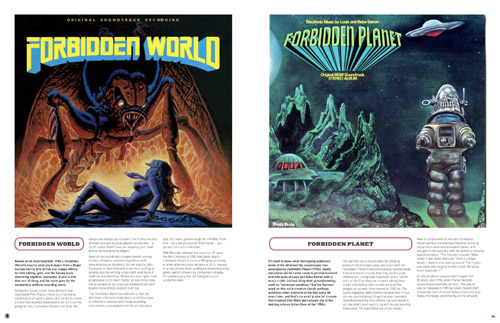
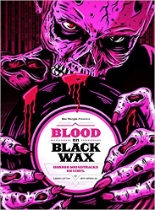
Although the back cover of Blood on Black Wax: Horror Soundtracks on Vinyl proclaims the book to be “long overdue,” I’d argue its timing couldn’t be better. As if the crush of hipsters on Record Store Day hasn’t clued you in, vinyl has made a startling, about-face comeback in this Spotify age, with limited pressings of fright-film soundtrack albums — from such niche labels as Death Waltz Recordings and Waxwork Records — among the most salivated-over collector’s items. Co-authors Aaron Lupton and Jeff Szpirglas take glorious advantage of this fan frenzy, striking while the iron is white-hot.

Following up the recent Ad Nauseam: Newsprint Nightmares from the 1980s, 1984 Publishing and Rue Morgue magazine collaborate again for a hardcover that is as much an objet d’art as the discs it celebrates, with color that pops off the page like so many zombies’ eyeballs. Although eschewing a countdown or list format, Lupton and Szpirglas spotlight one of roughly 200 slabs at a time, devoting no less than a full page to each.

Cover art is presented in a consistent span of left margin to right margin — look, Ma, no thumbnails! — with a brief article underneath reviewing the score and/or songs, giving background info and tracking the album’s release history. Some of the genre’s giants are interviewed about their compositions, most notably John Carpenter, but also Lalo Schifrin, Pino Donaggio, Henry Manfredini, Richard Band, Christopher Young and others.

You’ll find the expected classics, including John Williams’ Jaws and Bernard Hermann’s Psycho, but also cult favorites (Manfred Hübler and Siegfried Schwab’s Vampyros Lesbos), fresh cuts (Mica Levy’s Under the Skin), obscurities (Zdenek Liska’s The Cremator) and ungodly earworms (Robert Smith Jr. and Russ Huddleston’s Manos: The Hands of Fate). Contents are organized only by fairly broad categories, with the Goblin-strewn giallo earning special consideration.

The authors even go out of their way to invite a few choice compilations to the party, from Dick Jacobs and His Orchestra’s Themes from Horror Movies to the self-explanatory Bollywood Bloodbath: The B-Music of the Indian Horror Film Industry. Sporting a closing chapter on the current synthwave movement of faux soundtracks, the breadth of Blood on Black Wax’s curation is crazy impressive; the only platter I feel is sorely missing is Disasterpeace’s magnificent and moody It Follows soundscapes.

The turntable faithful and horror enthusiasts alike will treasure this book. Unlike many of the records featured, it won’t break the bank. —Rod Lott

Get it at Amazon.

Fist of Fear, Touch of Death (1980)

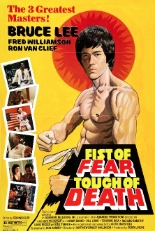
Part sports documentary, part biopic and part clip job, Fist of Fear, Touch of Death is all steaming pile. It’s also all comedy — and not that intentional kind, either. Matthew Mallinson’s film is so inept and pathetic on every level that it deserves to be known as the Plan 9 of not just Bruceploitation pics, but martial arts movies in general.
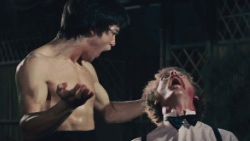
As it begins, ’70s trailer narrator king Adolph Caesar (Oscar-nommed for A Soldier’s Story, but certainly not for this) discusses the big impending karate championship at Madison Square Garden, where someone will walk away with the honor of the title of Bruce Lee’s successor. But will they also walk away with Lee’s curse — aka the Touch of Death? That’s the conflict set up by the — how you say? — “script,” and then completely discarded 80 minutes later.

Credited as “Hammer, the Ladies Man,” Fred Williamson (Vigilante) wakes up next to some skanky white ho in a hotel room. He’s gotta get to the Garden for the match, but his mattress partner wants to “make it a six-pack,” not fully satisfied with being Hammered the mere five times prior. In a running gag, the Hammer is continually mistaken for singer Harry Belafonte. This, my friends, is what the dictionary means by “funny.”

After giving Williamson a lift to the Garden and then interviewing him, Caesar brags about having discovered Lee, and then gives us the whole story about Lee’s pre-stardom years, courtesy of poorly dubbed black-and-white sequences. In these, Bruce often dreams of his great-grandfather’s prowess as a samurai warrior, which we see flashbacks of, courtesy of color clips from 1971’s kick-ass Invincible Super Chan with a fighting midget and a guy who uses an abacus as a weapon.

Caesar briefly mentions Lee’s breakthrough role as Kato on TV’s The Green Hornet, and in present day, we see karate champ Bill Louie decked out as Kato, beating up would-be rapists in the park, killing one with hurled ninja stars. The whole ugly scene starts when some horny redneck, spotting a comely jogger, exclaims, “Shit! Fuckin’ cantaloupe tits!”

As for the much-discussed karate match, we see precious little of it, but that’s okay. At least we get to see a bit of one bout, ending with one guy’s eyes being ripped out of their sockets, complete with cartoon sound effects! So what the hell are you waiting for? —Rod Lott

Get it at Amazon.

How to Choose, Grow & Style the Perfect Beard or Mustache (1997)

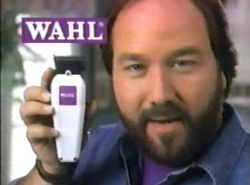
WTFFrom the Wahl Clipper Corporation, How to Choose, Grow & Style the Perfect Beard or Mustache is about welding and soldering. Ha! I kid. It’s about big, bushy collections of face pubes.
As the VHS instructional tape begins, it looks like you’re in for wacky pratfalls galore as some poor schmo gets water sprayed in his face in his own bathroom, and Home Improvement sidekick Richard Karn bursts in without knocking to save the day with a Wahl clipper! But these shenanigans last all of 30 seconds, whereupon Karn vamooses in favor of an elongated lesson facial hair lesson subtitled in Spanish. It’s kind of like back in junior high when you’d be invited to a “free” pizza “party,” only to discover you had to sit through a lecture on Jesus.

The “how-to” here is accompanied by image after image of thick-necked Bigfoot-type guys trimming their beards. One sleazeball with a bolo looks like he worked the evening shift at Radio Shack. One fat guy combs out his scraggly, multicolored beard, and I swear he was going to find bits of stew.

Then some “Draw Tippy!”-style illustrations demonstrate how a mustache and/or beard can enhance the faces of various effeminate males. You can play this game at home with one of those dime-store magnetic-dust face toys. The narrator said something about “will not leave a gummy residue,” which will do nothing to allay your fears. —Rod Lott

Fantomas Unleashed (1965)

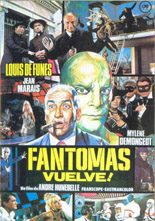
Picking up one year after the events of Fantomas, the sequel Fantomas Unleashed opens with the bumbling Commissioner Juve (Louis de Funès) being named a Knight in the Legion of Honor for ridding France of that masked master criminal Fantomas (Jean Marais) … uh, even though he didn’t. Fantomas just went on hiatus, but he’s back to embarrass the blood-boiling Juve and announce his intent to “perfect a ghastly weapon. … Soon, I will be the master of the world.”
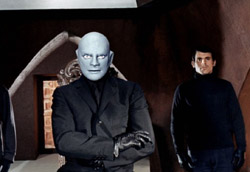
Said game changer is a mind-control ray, and all Fantomas lacks is the participation of both the scientists who have been developing it. Having abducted one already, he sets his sights on kidnapping the elderly Professor Lefèvre (also Marais) at the International Scientific Conference; hero journalist Fandor (Marais once more) offers to take the learned man’s place by disguising himself as the bald, bulb-nosed prof. It’d be a mistake for Unleashed to ignore a ripe opportunity for mistaken identity — and then some! — so it doesn’t.

“These days, it’s all secret agents and gadgets,” says Juve — a bit of self-reflexiveness, as returning director André Hunebelle doubles down on the 007 influence, packing the picture with more gadgetry and accoutrements than before. While Fantomas has acquired a remote-controlled mini-car and submerged-volcano lair, Juve makes use of a third-arm contraption and bullet-firing cigars. These items of spy-fi work in support of the cartoon opening credits to cue viewers in on how seriously not to take the next hour and a half.

Front and center in the first Fantomas, Fandor yields the spotlight to Juve this time, likely because the commissioner’s brand of comic relief — so hot-tempered, he’s a walking ad for beta blockers — works in harmony with the light tone. Back as Fandor’s fiancée, Mylène Demongeot enjoys an elevated role as her character more actively participates in the caper and gains a precocious little brother (Olivier de Funès, son of Louis, in his film debut). Whatever the ratio, the group not only continues to charm, but charms more, and Unleashed is the better movie for it. —Rod Lott

Get it at Amazon.