
All posts by Rod Lott

Midnight Movie (2008)

In the late 1980s, the short-lived The Popcorn Kid was your basic multicamera, laugh-tracked CBS sitcom. Set in a movie theater, it focused on the camaraderie among the young employees. Some 20 years later, Midnight Movie reminded me of that series, except none of The Popcorn Kid’s six episodes featured someone getting his or her heart literally ripped out.

Midnight Movie’s simple plot is not unlike Lamberto Bava’s Demons, with moviegoers trapped in a theater late one night, chased by killer demons. Now substitute “killer demons” with “a raging lunatic,” and voila! Said nutcase is Radford (Arthur Roberts, 1988’s Not of This Earth), a one-time B-movie director who’s in an insane asylum after becoming unhealthily obsessed with his 1970s horror cheapie — so obsessed that it pushes him to a literal bloodbath, slaughtering the staff and making his escape, never to be seen again …

… until a few years later, when a single-screen theater is showing his film that very night, to an audience of less than a dozen. They’re into the badness of it all, and then they become part of it. One by one, they’re killed by the film’s masked madman, and their deaths are projected seamlessly as if part of that original black-and-white movie; their friends sure are slow to realize what’s going on — amused where we would be apoplectic.

A movie-within-in-a-movie concept is always welcome, but a picture must have something more than just that, or it risks gimmickry. Because all but a slim fraction of director Jack Messitt’s cast are woefully amateurish, Midnight Movie embraces that risk. Besides, can’t gimmicks be a blast?

Absolutely, and Messitt gets a charge from viewers who remember the joys of old-school theaters, where one or two titles played, tops, making the experience more communal. Ironically, while widening your viewing options, multiplexes have sapped the fun out of going to the movies (and don’t get me started on audience members’ phones). It’s not what it used to be. Midnight Movie also celebrates the conventions of the B picture, becoming every bit as predictable as its cat-and-mouse chase in an enclosed setting, but with the added, contemporary bonus of bright and colorful bloodletting.

After a while, its repetitive nature may wear on you, but at least this slasher dares to do something different from the get-go. That it can’t entirely pull that off is more to blame on its minuscule budget than anything else. For those viewing the DVD’s alternate “Killer Cut,” note that the opening credits cite Mr. Radford as editor. That’s your first clue not to take this flick too seriously. —Rod Lott

Get it at Amazon.

Den of Thieves (2018)

With Den of Thieves, debuting director Christian Gudegast has made a heist sandwich, with bookended shootouts subbing for slices of Wonder Bread. Having penned the 2016 action sequel London Has Fallen, Gudegast sticks with the ingredient he knows best: Gerard Butler.

The Geostorm star takes the lead as “Big Nick” O’Brien, a detective with the L.A. County Sheriff’s Department. As the head of its Major Crimes division, O’Brien is a roguish bender and breaker of rules — your basic bundle of unshaven swagger. He also operates within that swath of gray that allows him to act like the criminals he earns a salary to catch; the movie more than suggests the only difference between O’Brien and his prey is the badge — in fact, it underlines it in a finale that literally sticks a label on the lawman (“SHERIFF”) to distinguish him from the other armed tough guy in a bulletproof vest.

The other armed tough guy in a bulletproof vest is Merrimen (Pablo Schreiber, 2018’s Skyscraper), a freshly sprung felon who wastes no time planning the heist of a lifetime: robbing the Federal Reserve Bank of Los Angeles of millions in untraceable cash headed for the shredder. Stuck between the two men is Donnie (O’Shea Jackson Jr., Straight Outta Compton), a member of Merrimen’s crew forced to be an informant to O’Brien.

Playing like Michael Mann’s Heat shorn of its great soundtrack and Oscar-caliber performances, Den of Thieves could be called Canned Heat. With swinging-dick posturing and testosterone squeezed from each sprocket of film, it also could be called the greatest David Ayer movie David Ayer did not make, presumably because he was too busy counting his Netflix bucks. Meanwhile, Gudegast swoops in and shoves an overstuffed crime epic onto our plate, complete with an ending that dares to go full Keyzer Söze. We didn’t ask for Den, and it sure didn’t look good, but once we took a bite … we liked it! Hey, Mikey! —Rod Lott

Get it at Amazon.

Reading Material: Short Ends 2/11/19

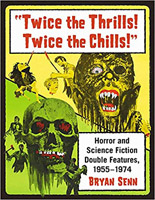
I loved comic books as a child, but because I was rather sheltered, many of them were off-limits, especially the forbidden fruit bearing the phrase “A Warren Magazine.” For years, those issues incessantly teased me from the rack at Pratt’s Grocery. Still, I devoured Bill Schelly’s James Warren, Empire of Monsters: The Man Behind Creepy, Vampirella, and Famous Monsters as if I were part of the club all along. A breeze of a read, the biography of Warren paints him as something as the Roger Corman of comics: a cheapskate, but something of a talent farmer. The latter gives Schelly a wealth of sources to tap since Warren — something of a recluse — did not directly participate. What’s surprising is how little a role Forrest J. Ackerman, the public face of Warren’s Famous Monsters cash cow, plays in the overall picture; that’s to the book’s benefit, as Warren is quite the personality on his own, sexual quirks and all. Meriting cameos in his rags-to-riches-and-back-again tale are Gloria Steinem, Stephen King, Hugh Hefner, Jane Fonda, Al Adamson, John Cleese and Fred Flintstone — only one of those a bedroom conquest. Coming from Fantagraphics, the hardcover is quite the beauty in the design department (kudos, Keeli McCarthy) and boasts an eight-page color insert of those gorgeously painted Warren covers that will have you crying for a full book of them.

Howard Maxford’s Hammer Complete: The Films, the Personnel, the Company is every bit the monster as the vampire adorning its cover; at almost 1,000 pages and 6 pounds, the McFarland & Company hardback demands such a description. Of course, per the title, the book is about more than Dracula, Frankenstein, the Mummy and other creatures that turned the once-moribund UK studio into a name brand forever associated with horror and fantasy cinema. Fifteen years in the making, Hammer Complete arrives with an admirable mission: Cover all things Hammer from A (Abady, Temple) to Z (Zuber, Marc). In essence, the book functions not as a cover-to-cover read, but as an encyclopedia, with luminaries like Ingrid Pitt and Peter Cushing meriting multiple pages. It’s thorough as hell, I’ll give it that — more thorough than thorough, even. Just when I was ready to ding it for not including movies announced but never produced (e.g., Vampirella), I arrive at an appendix of just that: pages and pages of them! For my money, I still find Tom Johnson and Deborah Del Vecchio’s Hammer Films: An Exhaustive Filmography (also from McFarland) to be the more useful resource, even if its 1996 publication means you won’t find the recent revival titles (such as The Woman in Black, Wake Wood and The Resident) that Maxford does.

If he were alive today, Robin Wood would’ve been tickled pink over the current horror resurgence, from arthouse to Blumhouse. As the new book Robin Wood on the Horror Film: Collected Essays and Reviews proves pound for pound, page by page, he was arguably the first film critic to take the genre seriously, whereas his peers equated it to pornography. Compiled by Barry Keith Grant (The Dread of Difference), the Wayne State University Press release contains everything Wood ever wrote on the subject, save for one paragraph, making it an automatic must-have for genre enthusiasts’ home libraries. Like any serious film critic, Wood could be accused of reading too much into things, but that’s the exception, not the norm; furthermore, his prose is simply pleasurable to read. Unlike any serious film critic, his attention to horror wasn’t limited to Alfred Hitchcock and George A. Romero; yes, those are here, of course, but so are Lewis Teague’s Cujo and Gary Sherman’s Raw Meat, which he champions so fervently, it’s infectious — David Cronenberg pun not intented. —Rod Lott

Get them at Amazon.

Godmonster of Indian Flats (1973)

Although nearly a half-century year old, Godmonster of Indian Flats remains startlingly relevant for our times. It’s a story of a God-fearing, anti-science populace clinging to the idea of yesteryear. It’s a story of a politician who abuses his power to enrich his own station in life, at the expense of the poorer townspeople. It’s a story of one African-American man trying to do what’s the right while forever under the thumb of a racist society that fears “the other.”

It’s also a story of a “damaged mongoloid beast,” but to the film’s credit, it could function with that plotline excised. I don’t want to live in a world in which such a removal were made — I’m only saying it could be done. More is bubbling beneath Godmonster’s matted-cotton surface than mere creature-run-amok chaos.

And holy moly, what a creature! One morning, to the amazement of all-business anthropology professor Dr. Clemons (E. Kerrigan Prescott, Fiend Without a Face) and mild-mannered sheep rancher Eddie (Richard Marion, Child’s Play 3), a half-developed embryo is birthed into the flock. Dr. Clemons notes the preemie’s condition is the result of chromosomal breakdown during cross-fertilization, and these 10 seconds form all the scientific explanation we as viewers need. The professor incubates the thing in his lab, where it grows into an 8-foot monstrosity that looks like a mange-ravaged Mr. Snuffleupagus or a walking tumor as depicted by a Nabisco Barnum’s Animal Cracker, or perhaps both.

When it gets loose and terrorizes the town, Godmonster morphs into a classic Western as members of the “vigilance committee” assemble on horseback to hunt it down and lasso that li’l doggie amid the mayor’s declaration of martial law. Needless to say, audience sympathy aligns with that of writer/director Fredric Hobbs (Alabama’s Ghost): squarely on the side of the deformed, misunderstood abomination, no matter how many schoolchildren he scares the shit out of or number of filling stations he somehow explodes. Godmonster of Indian Flats certainly hums an odd tune, but at least it hums. —Rod Lott

Get it at Amazon.

L.A. AIDS Jabber (1994)

At all of 19 years young, Jeff Roberts (Fart: The Movie’s Jason Majik, redefining “overwrought”) has a problem: In addition to mental issues and acid-washed jeans, he’s got the HIV. Shortly after receiving this death sentence from a rather lackadaisical doctor who can’t be bothered to get up from his chair, Jeff snaps and vows to get back at those who gave — or may have given — him the virus. Filling a syringe with his own blood, he becomes … wait for it … the L.A. AIDS Jabber.

Okay, so while he never goes by that name, the movie sure does. Unfortunately, although unsurprisingly, that eyebrow-raiser of a title is its most interesting aspect. Shot on video, the bad-taste slasher takes itself too seriously as Jeff jabs his way toward vengeance, starting with that whore Tanya. As people die by the little prick, a detective and a news reporter investigate, so much so that the sick flick becomes more about them.

The only movie written, directed and produced by actor Drew Godderis (Evil Spawn), L.A. AIDS Jabber cannot truly be discussed without spoiling its M. Night Shyamalandafuckyousay twist ending: The doctor learns the test results were mixed up; therefore, Jeff is not — repeat: not — infected with the HIV virus. One could say you definitely didn’t see that coming — Godderis included, because if Jeff’s blood was all on the up-and-up, what killed his victims?

The movie is sometimes called just plain ol’ Jabber, but hell, that’s no fun. —Rod Lott

Get it at Amazon.