
All posts by Rod Lott

Night Killer (1990)

Ladies of Virginia Beach are all atwitter over an unnamed serial rapist/killer terrorizing the community. (Let’s call him Night Killer, since the movie is named just that.) Luckily, he’s easy to spot: He’s the guy in the Toxic Avenger-esque rubber mask with matching rubber hand spouting spiky yellow fingernails long enough to vie for a Guinness World Record. Only if he stood under a neon arrow flashing “GET MURDERED HERE” could he be more identifiable.

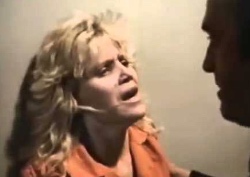
His signature move? Punching clean through women’s torsos. Melanie Beck (Tara Buckman, Silent Night, Deadly Night) somehow makes it through a terrifying home-invasion encounter with him, emerging with scraps, bruises and amnesia, but nary an extra hole. After being discharged from the hospital, life for Melanie continues to be a living nightmare, thanks to Night Killer still at large, as well as being stalked — and then abducted and sexually assaulted — by a creepy guy named Axel (Peter Hooten, who donned the cape as 1978’s Dr. Strange).

As a director, Claudio Fragasso (aka Clyde Anderson) is remarkably consistent. However, as other Fragasso films like Beyond Darkness, Monster Dog, Troll 2, et al. raise their right hands and testify, that consistency is a remarkable disdain for reality and rationale — and Night Killer might be his most imbecilic. Nothing happens as it should or would, even when allowing for a moviegoers’ suspension of disbelief. For example — and this is minor, mind you — Melanie reacts to a threatening phone call by looking in the mirror and yanking out her breasts. In fact, it’s just the first of several instances that call for Buckman to bare at least one of them, which accounts for her wardrobe choice of saggy sweaters for easy access; exposure happens so often — perhaps only a single instance merited — that I felt embarrassed for her.

Elsewhere, Melanie lays out a picnic of pills on the shore. In a public bathroom, Axel is forced at gunpoint to strip to the blue banana hammock that passes for his underwear. Seemingly from another movie emerges Blind Vision’s Lee Lively as an apparent stand-in for Donald Pleasence’s signature Halloween role of Dr. Loomis. I’m more than happy to discuss the bonkers twist, but don’t get me started on the choreographer. —Rod Lott

Get it at Amazon.

The New Gladiators (1984)

In 2072, the TV networks’ biggest shows are reality competitions like Killbike and The Danger Game, both as nihilistic as they sound. (Isn’t that crazy? I don’t mean those shows, but the idea that TV networks will exist in 2072. Oh, that Lucio Fulci — such a kidder!) The webs’ ante gets upped when the floating station WBS makes plans for The Battle of the Damned!

To be played in Rome’s Colosseum, where the bread-and-circus gladiators once sparred, this surefire ratings grabber forces death-row inmates to participate in games of mortal combat that update Ben-Hur-style chariot races with motorcycles. Among the first round of The New Gladiators (to borrow the film’s title) are Drake (Jared Martin, Fulci’s Aenigma), in the clink for killing the three guys who killed his wife, and Abdul (Italian post-apocalyptic flick staple Fred Williamson, Warriors of the Wasteland), who practices kung fu under disorienting strobe lights.

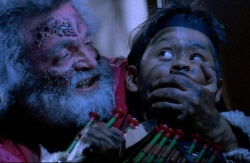
It’s a terrific idea, not fully realized until the release of the Arnold Schwarzenegger vehicle The Running Man three years later. The New Gladiators gets too caught up in prepping for the games, as Drake and friends — including Doctor Butcher M.D. himself, Donald O’Brien, as a severely burned ol’ pal with fiber-optic eyes — plot to destroy the show and WBS from within.

Known alternately as Warriors of the Year 2072, the movie certainly bears appeal, yet has more ambition than director and co-writer Fulci (The New York Ripper) has means. This is evident from frame one, when a pan across the cityscape at night aims to evoke the “wow” factor of Blade Runner — unachievable when said cityscape clearly is a model in miniature, akin to a backdrop from your cousin’s Lionel tabletop train set. Fulci gets in one good effect, when a woman’s face melts like a candle. —Rod Lott

Get it at Amazon.

Pet Sematary (2019)

Love, like or loathe 2017’s It, at least the Stephen King adaptation felt different than the 1990 TV miniseries. The same cannot be said for the Pet Sematary remake, so close to being a beat-for-beat Xerox of the 1989 original that audiences are left wanting a good shake of the toner cartridge. Too bad, because as fondly remembered as that King-penned ’89 film is, room for improvement exists; one flip of the gender doesn’t count.

Casting, however, is a coup. Jason Clarke (Winchester) and Amy Seimetz (Alien: Covenant) make for a personable, believable couple as Dr. Louis and Rachel Creed. Soon after moving to rural Maine with their two kids and a cat named Church, they learn their wooded land leads to a cemetery for childrens’ pets, many of whom become residents after being pancaked on the highway. Just past its gravestones — over that unscalable wall of bramble — lies ancient burial ground imbued with supernatural powers of rejuvenation. Those powers are flawed, which becomes apparent when Louis — presumably inattentive the day in school they read “The Monkey’s Paw” — plants the freshly departed Church there … and Church returns to life as an insufferable, feral asshole in matted fur. When tragedy strikes further, lessons are not learned.

John Lithgow (Obsession) would seem born to inherit and inhabit the role of kindly neighbor Jud Crandall, the kindly neighbor who warns Louis about all of the above, yet aides and abets anyway. Although one of our finest and most versatile actors, Lithgow is not nearly as effective as Fred Gwynne was three decades prior. Perhaps the comparison is unfair, but Lithgow apes Gwynne’s distinctive drawl; before delivering the iconic line of “Sometimes, dead is better,” he dramatically pauses as co-directors Kevin Kölsch and Dennis Widmyer (Holidays) push their camera in, as if signaling to a nostalgic audience, “Get those clappin’ paws ready!”

For all the craft and care Team Kölsch/Widmyer has put into giving the new Pet Sematary a shiny coat, it should be more engaging — even mildly frightening (especially since co-scripter Matt Greenberg wrote one of the scariest King adaptations in 1408). The first film’s surefire scare, Rachel’s physically twisted sister, suffers here from sheer overuse and needless extension. This isn’t a bad movie — just unnecessary. Sometimes, less is better. —Rod Lott

Get it at Amazon.

The Quake (2018)

Three years after Norway showed Hollywood what a contemporary disaster movie can and should be with The Wave, it does it again with the unlikely sequel, The Quake.

The first film’s tragedy has left geologist-cum-hero Kristian Eikjord (Kristoffer Joner, Mission: Impossible — Fallout) an addled mess, unable to shake (forgive me) the memory of the hundreds of people he wasn’t able to rescue. As a result, he remains in Geiranger alone, estranged from three people among the hundreds he did save: his wife (Ane Dahl Torp, Dead Snow) and two children. Meanwhile, in Oslo, when a colleague dies from falling debris in a tunnel, Kristian gets the feeling The Big One is about to rock that highly populated capital city, where his family now resides.

Given Kristian’s PTSD, no one believes his ranting and raving until, of course, the earthquake arrives, splitting the ground like a wet paper towel and toppling building like a toddler to Jenga blocks, in truly special effects. With his colleague’s daughter (newcomer Kathrine Thorborg Johansen) on hand for assistance, Kristian must save the Eikjords once more, heading to a hotel skyscraper whose flaccid top dangles precariously over downtown.

Taking over from Wave director Roar Uthaug (2018’s Tomb Raider) is Headhunters cinematographer John Andreas Andersen, and the transition is seamless. He proves quite adept in staging action and suspense, as well as working within Ulthaug’s established look, mood and skillful balance of spectacle and drama so Wave viewers will feel right at home, so to speak, ensuring continuity of genuine care about the characters.

Now, to address the plausibility of this scenario, it helps that the disaster this time around is frackin’ manmade. As with The Wave, the core incident is based on an incident in Norwegian history. Real science is rooted in the story, as is real pain; The Quake goes into territory the big-and-dumb blockbuster likes of San Andreas wouldn’t dare. That’s not an outright dismissal of American disaster movies, but the pairing of these pictures is all the justification needed that the genre does not require curdling. —Rod Lott

Get it at Amazon.

Naked Vengeance (1985)

It’s just not Carla Harris’ week. First, before their anniversary dinner is even digested, her husband is killed trying to save a woman being attacked in the L.A. restaurant’s parking lot. Second, after moving back to Silver Lake to live with Mom and Dad, she’s sexually assaulted by six guys in her own living room. Third, one of those blue-collar assholes shotguns her parents to death when they interrupt the party.

Once Carla emerges from a state of shock, it’s time for some vengeance: Naked Vengeance.

From Roger Corman’s Concorde Pictures and Filipino exploitation legend Cirio H. Santiago (Death Force, Vampire Hookers, et al.), Naked Vengeance gives Deborah Tranelli of TV’s Dallas her only film role, and damn, it’s a meaty one — the kind of meat whose second name is spelled M-A-Y-E-R, but meat nonetheless.

Her Carla is an actress whose career never took off beyond a dog food advert, so returning home a widow is doubly humiliating. In her absence, it appears every Silver Lake male who’s not her father — the gardener, the bartender, the grocery butcher, the car mechanic, even the ice deliveryman — has become a walking, mouth-breathing example of the “unwanted behaviors” section from your HR department’s anti-harassment policy.

They’re also close buds who drink together, lift weights together (one in a Garfield T-shirt), bowl together (for the Farm Fresh league) and, yes, rape together. For the kind of movie in which a cop uses a flashlight outside on a sunny day, the scene of the group attack is Carla is harrowing … and then nearly self-parodic, because Santiago — like his villains — doesn’t know when to stop. The viewer’s sympathy for Carla quickly morphs into embarrassment for Tranelli.

Because this is also the kind of movie in which the sheriff (Bill McLaughlin, Santiago’s Silk) is unwilling to take action, Carla does. Call it My Shoulder Pads and I Spit on Your Grave. Tranelli commits to her vigilante role in the rather enjoyable, yet unoriginal rape-revenge pic as if it were a drama opening on the Great White Way. Among the actors portraying her dirty half-dozen of abusers, only Kaz Garas (Steve Trevor from the 1974 Wonder Woman TV-movie) turns in a performance that, if not grounded, at least doesn’t float any higher than a month-old helium balloon; the other guys emote with bulging eyes, unnatural motion and raised voices, as if they were being mo-capped for a cartoon that never got made. One wishes shelved status also awaited the movie’s theme song, the Tranelli-warbled power ballad “Still Got a Love,” which we hear about three times too many. —Rod Lott

Get it at Amazon.