
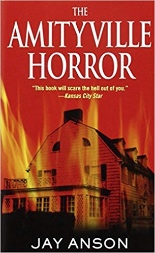
 It is one of horror’s most classic premises: “George and Kathy Lutz moved into 112 Ocean Avenue on December 18. Twenty-eight days later, they fled in terror.” We speak, of course, of Jay Anson’s The Amityville Horror. If there’s one good thing about the less-than-successful film remake starring Ryan Reynolds, it’s that its 2005 release finally put Anson’s 1977 novel (?) back into print.
My first exposure to the book was shortly after its debut, when the young woman babysitting me and my brothers for the night brought it with her to read. I was creeped out by the illustration of the houseflies that occasionally dotted its pages (sadly missing from Pocket Star’s reprint edition). I read it a few years later, before I saw the 1979 movie, and – what with all the unexplained voices, toilet goo, evil faces, telephone interference, loud noises, dead Indians*, levitation and flaming red pig eyes – it scared the bejeezus out of me.
Revisiting it today, I’m not sure why. Anson’s documentary-style approach prevents it from approaching real terror. There’s simply no tension. Anson will be describing some utterly mundane activity for several paragraphs and then throw in an exclamation like “Father Mancuso returned to his apartment to find a stupefying odor of human excrement pervading his room!” It’s not shocking, because it comes from nowhere, but every time you spot an exclamation point, know that Anson wants goosebumps to follow.
Even though Anson’s you-are-there prose isn’t exactly lively, the story remains compelling after all these years. Even people who’ve neither read the book nor seen the movies can relay freely at least some details surrounding the Amityville legend. But even the initiated probably don’t recall how clunky the book actually is, like this doozy of a sentence, which would be laugh-out-loudable in any book: “Regardless of the weakness he still felt in his loins from the diarrhea, George wanted to make love to Kathy.”
And that mental image, my friends, is far scarier than any poltergeist or possession.
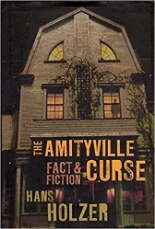 Parapsychologist Hans Holzer really hates Jay Anson’s The Amityville Horror. He refers to it as “sensational” – and not in a good way – and won’t even name its author. After all, Anson’s book is considered fiction, but Holzer believes in the spirits that reportedly have plagued the famous Long Island home. So he wrote his own version.
Long out of print, that nonfiction study from 1979 has been combined with Holzer’s two all-but-lost Amityville fictional efforts from ’82 and ’85 for Barnes & Noble’s three-in-one collection The Amityville Curse: Fact & Fiction. When it comes to competition from Holzer, Anson had nothing to worry about.
It opens with Murder in Amityville, a factual examination not of the Lutz family’s experience in the home (as depicted in the blockbuster ’70s movie) but of Ronald DeFeo, the 22-year-old man who took a shotgun to all six members of his family one night in 1974 (as depicted in the fiercely underrated and unjustly derided Amityville II). The reason? Spiritual possession!
“The only logical explanation for such behavior seems to be the transference of knowledge or skills from an outside source — an outside entity functioning in another dimension.” Why is this the “only” logical explanation? Because Holzer says so. “In all this uncertainty,” he writes, “only one thing is certain: No ‘demons’ are involved, because, unlike spirits, they are strictly figments of the imagination.”
And that’s the way it goes: His way or the highway, as every dig at Anson and others’ work is tinged with a palpable level of “I’ll show them!”-style arrogance and jealousy. It’s all for nothing, because Murder is terribly boring – a true-crime compilation of court transcripts and psychiatric interviews, which is hardly the interesting part of the Amityville story.
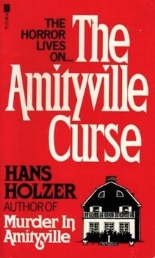 But at least it’s competently written compared to the abomination of his would-be novel The Amityville Curse. You can tell how ridiculous it is just from the setup: Three couples who know of the house’s horrible history decide to buy it, move in together and don’t leave once bad shit starts to pile on, even when that includes death. Even hiring an American Indian (named Black Eagle; good one, Hans – that’s not patronizing at all) to cleanse the spirits doesn’t help.
Holzer provides one Shocking Event after another, but because he cannot build suspense, it’s all rather pedestrian. Consider this supposedly terrifying passage of supernatural phenomena:
“The flour bin moved to the edge of the shelf, its top jerked open, and the contents poured out on the stove, creating a large white cloud. … The stove was completely covered with flour, and had to be washed. Undoubtedly, their meal would have to be cold.”
Not exactly pig eyes in the window, huh? Notice how that last line bursts with unintentional humor, as does “Good. Then I must tell you that building houses on Native American burial grounds is not the greatest of ideas.” Or, after a woman’s father is impaled to death by an “Oriental dagger,” “Well, it looks like we paid that medicine man for nothing.”
The narrative is repetitious; witness a doctor’s advice of “Or rather his curse, like a guided missile, will follow you,” and then, a mere 12 pages later, “You see, Mr. White, a curse is a little like a guided missile.” But laziness is Holzer’s greatest sin, like when the character of Frank accidentally kills the spouse of Lucille. Thank goodness it was only a spouse: “Lucille had refused to leave her room or even talk to anyone. … She was not angry with Frank, and when he came to talk to her through the closed door, she forgave him.” Whew! Glad that’s settled! Now who wants dinner?
Ready for more ludicrousness? Turn to The Secret of Amityville, which serves as a prequel to explain the Native American angle. Initially set in 1717 at outfits like The Pig and Whistle, it’s a tale of lords, Scots, buccaneers and wasted ink. If he couldn’t write a modern-day story, what made him think he could do historical?
The only thing remotely scary about this anthology? I paid for it. –Rod Lott
Get them at Amazon.
*Anson’s word, not mine.

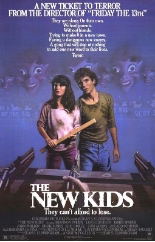
 With their parents perishing in a car wreck, military-base teens Loren (Shannon Presby, Trackdown: Finding the Goodbar Killer) and Abby MacWilliams (Lori Loughlin, Back to the Beach) move to Florida to live with their slovenly Uncle Charlie (Eddie Jones, Invasion U.S.A.). They earn their keep by helping get his decrepit, two-bit amusement park, Santa Funland, off the ground.
 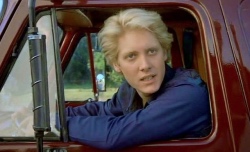 This late left turn into terror shouldn’t surprise anyone, seeing how The New Kids is directed by Sean S. Cunningham, he of the landmark slasher Friday the 13th. Now, James Spader is no Jason Voorhees, which is to say that while the former’s villainous turn failed to achieve the latter’s icon status, the actor is absolutely slimy to the point of serpentine — a petulant, entitled alpha male whose assholiness resonates even more today with a realism the supernatural slayer Jason can’t even hope to match (not that he would).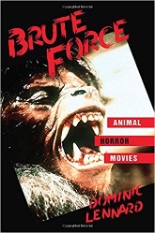

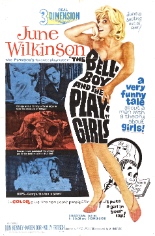
 Something’s afoot — and abreast — in room 229 of the Happy Holiday Hotel, and a cowardly bellboy wants to see for his peeping-Tom self in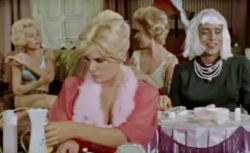

 When committing to a viewing of