

Madcap Screencaps #13
Can you guess what movie or TV show we’re watching? We’ve turned on subtitles (when available) not to give you a clue, but to enhance that WTF effect! Leave your best guess in the comments to prove your true Flick Attackosity!

Times Square (1980)
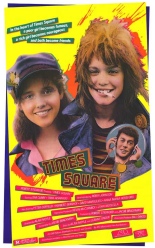
 Times Square is the kind of movie I love not despite its flaws, but because of them. Rather than be put off by its lack of authenticity and enormous leaps of logic, I find myself instead pulled into its fantasy and want to stay there for far longer than I am allowed. It’s not great. It’s probably not even good. I don’t care.
Directed by Allan Moyle, who also made Pump Up the Volume (which is great), the film follows two mismatched young girls who meet in a hospital room while being tested for their psychosomatic fits. Pam (Trini Alvarado) is the daughter of a well-known New York councilman. Nikki (Robin Johnson) is a charismatic delinquent who likes to cause trouble. The two run away together and become famous, thanks to a popular radio DJ (Tim Curry) who relishes the irony of the councilman’s daughter being a street kid on the very street her father has been tasked to transform.
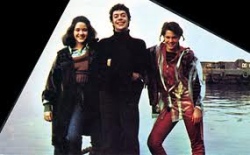 In reality, the girls would have been torn apart by the titular location within minutes of their arrival, but Times Square is a fairy tale. Viewed as such, it is a well-made and moving one, thanks especially to a stand-out performance by Johnson (who should have gone on to much bigger things, instead of her only other film, Splitz). Equally important is the amazing soundtrack, which features not only the best music of the era, but also two great original songs performed by the leads.
I can’t recommend that you check Times Square out, because you’ll probably hate it, but I love it all the same. I’ll take uplifting musical fantasy over gritty, depressing reality every single time. How does that not make sense? —Allan Mott
Faster (2010)
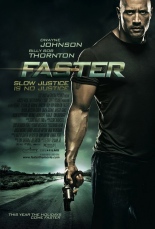
 Heads up, everybody: In Faster, the character known only as Driver (Dwayne Johnson) just got out of doing 10 years in the slammer for a bank robbery, after which his fellow criminals double-crossed him and murdered his brother. He’s making a list, checking it twice, gonna be up on their asses like white on rice. He’s armed with maps, a gun and a super-speedy Chevelle. Faster, Dwayne Johnson! Kill! Kill!
His spree of revenge ain’t that easy, though, what with two people on his tail. One is Killer (Oliver Jackson-Cohen), a British hit man; the other is Cop (Billy Bob Thornton), a, well, um, cop. As with all cinematic officers of the law, Cop’s nearing retirement. But he’s also addicted to smack, so there’s that.
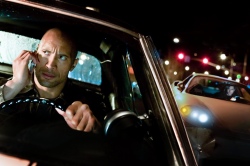 Despite the screenwriters putting zero thought into naming their characters, Faster is no generic actioner. In fact, it’s fast, furious and fairly no-holds-barred, with Driver never hesitating to raise his weapon, pull the trigger, and launch a bullet clean through his target’s forehead. Director George Tillman Jr. (Notorious) goes for a slick look, but also one that’s down and dirty along its edges, echoing the great revenge pictures of the 1970s.
The concept is simple — a little too simple, which accounts for the occasional padding. Tom Berenger has one scene upfront as the warden. Lost loser Maggie Grace shows up in her underwear. Carla Gugino is another cop, which the movie doesn’t need, but I’m cool with it, because I love to look at Carla Gugino. The same cannot be said of Dexter second banana Jennifer Carpenter, who has a cameo as a stick with a crooked mouth. —Rod Lott
Parasomnia (2008)

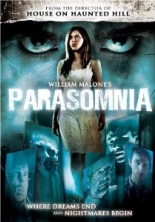 I’ve been following the career of horror director William Malone since his Tales from the Crypt days. He’s got a good eye for the creepy visual. Check out House on Haunted Hill. Unfortunately, he’s got the story sense of a 6-year-old — check out House on Haunted Hill — and doesn’t know when to stop. His endings leave a lot to be desired. And by “a lot,” I mean everything.
In Parasomnia, Dylan Purcell stars as Danny, who is wandering around in an asylum one day, gawking at the creepy inmates as if it were Bedlam, circa 1750. He sees Laura (Cherilyn Wilson), who suffers from the title condition, which keeps her asleep most of the time. Her doctor (Timothy Bottoms), who has never heard the phrase “medical ethics,” tells Danny her story, and the young man sneaks her out so she won’t get caught in the MacGuffin.
 Now the guy in the room next to hers is a serial killer named Volpe (Patrick Kilpatrick). So dangerous is this monster, he’s kept standing up in chains and masked so he can’t hypnotize the staff. Right, he’s in the room next to a sleeping girl. This place is not on the shortlist for Asylum of the Year honors.
Anyway, when Danny takes Laura home, Volpe escapes to track her down and kill everyone in the world. Jeffrey Combs is wasted in the cop role. Malone has outdone himself because not only is the ending bad, the rest of the flick is, too. Okay, there are some nice visuals when we get to Volpe’s Dr. Phibes-ish lair, but my God, this thing is stupid. —Doug Bentin