Contamination’s opening credits have the balls to claim it’s “based on an original story by Lewis Coates.” It should read, “based on an original story by Dan O’Bannon and Ronald Shusett,” because what writer/director Lewis Coates (aka Italy’s Luigi Cozzi, the man who gave us Starcrash, the Star Wars rip-off that’s more fun than Star Wars) came up with clearly wouldn’t exist without Ridley Scott’s Alien. In fact, Cozzi wanted to call it Alien Arrives on Earth.
Mind you, I’m not complaining. Cozzi took Alien’s elements of the outer-space eggs and stomach bursting, and ran with them. When you have an effect as cool as an exploding gut, why use it only once? Why not a dozen times? You certainly get your money’s worth. Just ignore the stupid ending.
The intestinal problems start in New York City, when a ghost ship from the tropics wanders into port without a crew — alive, anyway. The conditions the investigating authorities find the seamen in will put you off deli meats for the day. And in boxes bearing a coffee company’s logo are slimy, green eggs that pulsate. Posits one investigator, “It could be somethin’ like a giant squash or an avocado or some kind of mango!”
Despite the decrepit-flesh buffet they’ve just witnessed, another investigator thinks it best to pick the egg up. Let the tummy troubles begin! Who cares if the actors suddenly look pregnant before their midsection blows? Cozzi had the good sense to shoot them all in slo-mo. The eggs even emit a pre-kablooey sound, like sea lions orgasming. Speaking of sound, the great Goblin provides the synth-tastic soundtrack, which is good considering how slowly the film’s final third moves. —Rod Lott
Here’s what I want in a movie titled Drive Angry: anger, and driving. When Nicolas Cage is your hero, I’d think the anger would have been covered, but in a role that demands Wild at Heart Cage, or even Face/Off Cage, he gives us Bangkok Dangerous Cage. I love the dude — he’s usually a solid center at least, but looking mildly pissed off doesn’t cut it in a movie where the hero drives a car out of Hell to avenge his daughter’s death at the hands of a maniacal cult leader.
Well, could have been worse. Could have been Firebirds Cage.
The rest of the flick’s a mixed bag. Patrick Lussier’s direction is competent (I’d expect nothing more or less from the maker of Dracula 2000), but the effects, while perhaps more effective in 3-D, are far too cheesy in 2-D, and needlessly distract from the action. The scene that’s most often remembered, Cage killing bad guys left and right while humping a hottie, was done far better in the Clive Owen blast, Shoot ‘Em Up.
Two elements elevate Drive Angry: Amber Heard and William Fichtner. Heard takes a potentially nothing role that by all rights should have been Megan Foxed into nonexistence, and actually brings grit, spark and humor to the part of a waitress unwittingly caught up in Cage’s antics. Fichtner, meanwhile, is pure wonderment as The Accountant, a demon sent to bring Cage back to Hell. Effortlessly capturing menace and boredom in equal parts, wandering through each scene with bemused detachment, he truly is the next Christopher Walken. Had he gone up against Snake Eyes Cage, we would have had a minor genre classic, instead of merely an okay ride. —Corey Redekop
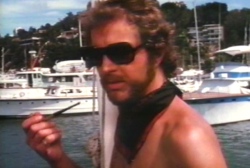
Soooo much pussy is present in René Cardona Jr.’s The Night of a Thousand Cats, a Mexican horror film that will scare nobody but representatives of PETA. It will, however, entertain the hell out of practically anyone willing to tolerate the director’s slow, but unintentionally silly style, evident in such zoo-minded snoozers as Tintorera: Killer Shark and Beaks: The Movie. This particular animal-oriented effort stars Nightmare City‘s Hugo Stiglitz as — wait for it — Hugo, a leather-wearing cad who flies around in his helicopter to pick up hot ladies. (Hey, it may be a gimmick, but guys, it works.)
Taking his latest find back to his bachelor pad, a 1600s monastery owned by his family, Hugo introduces her to his bald, mute robed goon of a servant with a limp, Dorgo (Gerardo Zepeda, El Topo), who’s “obedient and as faithful as a cat” and not too shabby in the cooking department, either; according to Hugo, “meat is his specialty.” (Dorgo also gets a hard-on for a stethoscope, but that’s neither here nor there.)
Anyhow, Hugo’s date is going along swimmingly, until a cat interrupts the meal. At that point, our angered, bearded douche hurls the helpless animal over a ridiculously tall chain-link fence, on the other side of which stand hundreds — or perhaps 1,000, hmmm? — of felines, meowing their precious widdle paws off. So Hugo grinds his girl up and feeds fistfuls of the ground round to the kitties. (Oh, but not the head! That goes in his basement collection.)
The script then plops Hugo back into the chopper to spy in on babes in pointy-boob bikinis, and pick the next one to fuck ‘n’ chuck. For a guy who gets so much bed action, Hugo’s sex scenes should be better, but Cardona’s camera zooms in on the noses of polar bears and other stuffed heads on the wall, which don’t mean nothin’. (I apologize for quoting Richard Marx; it’ll never happen again.) —Rod Lott
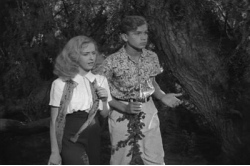
Nancy Drew’s third big-screen adventure gets under way when her lawyer father (John Litel) is alerted to come help Matt (Aldrich Bowker), a crabby old farmer accused of murdering a neighbor. Matt says the sheriff is “a gol darn liar.” Mr. Drew frames their sudden getaway as a farm vacation so Nancy won’t stick her snoopy nose in his gol darn business. She does anyway.
Coincidentally, vacationing there at the same time is Ted Nickerson (Frankie Thomas, TV’s Tom Corbett, Space Cadet), Nancy’s clumsy, platonic-for-now pal who quickly tires of her investigating nature: “Now, look, will ya cut the bubble-gum talk and give?” (I’m not sure what his problem is; he’s the one wearing a sweater with a hand-drawn sailboat on it, surrounded by random names like Butch Hogan, Darby McGraw, Popeye, Jimmy, Jiggs, Jeepers Creepers and Fanny W.)
I expected Nancy to get herself involved in crazy farm shenanigans; I didn’t expect to encounter one of the era’s cringing African-American dumb-goon stereotypes. Here, it’s in the form of Apollo (Willie Best, aka Sleep ‘n’ Eat, The Ghost Breakers), who tries to hide a hot roasted chicken up his shirt and pass off the pain with, “I guess I jes’ born jitterbug.” Almost as bad, he’s terrified of ghosts, which causes Apollo to burst through fences when Ted is accidentally covered in flour. Repeat: flour.
Racism aside, franchise director William Clemens has a knack for staging some lively set pieces that double as both action and physical comedy, from Nancy and Ted running from a live bull (caveat: via sped-up film) to trying to land a biplane after the pilot bails. Loop-de-loops ensue. As far as patience goes, Trouble Shooter is no trouble at all. —Rod Lott

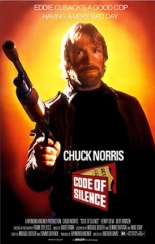 1. Dennis Farina and Chuck Norris going undercover as garbage men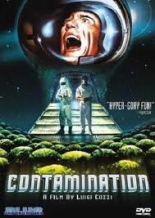

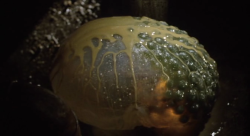 The intestinal problems start in New York City, when a ghost ship from the tropics wanders into port without a crew — alive, anyway. The conditions the investigating authorities find the seamen in will put you off deli meats for the day. And in boxes bearing a coffee company’s logo are slimy, green eggs that pulsate. Posits one investigator, “It could be somethin’ like a giant squash or an avocado or some kind of mango!”
 Here’s what I want in a movie titled
  The rest of the flick’s a mixed bag. Patrick Lussier’s direction is competent (I’d expect nothing more or less from the maker of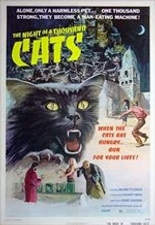
 Soooo much pussy is present in René Cardona Jr.’s
  Anyhow, Hugo’s date is going along swimmingly, until a cat interrupts the meal. At that point, our angered, bearded douche hurls the helpless animal over a ridiculously tall chain-link fence, on the other side of which stand hundreds — or perhaps 1,000, hmmm? — of felines, meowing their precious widdle paws off. So Hugo grinds his girl up and feeds fistfuls of the ground round to the kitties. (Oh, but not the head! That goes in his basement collection.)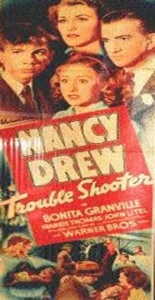
 Nancy Drew’s third big-screen adventure gets under way when her lawyer father (John Litel) is alerted to come help Matt (Aldrich Bowker), a crabby old farmer accused of murdering a neighbor. Matt says the sheriff is “a gol darn liar.” Mr. Drew frames their sudden getaway as a farm vacation so Nancy won’t stick her snoopy nose in his gol darn business. She does anyway.