Can you guess what movie or TV show we’re watching? We’ve turned on subtitles (when available) not to give you a clue, but to enhance that WTF effect! Leave your best guess in the comments to prove your true Flick Attackosity!
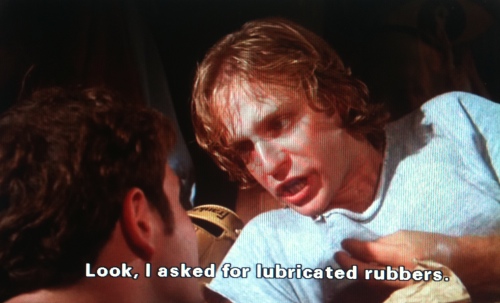

Can you guess what movie or TV show we’re watching? We’ve turned on subtitles (when available) not to give you a clue, but to enhance that WTF effect! Leave your best guess in the comments to prove your true Flick Attackosity!
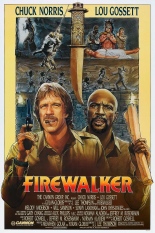
 Chuck Norris does his best Harrison Ford (which isn’t good enough) in Firewalker, the Cannon Films answer to the Indiana Jones franchise. Give Chuck credit for trying something different, but it doesn’t work. Call it Texas Ranger and the Temple of Dumb.
Norris is adventurer-for-hire Max Donigan, hired by Flash Gordon‘s Melody Anderson (as the ersatz Kate Capshaw) to guide her to a horde of Aztec gold located in a cave supposedly guarded by a cyclops — so says the ancient treasure map which has come into her possession. Iron Eagle‘s Louis Gossett Jr. is Donigan’s minority sidekick, and stepping into John Rhys-Davies’ Raiders of the Lost Ark role is John Rhys-Davies, because what else does the guy have to do but eat?
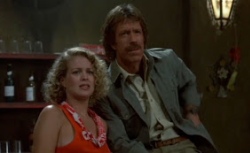 Finding the cave is simple; getting the gold is another matter. Chuck sums up the plot as best as anyone: “OK, you’ve got gold, human sacrifice, a dagger and the sun.” He and his cohorts get into all sorts of wacky, Central American pickles, from puttering around the jungle in a camo-painted VW Bug to hopping aboard a train disguised as Catholic clergy members.
Firewalker begins in a semisolid state, as old-fashioned serial fun. It ends that way, too, but dumber. The problem is its meandering, near-torturous midsection, made worse by Norris and company’s inability to handle the script’s reliance on comedy. The movie might have worked better in the less-wrinkled hands of a younger, livelier director, whereas J. Lee Thompson (The Guns of Navarone) was nearing the close of his long career. Besides, didn’t he receive his first Social Security check somewhere between chapters six and seven of Radar Men from the Moon?
Our heroes take so many photographs during their journeys that you’d expect to see the shots during the end credits, but Cannon budgets didn’t allow a line item for Fotomat developing. Also, no one walks on fire. —Rod Lott
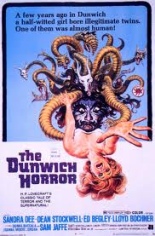
 In Grease, when they sang about Sandra Dee being “lousy with virginity,” I’d like to believe it was a direct reference to The Dunwich Horror, an H.P. Lovecraft adaptation from AIP. In it, Dee plays Nancy Wagner, a college virgin lured to the sleepy, strange town of Dunwich by its least favorite son, the creepy-eyed Wilbur Whateley (Dean Stockwell, Blue Velvet), sporting a porn-star mustache.
Wilbur lives with his freaky-ass grandpa in a big, spooky house. He’s also the son of the devil and has recruited Nancy as his virgin sacrifice for a ceremony that will open the gates of hell. Meanwhile, just what in the hell is that thing in Wilbur’s closet?
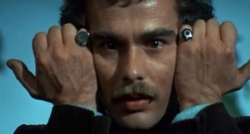 This could have been some half-assed, thrown-together horror effort, but surprisingly, it’s pretty classy, like Roger Corman’s Edgar Allan Poe pictures. Although some dialogue is dry, the look and feel of Dunwich is top-notch. Die, Monster, Die!‘s Daniel Haller does a terrific job with the direction, especially in the latter half when things get really weird; the tricks he pulls with quick cuts and color flashes help intensify the film’s jolts.
Dee looks rather puffy-faced in this one, but does turn her image on its head by doing a nude scene. Stockwell pulls his patented weirdo character out of his sleeve, but hey, it works. Everything gels in this one; I find it somewhat of a minor classic. Dig that ending! —Rod Lott
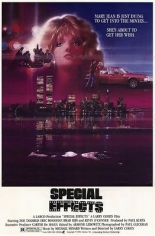
 Larry Cohen does his best Brian De Palma imitation with Special Effects, which is to say a poor one. Perhaps the only special thing about this minor effort is that, more than any other of the filmmaker’s works, the movie demonstrates he’s better at conceiving ideas than birthing them. This one’s certainly no Q; it’s a Zzzzz.
In her first role post-Ms. 45, Zoe Tamerlis plays Mary Jean, a naive, Oklahoma-to-Manhattan actress who cheats on her hick husband, Keefe (Brad Rijn, Smithereens) with a down-and-out film director she’s just met. He’s Neville (Talk Radio’s Eric Bogosian, speaking out of his mouth’s left side), who feeds her the line, “I think we should do a slow dissolve to the bedroom.” It works, and while writhing in the pink satin sheets, Neville strangles her to death.
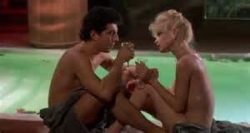 Rather than become the prime suspect, Neville cannily deflects suspicion by making a movie about the murder, with the intent to pin the crime on the yokel spouse who agrees to play himself. Essaying the role of Mary Jean is her dead ringer, Elaine (also Tamerlis), a clothes sorter at the Salvation Army.
Sounds absurd, right? It should, for Special Effects is a messy bundle of story threads Cohen doesn’t bother to unravel before attempting to connect. If he had, I suspect the film would remain too ludicrous to swallow; Rijn and Tamerlis’ near-amateurish performances wouldn’t be remedied by even the sharpest script. With touches like Neville choking someone with 35mm film and asking, “Who made your head? Carlo Rambaldi?,” the movie must be intended as some industry-insider statement, but what the statement says is as mysterious as the entire premise is muddled.
Aside from a quick visual joke referencing Tootsie, Special Effects bears precious little of Cohen’s clever sensibilities. —Rod Lott
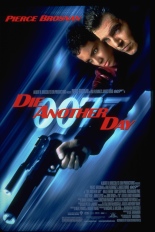 Following the terrible The World Is Not Enough, Pierce Brosnan returned as James Bond in the equally bad Die Another Day, his fourth and final turn as 007. I’d like to think that Madonna skank-tainted this one from the start by providing the wretched theme song that makes Bond fans long for the comparative glory days of a-ha.
In the prologue, Bond is captured by Koreans and held prisoner, long enough for Brosnan to grow his hair to its Crusoe lengths of 1997. Then he is traded for a bald-headed Korean named Zao (Rick Yune, The Fast and the Furious), whom the British government held captive — the same guy whose face now is streaked with diamonds, thanks to Bond’s ingenious explosion of a briefcase full of jewels in the aforementioned opening moments.
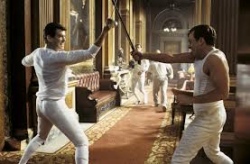 Then other stuff happens and Halle Berry shows up as an as assassin named Jinx so Bond can bed a black chick, because too many years have passed since he’s done that. And things explode and there’s a swordfight and Madonna appears in a cameo to bring the film to a stop so those watching can go, “Oh, hey, it’s Madonna.” And it culminates at an ice palace with Bond in an invisible car.
To clarify: an invisible car. With that, the series became all gums, no teeth.
And stupid. Did we really need Berry sassing up the franchise with quips such as “Yo mama!” and “Read this, bitch!” As good as Brosnan was in GoldenEye and Tomorrow Never Dies, his emotional investment appears to have dissipated. Speaking of appearances, in a couple of places during the movie, from certain angles, Brosnan looks just like game show host Chuck Woolery. —Rod Lott