
Beowulf (1999)

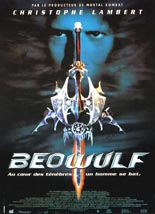
beowulfThe classic, Old English epic poem known as Beowulf saw a surprising resurgence in popularity in 1999 with Seamus Heaney’s new translation; that same year’s film adaptation of Beowulf is in no such danger, but its fantasy brand of cheese actually tastes quite enjoyable.

The inhabitants of a big, spooky castle are under constant threat of attack by a ghost demon named Grendle, who likes to eat people. Their saving grace comes in the form of a visiting mysterious stranger named Beowulf, played by Christopher Lambert, Highlander refugee and graduate of the Angry Whisper School of Acting.
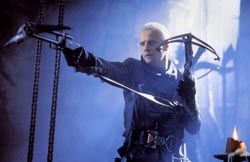
beowulf1Beowulf has a gift of sensing danger, so he knows when the monster is near. The beast is mostly a CGI creature given a wavy effect that looks like someone dragged a big magnet across your TV screen. The fight scenes — set to a techno score by Juno Reactor — alternately ape those found in Mortal Kombat, The Matrix and Evil Dead II. Beowulf also busts out some Gymkata fight moves. Assisting Beowulf is a foxy brunette (Rhona Mitra, Underworld: Rise of the Lycans) who has a name, but I didn’t catch it because her bosoms threaten to break free the entire film.

Now, I don’t know how faithful this superheroic take on Beowulf is to the source material, as the piece of literature was a chore to get through in high school, but I’m pretty sure if the castle dudes were being visited in their dreams by a horny Playboy Playmate, I would’ve remembered, and maybe even aced the test. The filmmakers end up dubbing the Playmate (Layla Roberts, Miss October 1997); maybe director Graham Baker (Alien Nation) should’ve done Lambert while they were at it so we could understand him once and for all. —Rod Lott

Buy it at Amazon.

The Ripper (1985)

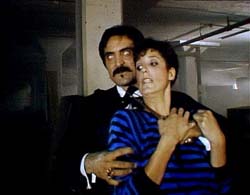
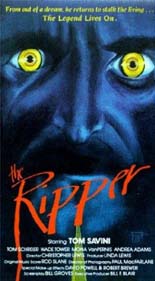
ripperThe major problem with The Ripper is not that it’s a Jack the Ripper movie made in Tulsa, Oklahoma, but that it looks like a Jack the Ripper movie made in Tulsa, Oklahoma. Although unrelated in story, it forms an unofficial trilogy with director Christopher Lewis’ other video-lensed, T-Town opuses, Blood Cult and its sequel, Revenge — all full of faults, yet full of fun. This one stands out for the participation of splatter icon Tom Savini — not as a special-effects artist, but as an actor, playing none other than London’s most famous 19th-century serial killer.

Clad in cape and top hat, Savini first appears in the flick’s historical prologue depicting the Ripper’s first murder, complete with English accents and a horse-drawn carriage (and, unfortunately, moving cars and working traffic lights). The tale is being told by Professor Hartwell (Tom Schreier, Dark Before Dawn) to his classroom of college students. Hartwell then picks up his girlfriend, dance prof Carol (Mona Van Pernis), to go antique shopping.

ripper1While Carol negotiates the price of a brass headboard (discussed so much throughout The Ripper that the piece of furniture deserves screen credit), Hartwell is drawn to an ugly red ring that flashes images of the aforementioned prologue in his head. He later returns to purchase it, and can’t get the ring off his finger. The jewelry gives him nightmares and — gasp — turns him left-handed! It also may or may not have implanted the evil spirit of Jack the Ripper inside him, thereby making him responsible for the sudden string of intestines-yanking of several young ladies around the metro area.

While these gross-out scenes aren’t near the level of what Savini can do, they do look good, especially for Super VHS. As with Lewis’ other slashers, they’re the movie’s raison d’être, leaving less attention paid to other elements, like pacing and performances. As Hartwell’s pet student, Revenge killer Wade Tower gets a sex scene with his girlfriend (Andrea Adams, Blood Lake); she remains clothed, but he bares bright-red briefs. Staying in that same color scheme, New Coke abounds as the characters’ drink of choice. —Rod Lott

Buy it at Amazon.

The Invincible Space Streaker (1977)

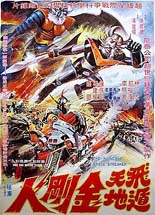
spacestreakerSo nonlinear that calling it nonlinear doesn’t cut it, the Hong Kong oddity The Invincible Space Streaker has nothing to do with space, and there’s no streaker. But here’s what goes down, or as much I was able to decipher from its truncated-English subtitles (“I order you kill him!”): After a hard day at grade school, about two dozen little boys go to a local watering hole and remove their little-boy pants to go skinny-dipping. This odd group activity is halted by the appearance of a mystical guy with a stereotypical bad haircut. He’s dressed in a robe that makes him look like Dr. Strange, except that I don’t recall the Marvel Comics character having ever enjoyed an eyeful of undescended testicles during an afternoon romp.

Anyhow, this creepy doctor convinces roughly half the kids to follow him to this lab by using a poster of a superhero as bait, presumably because candy — the favored tool of kidnappers the world over — sucks ass in Asian countries. Doc promises to turn them all into “superman” (lowercase), but once the first kid is wired into a crazy contraption in the evil lair, it’s clear there will be no kid-to-superman transformations.

spacestreaker1Instead, Doc changes the first boy into a cute capuchin monkey. The other children react via frightened subtitles: “It’s the monkey! Not superman!” Another kid becomes a pot-bellied pig. A third boy is on the road to mutation when his full-bladdered friend yanks down his shorts and pees all over Doc’s face and the machine. (And it’s no special effect, either, as the camera horrifyingly details.) These two tots manage to escape, but the one whose transformation was interrupted by the ol’ stream-of-urine-as-means-of-distraction trick finds himself turned into a masked superhero. His costume is an unsettling blend of Boba Fett, Evel Knievel, The Fly and Liberace. He kicks bad guys and then there’s an elaborate (at least by the standards set forth thus far) motorcycle chase.

Then there’s more fighting as the hero fights a walking bug, several guys on choppers and, for a split second, what appears to be a man in a wolf costume. Pee-Pee Boy helps out by discovering the joys of explosives, and then promptly dies in a slow-motion scene highly reminiscent of Willem Dafoe’s death in Platoon. This makes the hero angry enough to zap the crap out of the bad guys to emerge victorious. Why he didn’t do that in the first place and thus spare his best friend’s life is beyond me. But all the little boys celebrate this triumph by taking another nude group swim, as the title card screams, “THANK YOU FOR YOUR COMING!” —Rod Lott

Insidious (2010)

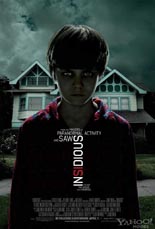
UnknownHaving watched James Wan “evolve” as a filmmaker — the gruesome Saw, the dull Dead Silence, the better-than-it-should-be Death Sentence — I assumed he’d hit a career stride of making moderately entertaining, derivative genre flicks. Unsurprising, in other words. So color me eight shades of surprised when Insidious, a haunted-house movie that absolutely does not try anything new, grabbed me with old-timey spookhouse values like craftsmanship, sound design and frights instead of gore. It’s so old-school it’s new again.

Insidious joins movies such as The Woman in Black and The Orphanage in the current renaissance of horror films that forgo the genre’s modern cynicism and instead stress atmosphere over blood. Working with a tiny budget, Wan recreates the plot of Poltergeist (child kidnapped into ghost realm; family must retrieve him) without the grandiose effects that made Tobe Hooper’s movie a rollicking funhouse and an exception to the rule that big budgets are death for horror films (looking at you, The Haunting remake). Wan keeps the effects to a minimum, plays with silence (always a good bet for tension), and succeeds in generating actual terror. The most nerve-rattling scene has absolutely no scares at all — just a whispering psychic describing a demon only she can see.

insidious1Populating his plot with appealing actors such as Patrick Wilson (Watchmen) and Rose Byrne (28 Weeks Later), Wan keeps the movie on a slow boil, amping up the dread, sprinkling a supply of boo! moments about, and artfully toying with the audience. For two-thirds of its running time, Insidious is one of the scariest movies in recent memory, only stumbling into the realm of rote when it fully reveals “the further,” the netherworld that is pretty much just a lot of fog.

Yet even here, the budgetary restraints lend the goings-on a charm lacking in bigger-budgeted fright flicks (i.e. the abysmally silly ending to Poltergeist II: The Other Side). It’s a forceful reminder that genre filmmakers often do their best work in the low-budget sphere. Let’s pray Sam Raimi doesn’t forget. —Corey Redekop

Buy it at Amazon.

Naked Violence (1969)

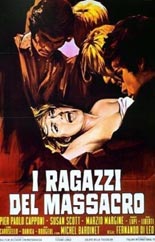
nakedviolenceChaos in the classroom used to mean something different than the school shootings of today. In Fernando Di Leo’s Naked Violence, it’s the rape and subsequent murder of a female teacher by her teen students — all boys, all juvenile delinquents. Di Leo shrewdly shoots them in unflattering close-up so viewers automatically responds to their greasy faces with disgust.
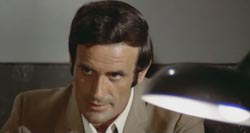
Police detective Lamberti (Pier Paolo Capponi, The Cat o’ Nine Tails) investigates. He has unusual interrogation methods, one of which is dousing the suspects’ chair with absinthe to upset them; the 85-percent-proof alcohol was downed by the boys at the time of the crime.

nakedviolence1Under duress, one particularly troubled student lets slip the personal pronoun “she,” leading Lamberti to believe a woman masterminded the whole brutal act, from its inception to their stories of denial afterward. The truth is something else — in more ways than one, although the film’s “twist” is easily guessed, partially because of the director’s awkward blocking.

Known for brutal Eurocrime efforts like The Italian Connection, Di Leo comparatively presents a softer side with this procedural; it’s simply not as hard-hitting. Even the brutality of the act is shielded by the opening credits; when the sequence is repeated at the conclusion, it carries more weight — probably due to being soundtracked by obnoxious, off-putting metallic screeches.

“What’s wrong?” asks Lamberti’s boss in the final scene. “Aren’t you satisfied?” Eh, almost. —Rod Lott

Buy it at Amazon.

Random Genre & Cult Movie Reviews