
Superman III (1983)

superman3You’re a movie executive who’s just watched a double feature of Batman Begins and The Dark Knight, and inspiration strikes. These movies are great, no question, but you know what they need? Laughs! You set up a meeting and pitch the filmmakers on a third Batman film, only this time, the main villain will be portrayed by Adam Sandler in full Waterboy mode.

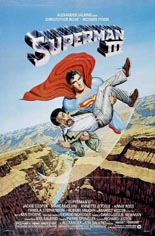
Thus, Superman III, a sequel overloaded with pratfalls, double takes, broad acting, pathetic plot contrivances and the ruinous casting of comedian Richard Pryor (Silver Streak) as a computer genius led awry into cartoon villainy. It’s genuinely mind-boggling that producers would take a beloved and financially successful cultural icon and treat it like garbage. Then again, look at 1997’s Batman & Robin. Better yet, don’t.
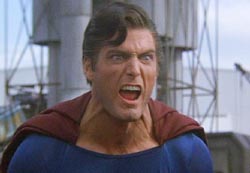
superman31With the right material, Pryor was a comedy genius, but in a movie laden with miscalculations — replacing Richard Donner’s stewardship of Superman: The Movie and Superman II with the unsuitable campiness of Richard Lester (Help!); treating Lois Lane (Margot Kidder) like an afterthought; believing that computers can do anything, because science — the stand-up legend’s painful flailing about is by far the most atrocious. He seems to be acting in an entirely different film, and not a good one.

Christopher Reeve, the ideal Superman/Clark Kent combo, heroically survives scenes that would cripple a more cynical actor. Reeve’s main strength was an ability to project decency, and this alone allows him to escape the debacle relatively unscathed. He even adds a dash of surly menace when a piece of faulty kryptonite turns Superman evil — well, more dickish, really; a prick with a 5 o’clock shadow. It’s still campy, but Reeve makes it work, even when he goes all Fight Club and battles himself in a junkyard. It makes no logical sense, but it’s by far the most interesting scene.

The rest, sadly, crumbles away as Pryor and co-antagonist Robert Vaughn (The Magnificent Seven) compete to see who can debase himself more. And at the end, after causing untold danger to life and property, Superman releases Pryor because hey, mistakes are why pencils have erasers. Also, Lester hates you.

Side query: While his job is integral to the mythos, have we ever seen Clark Kent actually perform “journalism”? His big story here is writing a piece on his high school reunion, leading me to believe Clark is less a star reporter and more The Daily Planet’s advice columnist. —Corey Redekop

Buy it at Amazon.

Machete Kills (2013)

machetekillsWhile Machete Kills is nearly indistinguishable from the 2010 original Machete, it does bring one differentiating element to the table by beginning with a fake trailer. This in-joke within an in-joke not only nods to the accidental franchise’s birth as a faux coming attraction that kicked off Robert Rodriguez’s half of 2007’s Grindhouse, but also proves to be the best part of this sequel. Since it promotes a purported third chapter set in the realm of ’70s cinematic outer space, how could it not? Perhaps Rodriguez should have ended Kills with this gag, as the whole movie sets the story up for heading that direction; it’s like hearing the punchline first.

After his partner is killed during a mission at the border, the superhuman Mexican known as Machete (Danny Trejo, xXx), is hired by the President of the United States (Charlie Sheen, here credited under his actual name of Carlos Estevez) to execute a cartel turncoat / schizophrenic madman named Mendez (Demian Bichir, The Heat) who has a big ol’ missile pointed at America and a $10 million bounty on his head. Machete soon learns that Mendez has whipped up a life-insurance policy, so to speak, by wiring the missile to his heart; should his meat ticker stop, the weapon’s ticker starts.

machetekills1And that’s merely one loco idea in the screenplay by newcomer Kyle Ward (and not by Rodriguez, strangely enough). Others include pairing Machete with a Texas beauty pageant contestant (Amber Heard, All the Boys Love Mandy Lane); befitting a bordello madam (Sofia Vergara, the hot tamale of TV’s Modern Family) with a metal bra that fires bullets; and having a character named El Camaleón be played by, in order of appearance, Walt Goggins, Cuba Gooding Jr., Lady Gaga and Antonio Banderas. Exactly none of these wacko bits advances the plot, save for the stunt casting of former Lethal Weapon Mel Gibson as the villainous Voz, a tech billionaire who happens to be a clairvoyant end-timer.

As with its predecessor, Machete Kills is to be taken as a chunk of cinematic queso, period. Trejo’s ever-frowning hero is easy to root for — especially for an action-oriented protagonist pushing 70 — and several of the supporting players get the joke, none more than the unexpectedly very funny Bichir. That joke has a shelf life, however, and would operate better under the economy of Rodriguez’s early work. (Lest we forget, his 1992 debut, El Mariachi, was only 81 minutes.) Even at his usual breakneck pace, this action-packed goof is just a little too long in the tooth — one that nonetheless still gleams with mischief. —Rod Lott

Buy it at Amazon.

Welcome to the Jungle (2013)

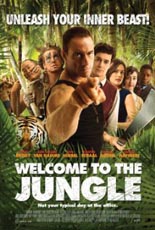
welcomejungleSome would argue that Jean-Claude Van Damme has been doing comedy his entire career — he just didn’t realize it. Whichever side of the argument you fall, there’s no denying Welcome to the Jungle is Van Damme’s first intentional comedy — not a bad step toward a redemption/comeback that started with 2008’s self-aware JCVD and enlisting in 2012’s The Expendables 2.

So what if his role is really just an extended cameo? In being open to poking fun at himself, he’s genuinely enjoyable as Storm Rothschild, a past attendee of web-design classes at DeVry University and current he-man leader of team-building corporate retreats. Storm’s latest clients are the dysfunctional denizens of an advertising agency where young pup Chris (Adam Brody, Scream 4) is constantly bullied — not to mention having his good ideas stolen — by douche-tastic senior VP Phil (Rob Huebel, Hell Baby).

welcomejungle1Storm flies the gang via rickety aircraft to a jungle island, where they are stranded when the old coot of a pilot croaks. Phil is so power-mad that he practically wills a Lord of the Flies scenario into existence, while Chris tries to overcome his wimpy rep and keep the peace among his co-workers, particularly his über-luminous office crush (Megan Boone, TV’s The Blacklist).

A mix of tribal trouble and the more relatable office politics, Welcome to the Jungle never quite finds a stride with which director Rob Meltzer is comfortable. Laughs are present, albeit all front-loaded and operating only as internal chuckles. I suspect few were in freshman Jeff Kauffmann’s script, since so many land by Huebel’s sheer force of delivery alone. (If you dislike his Human Giant style of comedy, don’t even bother.) The large cast, which underuses Kristen Schaal (TV’s Flight of the Conchords), is nonetheless incredibly game and genial, making the mild disappointment at least pleasingly painless. Plus, there’s a tiger. —Rod Lott

Buy it at Amazon.

Sexplosion: From Andy Warhol to A Clockwork Orange — How a Generation of Pop Rebels Broke All the Taboos

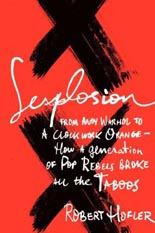
sexplosionOnly in a book like Robert Hofler’s Sexplosion could a line like “Blowjobs continued to present sizable problems for filmmakers” not be played for laughs.

Having last chronicled the flamboyant flame-out of producer Allan Carr in 2010’s Party Animals, New York City-based journalist Hofler continues in a libidinous vein with Sexplosion, the first great book of 2014. The subtitle says it all — in part, How a Generation of Pop Rebels Broke All the Taboos.

Concentrating on the half-decade between 1968 and 1973, Hofler crafts a remarkably cohesive narrative of change and controversy, despite such disparate creative elements at work. Then again, it was not one piece of popular culture that changed the morality grip — no matter how many of them were connected to Andy Warhol and his Factory hangers-on — but the cumulative effect of all of them.

Sexplosion delves into the major players, finding most of its pages spent at the movies, from Myra Breckinridge to Straw Dogs, but also looking long and hard at theater (like Mart Crowley’s The Boys in the Band) and literature (such as John Updike’s Couples). Merely touched upon is the boob tube; the most conservative medium of them all nonetheless made waves and headlines with shows both factual An American Family and fictional All in the Family.

Along the way, readers get not only accounts of their making — often made against all odds — but wonderful stories most authors might find too crude to include. This book, however, is Sexplosion, which is way we learn how some of Hair‘s initial female cast members were so comfortable appearing nude onstage, they didn’t mind their tampon strings flopping around in the audience’s line of sight, or how concerned Marlon Brando was about his penis size while shooting the sex scenes of Last Tango in Paris.

On the lighter side, you’ll learn that studio execs were so vexed by Midnight Cowboy that they wanted to turn it into a musical for Elvis Presley, and that the Rolling Stones sought to star as A Clockwork Orange‘s gang of Droogs.

No matter the spice level of the words on the page, Hofler’s Sexplosion is that most rare of histories: as fun as it is fascinating. —Rod Lott

Buy it at Amazon.

Firefox (1982)

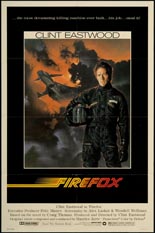
firefoxIn Firefox, Clint Eastwood, in a bold change of pace, plays a renegade computer programmer who invents a new web browser that quickly becomes popular, making him rich.

Sound dull? Unfathomably, the real Firefox, in which Eastwood (also directing) plays a burned-out pilot tasked with stealing “the most sophisticated warplane on the face of this earth,” is rarely more interesting. Well, at least it gives us another entertainingly eccentric performance from Freddie Jones (The Elephant Man) on which to chew.

There’s more than a whiff of the lackluster from the start, when Eastwood suffers what appears to be flashbacks to a stock-footage festival he attended while fighting in Vietnam. This debilitating dread, played up as a great demon he must constantly battle, manifests itself mainly through Eastwood sweating and dramatically pausing when he shouldn’t as he goes undercover in Russia. Fully two-thirds of a movie ostensibly about one kick-ass piece of weaponry is bequeathed to a lethargic spy thriller rife with bad accents, dull dialogue and rather unpleasant jingoism.

firefox1All this could be forgiven, perhaps, if the main attraction were at all interesting, but even here, despite some really neat effects work by John Dykstra (Star Wars), the plane is ultimately a letdown. For a film built around the concept of “the greatest warplane ever built … a Mach Five aircraft with thought-controlled weapons systems,” the filmmakers do precious little to make it seem unique.

It looks cool, sure, but after a wearing hour and a half of setup, finally arriving at the “Let’s see what this baby can do!” point, I expect a tad more from an action thriller than a half-hour of cruising altitude and refueling while Soviet generals argue with each other over where the plane might be. And when there is finally some bloody action in a long-promised dogfight the likes of which we presumably have never seen … we’ve seen it before, and better, and longer.

In film, there’s Eastwood classic (Unforgiven) and Eastwood junk (Pink Cadillac). Firefox, all buildup and no payoff, is Eastwood meh. —Corey Redekop

Buy it at Amazon.

Random Genre & Cult Movie Reviews