
The Arrival (1996)

arrivalHypothetical question: It’s the year 1996, and alien beings, cleverly disguised as humans, are destroying the earth for their own selfish needs. Who you gonna call? No, not Rowdy Roddy Piper; he sacrificed himself a few years back (that’s a They Live reference, BTW). Also, 1996 Will Smith is busy saving the world from other alien overlords (Independence Day), and 1996 Jack Nicholson has his hands full with yet another xenomorphic conflict (Mars Attacks!).

Who else you got? If you’ve guessed “Pudgy Charlie Sheen” … congratulations?

The Arrival, the third alien invasion movie of 1996, made little impact upon its release. It wielded neither the star wattage nor big budget of its higher-profile kin, and its special effects are best described as “eh, pretty good, all things considered.” But, much like spiritual soulmate They Live, its subtext makes it increasingly relevant, even if it’s too long and has all the visual élan of an episode of T.J. Hooker.

arrival1David Twohy (the Riddick trilogy) was a neophyte director here, and it shows; his lackluster pacing drags The Arrival out way longer than it needs to be. His writing is stronger, full of smart people sounding smart while doing smart things (and a few dumb things, because tension), and by layering in themes of climate change and environmental devastation, he (like John Carpenter with — again — They Live) transforms a slight B movie into something more topical and thought-provoking.

Sadly, most of the actors can barely muster interest, with only the passionate climatologist played by Lindsay Crouse (House of Games) making a true impression (so, obviously, she dies). Ron Silver (Timecop) is comatose as the baddie, Teri Polo (the Meet the Parents trilogy) is blandness personified as Girlfriend Character, and Sheen only rouses at the finale as his put-upon astronomer becomes more and more unhinged.

Sheen is also leagues away from the ripped and shredded physique he showed off in Hot Shots! Part Deux, which actually works in the movie’s favor. Be honest: Aren’t we all tired of movie scientists who also resemble GQ catalog models? Sheen’s corporeal puffiness adds a level of verisimilitude to The Arrival that his sleepy performance sadly cannot match. —Corey Redekop

Buy it at Amazon.

Hercules (2014)

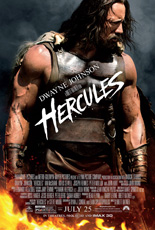
herculesAs reimagined by director Brett Ratner, Hercules is half-god, half-human and all but a lost cause. Hardly under-represented in cinema history, the mythological hero has been embraced by the public consciousness worldwide for centuries, largely through the “12 labors” tales that found him battling a three-headed dog and slaying the Hydra. Assuming you ditch the one about Herc having to clean stables in a day’s time, these stories are arguably the most ripe for screen adaptations; naturally, Ratner does away with them in the prologue, showing us only pieces of a few, like a greatest-hits reel. Tellingly, these are the high points of the film’s trailer, so you’re in for a long 98 minutes.
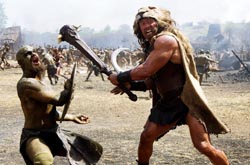
Based on Radical Comics’ series, this Hercules (Dwayne Johnson, Fast & Furious 6) toils for gold as a freelance mercenary (characters spit that word like a slur, the way “liberal” is used today), despite being the son of Zeus. The story’s stone wheels start moving when Herc is hired by Lord Cotys (John Hurt, V for Vendetta) to help quell a civil war in Thrace. With half a dozen special-skilled sidekicks (Dark City’s Rufus Sewell and Deadwood’s Ian McShane among the most notable) supporting him, Herc preps for battle by donning the skin of a vicious lion he once killed, draping it over his head the way preschoolers do security blankets. Speaking of animals, Herc later punches wolves.

hercules1Although with little variety from one to the next, the war sequences are staged with far greater competence than Ratner’s track record with action would have us expect — at least any action scene not involving Jackie Chan’s dazzling acrobatics, that is. But lordy, is this epic dull. More mortal than its main character, the film is doomed from the start when two CGI snakes look as if they were created on an iPhone app someone downloaded for free through a Starbucks promotion. Shorn nearly completely of the fantastical elements that make previous Hercules flicks such a hoot to watch — Cannon’s early ’80s pair of Lou Ferrigno vehicles, in particular — this massively budgeted monstrosity fails to muster any significant feelings beyond boredom and contempt. It’s even too soulless to be fun, for which, all other things being equal, I gladly would have settled. By comparison, Johnson’s similar-in-appearance Scorpion King is Raiders of the Lost Ark.

None of this is Johnson’s fault; as always, the guy perspires charisma. Ratner errs in letting too much humor show through, to where everyone is at the ready with a quip engineered for pandering laughter, which would be a masterstroke if the Rush Hour conductor were making — or remaking — Hercules in New York. He was not. He made an action-adventure summer blockbuster so beholden to mass appeal, each reel has been cast in that Jerry Bruckheimer-favored Instagram filter marked “Weasel Piss.”

To be fair, Ratner’s Hercules is more watchable than 2014’s competing Greco-Roman project, Renny Harlin’s The Legend of Hercules. (To be fair again, Harlin left the bar set at ground-level.) This Herc pic is so far from mighty, Greece is not the word. —Rod Lott

Buy it at Amazon.

Nazithon: Decadence and Destruction (2013)

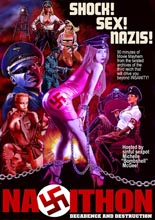
nazithonWTFFollowing close on the stiletto heels of 2013’s Blood of 1000 Virgins, GrindhouseFlix’s first original feature, the jackbooted Nazithon: Decadence and Destruction emerges as the second. It, too, is a trailer collection brimming with no-frills fun and it, too, is directed by company head Charles Band, if hitting the “REC” button for host segments can be called direction. While Virgins wallowed in sexploitation, Nazithon naturally casts its eye on that most odious of psychotronic-film movements: Nazisploitation!

While we’re on the subject of odious, Nazithon is hosted in monotone by Michelle “Bombshell” McGee, a pseudo-celebrity known for her gnarly face tattoos, but only because she’s known for breaking up Sandra Bullock’s marriage. Having previously played an SS soldier in Band’s Puppet Master X: Axis Rising, Ian Roberts stands silently behind the heavily inked McGee, who appears all too comfortable in Nazi garb as she introduces each themed grouping of vintage previews. Many of the coming attractions sport interchangeable titles: SS Experiment Love Camp, SS Camp 5: Women’s Hell, Love Camp 7. The latter, per its trailer’s narrator, is “where women were used like cattle!”

nazithon1Popular in the 1970s, such flicks prove tough sits, partly because of their subject matter, partly because they seem to incite audience pleasure in the torture of females, and partly because they’re just so damned boring. However, their hyperbolic ads show so much — including enough showering to dry one’s epidermis to Sahara levels — you’re left with no need to suffer through the actual experience. The exception may be the Ilsa saga (all four chapters of which are represented here), partly because they’re aware of their cheesy center, partly because of the eye-popping Dyanne Thorne and — with my 37-22-35-track mind, it merits repeating — partly because of the eye-popping Dyanne Thorne.

Showcasing more variety, Nazithon’s back half is better, starting with a section on neo-Nazis, which basically allows for the cross-pollination of the genre into the likes of blaxploitation (The Black Gestapo) and biker films (The Tormentors). The program’s pinnacle arrives at the home stretch, devoted to the goose-steps-meet-goose-bumps realm of supernatural Nazis, as exemplified by Ken Wiederhorn’s Shock Waves, Jean Rollin’s Zombie Lake and Jess Franco’s Oasis of the Zombies. —Rod Lott

Buy it at Amazon.

Aliens vs. Predator: Requiem (2007)

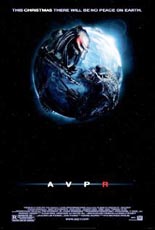
AVPRAliens vs. Predator: Requiem begins where 2004’s Alien vs. Predator left off: with the miracle of birth! To be precise, an Alien-style chestburster rises from the womb-like corpse of a Predator — behold, the PredAlien! (Seriously, that’s what 20th Century Fox calls it.) This milestone occurs in space, aboard a Predator ship (PredShip?), which the newborn causes to crash-land on Earth, thereby loosing the Predators’ jarred collection of live Alien facehuggers on the quaint, quiet town of Gunnison, Colo.

Following the spacecraft’s distress signal to our planet is a clean-up Predator (Ian Whyte, The Scorpion King 4: Quest for Power) whose figurative job is to mop up the mess left behind using explosives and a beaker of blue acid. He makes that damned clicking sound while going about his business. Skirmishes occur amid the great outdoors, but also in the town’s sewer system, nuclear power plant, high school pool and hospital — woe be to the visibly already-pregnant woman who gets mouth-raped by the PredAlien.

AVPR1VFX wunderkinds Colin and Greg Strause (Skyline) spend the first act of their feature-directing debut setting up members of their expendable human cast — an ex-con, a pizza delivery boy, an Iraq War vet, the customary cop and so on — and the next two acts knockin’ ’em down. To my surprise, they do a much better job establishing those earlier stages than in dishing out Requiem’s supposed meat. That the characters are introduced with so little personality should tell all about the degree to which the brothers’ film disappoints, especially in the only area in which their target audience gives a damn. They’re no Paul W.S. Anderson.

Requiem might be a fanboy’s dream if we could see the sequences that justify the “vs.” portion of the title. For whatever reason — perhaps to mask some digital seams? — these scenes appear unforgivably dark on disc just as they did in theaters; they’re even trickier for the eye to decipher than the movie’s “what is that?” one-sheet. The Strauses work from a through-the-motions script by Shane Salerno (2000’s Shaft remake), whose coda sets up a never-made third film. Neither Anderson’s original nor the Strauses’ sequel were able to meet the inherent potential of this spin-off franchise, but the Strause boys really squandered it. —Rod Lott

Buy it at Amazon.

The Adventures of Sherlock Holmes (1939)

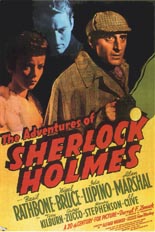
adventuressherlockExcepting 1939’s The Hound of the Baskervilles, perhaps the most famous installment of the 14-film Sherlock Holmes series starring Basil Rathbone is its second, also from that year: The Adventures of Sherlock Holmes. Not based directly on any one particular story from the Sir Arthur Conan Doyle canon, the movie does a great job of culling from Holmes’ overall world, to the point where it seems like it could’ve preceded Hound in theaters.

The joy here is watching Holmes (Rathbone) try to remain one step ahead of his archenemy, Prof. Moriarty (George Zucco, The Mummy’s Hand), who’s declared not guilty of murder by the courts, but only due to lack of evidence. Holmes possesses such evidence, but arrives a minute too late, leaving Moriarty free, since no man can be tried for the same crime twice. He vows to Holmes that he shall pull “the crime of the century,” and that our hero won’t be able to stop him.

adventuressherlock1A jewel heist is involved, and events culminate in a tussle atop the impressively moody Tower of London. Both Holmes and Moriarty reveal themselves as masters of disguise, suggesting an even match. As with its predecessor, Adventures is a Hollywood classic. It’s not for nothing that Guy Ritchie’s 2009 Sherlock Holmes reboot lifted the amusing scene in which the detective experiments with a fiddle and a glass full of houseflies. —Rod Lott

Buy it at Amazon.

Random Genre & Cult Movie Reviews