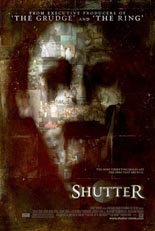

Shutter (2008)

shutterWhile watching movies for review, I often take notes on my iPhone, as I did for Shutter. Tellingly, the device infamous for incorrect autocorrections wanted to change “Shutter” to “Shitter.” Given that “shutter” is a legitimate word, I can’t explain the switcheroo; perhaps, as in this film, otherworldly forces beyond our understanding were trying to tell me something.

Shutter, shitter: It fits. Shudder.

Newlyweds Ben and Jane Shaw (The Skulls’ Joshua Jackson and Transformers’ Rachael Taylor, respectively) move from the U.S. to Japan for his new job as a fashion photographer. Driving late at night to their new digs, Jane runs over a young Asian woman who suddenly appears in the middle of the road, then loses control of the vehicle and plows into a tree. Both Shaws emerge with only minor scrapes; the woman is nowhere to be found, nor is blood, let alone any trace of her to suggest she existed as nothing more than a figment of Jane’s weary imagination.
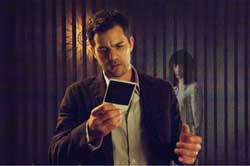
SH-5166RIf so, that’s some imagination, because subsequent photos taken of and/or by Jane develop with inexplicable smears of white. Ben’s assistant refers to them as “spirits,” so to whom should Jane turn for counsel? Why, Tokyo’s own “spirit-photography magazine,” of course! (Want more unbelievability? The publication appears to have a paid staff of 10.) What do these spirits start to do? Kill people, of course!

A remake of the 2004 Thai film of the same name, Shutter exists as one of many substandard Americanizations of Asian horrors — Dark Water, Pulse, One Missed Call — that smothered our multiplexes in the aughts, following the wave created by The Ring and The Grudge. In keeping with those films, director Masayuki Ochiai (Infection) gives Shutter’s story space to breathe. That is a nice way of saying it’s slow. But a slow burn, it is not. Unworthy of its slight time investment, it is a humorless piffle that checks off the boxes with duty and without enthusiasm.

Only at the denouement does the movie break from its sleepiness long enough to convey a jolt. I’ve yet to conclude if that twist is truly clever or utterly ridiculous; then again, I stopped thinking about it the next morning — already several more hours than the whole deserves. —Rod Lott

Buy it at Amazon.

Non-Stop (2014)

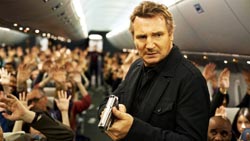
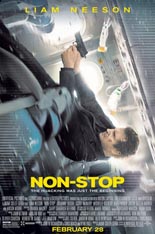
NST_31_5_Promo_4C_4F.inddAt least at press time, Non-Stop stands as the second of three collaborations between Liam Neeson and director Jaume Collet-Serra; 2011’s Unknown and 2015’s Run All Night are the others. The streak running through this thriller triumvirate? Vanilla flavoring.

On a New York flight of 150 passengers bound for London, air marshal Bill Marks (Neeson) temporarily has to shelve his ongoing love affair with booze — oh, sweet booze! — when, halfway over the Atlantic Ocean, he receives a series of threatening text messages on his supposedly secured-line phone. They aren’t your everyday threatening texts, either, like “OMG ur so fat” or “imma block u on instagram” or “saw yr mom on tinder #gonnahitdat!” Nope, these digi-missives are of the stop-the-presses, sound-the-alarms, batten-down-the-hatches variety: from a terrorist! Maybe even — gulp! — terrorists, plural!

nonstop1With each superimposed onscreen in a gimmick that quickly grows old from sheer overuse, the texts warn that if a million bucks per passenger — that’s $150 million total for those of you not paying attention and/or with appalling multiplication skills — isn’t wired to an account within 20 minutes … well, the passenger count goes down to 149. Repeat for every 20 minutes thereafter. Making things worse, said account is in Bill’s name, meaning that whoever is pulling the scheme’s strings has framed the marshal for hijacking.

Simple enough, right? As a federal agent barks over the phone to our — hic! — sexagenarian hero, “We will not negotiate with terrorists,” and they think that’s you, Billy Boy! Neeson has played this part so often, with only slight variations, since his career resurgence as Aging Badass with 2008’s Taken; the difference here is that Taken took viewers somewhere.

For Non-Stop’s first half, that vanilla tastes delicious enough, with Collet-Serra unapologetically building a high-stakes, high-altitude, high-gloss, high-concept whodunit — and whosdoingit — set in the unfriendly skies. Once the tone veers into action territory, vanilla’s generic nature seeps to the forefront, leaving viewers wishing more resided on the surface: chocolate sauce, gummy worms, butter brickle — hell, even granola! By then, the film loses all its fuel, drifting into a scenario so tired and seen-it-all-before, Non-Stop could be retitled Airport 2014.

While the studio-funded flick no doubt gave the great Julianne Moore (Boogie Nights) a paycheck a few zeroes above her usual indie gigs, the raise wasn’t accompanied by an opportunity to do anything but be Bill’s eventual arm dressing. Doomed to similar standing-’round status are The Strain’s Corey Stoll and, as the nervous-Nellie flight attendants, Michelle Dockery (TV’s Downton Abbey) and Lupita Nyong’o (then a newly minted Oscar winner for 12 Years a Slave). I won’t name the one supporting character who is given a hunk of meat to chew, because his casting proves detrimental — not because he’s a bad actor (because he isn’t), but because if you’re familiar with his filmography, the minute he appears is the minute you’ll think, “Oh, he did it.” And he did. —Rod Lott

Buy it at Amazon.

The Ghastly Ones (1968)

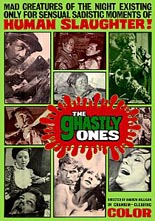
ghastlyonesNow that all of them are married, three sisters are called to New York for the reading of their father’s “highly irregular but legal” will. The document decrees that they and their spouses are to reside “in sexual harmony” at his island estate for three days. Then and only then shall his mysterious trunk be brought down from the attic and shared among the women.

Presumably, the inheritance includes the Victorian house, although its halls and walls bear such gaudy wallpaper, I’m not sure who would covet the property. Perhaps The Ghastly Ones refers to these eyesores of rooms? Or maybe the home’s three servants, one of whom (Hal Borske) is a half-wit hunchback with novelty Bubba teeth and a craving for live rabbits.

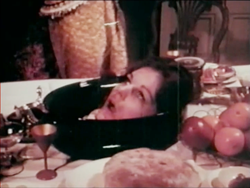
ghastlyones1A brief tear of murder begins when the bloodied, furry corpse of a bunny turns up beneath one couple’s sheets, prompting the serious admission, “It’s not very comfortable having a dead animal put in your bed.” (My favorite bit of dialogue? “I did not, you brazen hussy.”) Performances are accidental in The Ghastly Ones, as they are in all of Andy Milligan’s penny-ante productions that escaped from his mad mind: a sex-gore netherworld that includes Torture Dungeon, Bloodthirsty Butchers and (exclamation points his, of course) The Rats Are Coming! The Werewolves Are Here!

His directorial approach is an anti-style marked by not much going on in the upper half of the frame, the camera appearing clearly in the mirror (especially startling for an attempted period piece as this) and being so in-your-face as to accentuate his cast members’ nose hairs and blemishes. A considerable amount of blood also exists, exceeded only by boredom. —Rod Lott

Buy it at Amazon.

Furious 7 (2015)

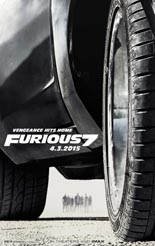
furious7Law of diminishing returns be damned, the accidental franchise that began with 2001’s The Fast and the Furious not only keeps chugging along well past other repeat players’ sell-by dates, but somehow grows even more successful. Now we’re up to Furious 7. Seven!
In terms of sequentially numbered series — no reboots, no remakes — such longevity and mobility are unheard of. For sake of perspective, other chapter sevens have found Friday the 13th’s Jason Voorhees facing New Blood in the form of a telekinetic teenager, and the Police Academy gang on a rather говенный Mission to Moscow. Respect, Furious 7, respect.

After the one-two horror punch of Insidious and The Conjuring, director James Wan trades poltergeists for pistons to take over the driver’s seat from Justin Lin, helmer of the past four adventures, from 2006’s underrated Tokyo Drift to 2013’s Fast & Furious 6. The change is imperceptible, because Wan keeps the camera at ass-cheek level around the gyrating bikini models and follows the Mad Libs plot structure: Reformed ex-con Dominic Toretto (Vin Diesel, Riddick) is called upon to reassemble his team of gearheads for one last time — again!

furious71For this go-round, the whole frickin’ world is at stake, with terrorists itching to wrest control of a global-surveillance system by kidnapping a frizzy-haired hacker (Nathalie Emmanuel, TV’s Game of Thrones) who conveniently looks dynamite in a bikini. And who else does the U.S. government rely upon to quash the threat but a bunch of grease monkeys with an extended subscription to Motor Trend … but only for the pictures.

So stuffed to the brim is F7 that it juggles two villains: the aforementioned international terrorist (Djimon Hounsou, Guardians of the Galaxy) and a British special-ops assassin (Jason Statham, The Expendables 3) who’s hissing-snake evil in his quest for vengeance following the murder of his F6-antagonist brother. As for the movie’s three set pieces, “big” doesn’t do them justice. They’re so outrageous — and know it — that they remind one of elementary schoolers tearing up Mom’s garden by playing with Hot Wheels: Cars parachute from military aircraft! Cars fly from skyscraper to skyscraper! Cars leap hovering helicopters! Whatever they dream up has been rendered possible and sold as plausible.

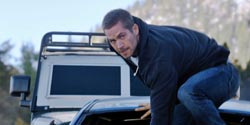
Not wanting to mess with a good thing — assuming you found the past couple of sequels to be that (and I did) — F7 retains that fizzy feeling for more than two hours, with Wan turning in what amounts to an all-star edition that presents practically every not-dead character from previous installments as audience rewards, complete with intentionally howl-worthy dialogue. The studio juggernaut feels like a love letter — or a “swipe right” on Tinder — to those long-haul fans who, like Dom, aim to live their lives a quarter-mile at a time. (That it marks the final bow for co-star Paul Walker, who died tragically halfway through filming, makes those good vibes stickier.)

New to the fold on sides both heroic and hateful are a smooth-as-snot Kurt Russell (Grindhouse); Ong-Bak’s Tony Jaa, Thailand’s answer to Jackie Chan; and UFC champ Ronda Rousey. Among the most notable returners is Diesel’s belly button, which, jutting from beneath a muscle shirt in the fiery climax, resembles a rather intimidating camel toe. —Rod Lott

Buy it at Amazon.

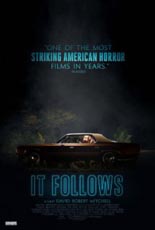
It Follows (2014)

itfollowsSo much of modern horror has been reduced to a series of cheap jumps and contrived shock-value tactics, a trend 20 years or so in the making that managed to suck a lot of the life out of a once artful ilk. The genre arguably peaked in the late ’70s and early ’80s with heavily stylized, blood-curling flicks like Dario Argento’s Suspiria and Stanley Kubrick’s The Shining — movies predicated mostly on the potential perils of the unknown. And the best of horror’s contemporary offerings — The Blair Witch Project, The Others and, most recently, The Babadook — were similarly averse to predictable jostles and jolts.

It Follows is this same breed of horror, inducing its pervasive unease through the use of old-school tactics: crafty camerawork, a hair-raising score and Maika Monroe’s breakthrough performance as the film’s tormented lead actress. It has the look and feel of a work that could have been released at any point in the last 50 years — something writer/director David Robert Mitchell (The Myth of the American Sleepover) seems keenly aware of, given the prominence of landline phones and TVs with knobs on them — yet its one-of-a-kind premise combats any disposition toward mere homage or some uninspired retread.

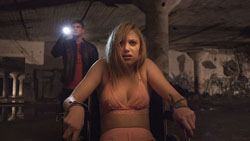
itfollows1Set in suburban Detroit, the film follows a teenaged Jay (Monroe, The Guest) who, after a sexual encounter with her boyfriend Hugh (Jake Weary, Zombeavers), contracts the worst kind of STD: being stalked by naked dead people. Only those who have had sex with someone affected can see these ghastly creatures, who walk slowly yet persistently toward the most recent victim with intent to kill. This supernatural force takes on many faces and arrives when its target least expects it, and the only way to alleviate the haunting is to pass it on to someone else through intercourse. With the aid of her friends, Jay’s struggle is to first acknowledge that it’s real, then to remedy it, then to ultimately destroy it.

That may sound ridiculous on a surface level, but it’s executed with such mastery that it’s nearly impossible to find fault. The notion of there being something out there somewhere that’s going to find you at some point lends itself to a state of constant paranoia, a concept compounded by Mitchell’s brilliant use of backdrop and camera movement. The movie is shot almost entirely in deep focus, not just allowing but coercing the audience to be mindful of what’s happening behind every single frame. And through the use of 360-degree pans and prowling slow-zooms, Mitchell’s camera can, depending on the circumstance, create either full spacial awareness or lull you into complacency.

The synth-heavy score — composed by Rich Vreeland under his Disasterpeace moniker — adds an anxious, retro-horror undercurrent to it all, not unlike that of John Carpenter’s Halloween or the aforementioned Suspiria. Yet the music acquiesces at all the right moments, whether to approaching footsteps or a disquieting youthful whimper, allowing the suspense and anguish of ambience to take hold without relinquishing effectiveness.

Through each of the film’s 100 minutes, Mitchell injects new life into horror by conjuring elements from decades past and applying them to modern-day ideals. It’s one of the genre’s most subtly immersive, if not altogether scariest, films of the last several years, and it accomplished as much with an indie-friendly budget and a cast of relative unknowns. No matter; It Follows is less about the spectacle and more about the experience. —Zach Hale, Oxford Karma

Random Genre & Cult Movie Reviews