
Crocodile (2000)

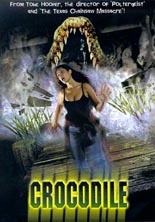
crocodileDirected by the fallen-from-grace Tobe Hooper, who did the killer-croc thing before in 1997’s Eaten Alive, Crocodile kicks temporary-escapist ass for one simple reason: It does not skimp on the bloody croc attacks. So many animal-attack films seem to miss this point entirely, resulting in utter disappointment, but Hooper gives nearly 10 violent on-screen deaths! Yes!

The rote story puts several drunken frat types and their so-hos on a houseboat during spring break. The lake they visit should have a sign posted reading, “DO NOT FUCK WITH CROCODILE EGGS,” because once these immature bozos do, it’s feedin’ time! And that’s what Hooper does right. What he does wrong is put a poodle named Princess in jeopardy at least three times, yet ultimately lets her live. (I’m also curious why he let the croc vomit up the annoying punk kid at the end, but that’s beside the point.)
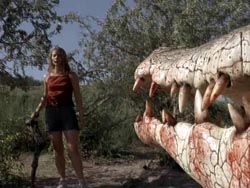
crocodile1Members of the cast are unremarkable and unmemorable — they’re just croc food, after all — with the possible exception of Caitlin Martin (When Billie Beat Bobby), playing the kindhearted Girl Next Door who charms the screen with her crooked-eye-and-bit-lip routine. She did not return for 2002’s expected sequel, Crocodile 2: Death Swamp, but neither did Hooper. —Rod Lott

Get it at Amazon.

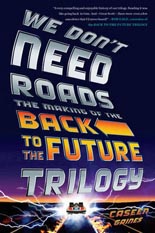
We Don’t Need Roads: The Making of the Back to the Future Trilogy

wedontneedroadsI can think of a few people who may hate reading Caseen Gaines’ history of the Back to the Future trilogy. These people are Eric Stoltz (fired from the lead role of Marty McFly after filming began), Crispin Glover (more or less blackballed from the sequels), Jeffrey Weissman (Glover’s ill-treated replacement) and Cheryl Wheeler (a stuntwoman who nearly died during a questionably safe stunt in Part II).

Everyone else, go for it! While inessential in terms of claiming a cineaste’s shelf space, We Don’t Need Roads is a must-own for anyone with a deep fondness for the classic time-travel comedy, especially if you were among those audiences wowed upon its release in the summer of 1985. That’s the power of love.

Author of similar treatments on A Christmas Story and TV’s Pee-wee’s Playhouse, Gaines grants an insider’s view into the creation, production, impact and enduring legacy of the films, thanks to personal interviews with many key players. While Michael J. Fox, Thomas F. Wilson, Steven Spielberg and the aforementioned Glover are not among the dozens of participants, those who are can’t be considered lesser-ran slouches, including Christopher Lloyd, Lea Thompson, Huey Lewis and the two “Bobs”: producer Gale and director Zemeckis, both of whom wrote the Oscar-nominated screenplay — plenty of credibility.

Naturally, the first film takes up more space (as it should) than the consecutively shot sequels: 1989’s darker follow-up and 1990’s lighthearted Western. Readers get plenty of dished-up dirt on all, however. While presented chronologically, Gaines’ narrative finds him spending a bulk of each chapter focused on particular (and sometimes peculiar) aspect: Stoltz’s dismissal, the pimped-out DeLorean, the music of the Enchantment Under the Sea high school dance. It’s a unique way of approaching a behind-the-scenes tale, but if you don’t want an overload of info on, say, hoverboard technology, remember that patience is a virtue, and just settle back and enjoy the ride. So nontaxing and entertaining is We Don’t Need Roads that the Plume paperback can be read in virtually no time at all — and that’s even without a flux capacitor. —Rod Lott

Get it at Amazon.

Zombeavers (2014)

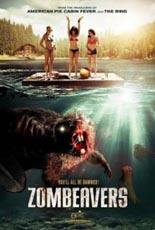
zombeaversAren’t you sick of those half-assed, would-be creature features in which the entire experience is the title? You know the ones: Pick one animal from Column A, then another from Column B, and pat ourselves on the back for our “best thing ever” hipsterism, i.e. Sharknado, Sharktopus, Dinoshark, Dinocroc, Pteracuda, Piranhaconda, Sharknado 2, et al.

Me, too. Well, Zombeavers is nothing like that. Zombeavers is a tool of goodness. For 85 minutes, I felt pure joy. And upon a second viewing, I felt that all over again. It’s a real-deal motion picture — not a time-slot filler that aims no higher than to be a Twitter trending topic. I loved it.

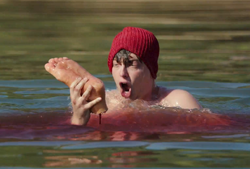
zombeavers1Three sorority sisters (headed by Dumb and Dumber To standout Rachel Melvin) head to a cabin in the woods for a weekend escape. Their respective boyfriends crash the party. And so does a colony of beavers, rendered radiated and mutated by an errant barrel of toxic waste. Leave it to the beavers to spoil the collegians’ trip of tanning bods and guzzling booze and swappin’ spit.

Several aspects keep Zombeavers blissfully afloat, including scene-stealing supporting turns from Rex Linn (TV’s CSI: Miami) and — believe it — white-bread pop singer John Mayer.

But the main reason is that the horror comedy is like a PB&J: It sells both sides. It earns its “Ewww”s for every lost limb and spewed fluid, and yet it never loses sight of being a joke-delivery vehicle — a screamingly funny one at that. No winking at the camera, no has-been cameos, no self-referential BS; following in the muddy, bloody footsteps of Eli Roth’s Cabin Fever, director/co-scripter Jordan Rubin (a writing vet of several years’ worth of MTV Movie Awards) strikes that delicate balance of tone that allows the film to be deliberately campy without becoming a joke itself. —Rod Lott

Get it at Amazon.

House on Bare Mountain (1962)

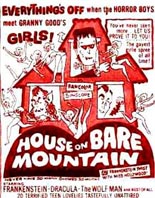
baremtnVery little story exists in House on Bare Mountain. Very little needs to; it’s not meant for telling a story. The debut of The Defilers director Lee Frost, the flick is a nudie cutie, period.

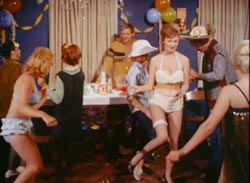
The House in question is the site of Granny Good’s School for Good Girls, with Granny Good being played by Frost’s regular producer, Love Camp 7 commandant Bob Cresse, in drag. While ostensibly “about” a mysterious new enrollee and/or the wolfman in the basement, it’s really about the student body and its bodies, almost always nude from the waist up, even while reading the dictionary front to back. The ladies exercise, then draw, then shower. A masked ball is held in mixed company, at which Dracula and Frankenstein spike the punch, but it’s not until Granny douses it with her illegal home-brewed hooch that tops are doffed. The end.

baremtn1Like so many entries in the pioneering genre, Bare Mountain is all “look, but don’t touch.” One can sense the humor at work without succumbing to actual laughs; pay particular attention to the opening titles, crediting “Hoover Vacuum” for hairstyles and “Everybody!” for body makeup. Speaking of, Frost heats up the screen as best as censors would allow, making for an hour-long movie as saturated in skin as it is in rather appealing vibrant colors. —Ed Donovan

Get it at Amazon.

The Pact II (2014)

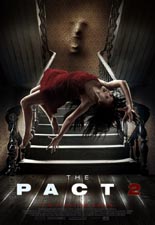
pactIIPart of what made Nicholas McCarthy’s The Pact so effective was its twist — one not of plot, but overall structure. Without spoiling its secret, the 2012 indie chiller cleverly led viewers to believe it belonged to one horror subgenre, only to reveal itself as another. Without spoiling the sequel, either, it is disappointing to see The Pact II undo that trick. It’s tough to tell for certain, but if it hasn’t fully embraced its predecessor’s initial path, it has blurred the line.

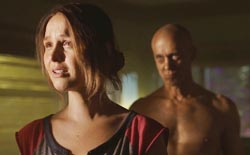
Although Caity Lotz (The Canary of TV’s Arrow) returns for what amounts to an extended cameo, the central character this time around is June (Camilla Luddington, TV’s True Blood), a crime-scene cleaner by day and aspiring graphic novelist by night. One of her freelance scrub-downs of gray matter is, believes no-nonsense FBI Agent Ballard (Patrick Fischler, 2 Guns), the work of a serial killer. To say more would ruin everything I warned against in the previous paragraph.

pactII1I can say that co-directors Dallas Richard Hallam and Patrick Horvath (Entrance) do their best to stay true to the tone established by McCarthy in the original Pact — and carried through to his similarly eerie follow-up, 2014’s At the Devil’s Door — but their screenplay ultimately keeps this reverent-in-intention sequel from being nearly as good. Luddington and Fischler deliver big nonetheless. While the film is spooky in places, The Pact II cannot replicate its big brother’s feat of eliciting real scares. At least it tried. —Rod Lott

Get it at Amazon.

Random Genre & Cult Movie Reviews